


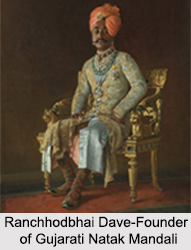
 Gujarati Natak Mandali is an Indian theatre group. This group and its successor in Bombaycontributed immensely to Gujarati theatre with their colossal output. Indeed, Gujarati theatre properly arose from the formation of this company out of discontent with Parsi theatre-owner Framji Gustadji Dalal's high-handedness, perceived as an insult. The pioneer dramatist Ranchhodbhai Dave originated and shaped the management of the new troupe. Gujarati Natak Mandali existed until 1889. Gujarati Natak Mandali is an Indian theatre group. This group and its successor in Bombaycontributed immensely to Gujarati theatre with their colossal output. Indeed, Gujarati theatre properly arose from the formation of this company out of discontent with Parsi theatre-owner Framji Gustadji Dalal's high-handedness, perceived as an insult. The pioneer dramatist Ranchhodbhai Dave originated and shaped the management of the new troupe. Gujarati Natak Mandali existed until 1889.
Formation of Mumbai Gujarati Natak Mandali Actor-director Dayashankar Vasanji Girnara added 'Mumbai' to its name and continued the company in another style and form. This Mumbai Gujarati Natak Mandali during the years 1889-1948 owned by Patel Chhotalal Mulchand Kapadia of Khambhat in Kheda district, Gujarat and guided by Girnara, revealed greater distinction and artistic endeavour on account of gifted actors, scholarly dramatists, far-sighted directors and cooperation from literary personalities. Members of Gujarati Natak Mandali A few Gujarati teachers started the venture as amateurs, then three partners namely Jayshankar Sarveshvar, Narottam Bhaichand, Shivshankar Karasanji founded the Mandali as a business concern. Manekram Dhirajram, Damodar Ratansi Somani and Lalji Karsanji joined as new partners. Every partner was allotted a different responsibility; Sarveshvar was manager and director. They organized the Mandali successfully, giving Dave respect and attention as he had been associated with the Natak Uttejak Mandali during the years 1875-94 previously. The talented actor-director Bapulal Nayak and music director Vadilal Shivram Nayak were other powerful members. Vadilal composed above 500 melodious songs with a classical touch in over forty plays. A hundred of these songs were published in Gujaratna natako-gitoni sarigam i.e. Notations to Songs in Gujarati Drama' in 1956. Plays of Gujarati Natak Mandali The first production was Ranchhodbhai Dave's reformist Lalita Dukhdarshak i.e. 'Lalita's Manifold Sufferings'. This was the first Gujarati social tragedy, in five acts and thirty-four scenes, with twenty characters. The characterization of the foolish Nandan grew so popular that his name became synonymous with a fool. An unknown, thin, handsome Gujarati boy was the first to act a heroine on the urban Gujarati stage. The drama was staged on 6th January 1878 at Victoria Theatre, fully packed with around 1200 spectators. The second play, Nal-Damayanti i.e. 'Nala and Damayanti' was also written and directed by Ranchhodbhai Dave. This play was equally important. According to him, Madalsa ane Ritudhvaj i.e. 'Madalsa and Ritudhvaj' and Banasur mad-mardan i.e. 'Taming of Banasurs Arrogance' were also performed by this Mandali. Its greatest service to Gujarati theatre was the gift of the play Sundari or 'beauty'' named after Shakespeare's Desdemona in Othelo. Jaishankar, a boy of 12 years, who acted as the young heroine, fascinated thousands of playgoers. Dramatists like Mulshankar Mulani and Nrisinh Vibhakar wrote for the Mandali with vigour, higher tastes and cultivated cultural insight. The first play, Kulin Kanta i.e. 'Well-bred Kanta' in 1889, impressed the audience owing to its classic subject matter of the famous Gujarati author, Manilal Nabhubhai Trivedi. Mulani shaped it into theatrical form. His other well-known plays like Saubhagya Sundari i.e. 'Fortunate Sundari' from Othello in 1901, Vikram charitra i.e. 'Vikram's Story' in 1901, Jugal Jugari i.e. 'Jugal the Gambler' in 1902, Kamlata i.e. 'Love struck Girl' in 1904, Krishna Charitra i.e. 'Krishna's Story' in 1912, and Pratap Lakshmi i.e. 'Pratap and Lakshmi' in 1914 throw light on his historical and mythological style of writing. Sundari and Bapulal charmed the audience by their graceful acting as heroine and hero respectively. This romantic pair lasted up to 1932. Plays of Gujarati Natak Mandali with New Ideas The Gujarati Natak Mandali displayed the courage to experiment by introducing Nrisinh Vibhakar as a dramatist. He brought novel ideas of women's freedom, home-rule agitation, patriotic spirit and workers' problems in his plays. The new ideology attracted the intelligentsia by its realistic, fresh, and modern presentation. Sneh sarita i.e. 'River of Affection' in 1915, Sudha Chandra i.e. 'Sudha and Chandra' in 1916, Madhu Bansari i.e. 'Sweet Flute' in 1917 created an impact on the people of Bombay. The Gaiety Theatre i.e. the present-day Capitol Cinema owned by the Mandali from 1893, was filled to capacity. Gajendrashankar Pandya's College Kanya i.e. 'College Girl' in 1925 featured the famed Pransukh Nayak and Chhagan Romeo as comedians. Bapulal, owner of the Mandali since 1922, presented Raino Parvat i.e. 'Mustard-seed to Mountain'. This was a literary piece by Ramanbhai Neelkantft, in 1926. Contributions of Gujarati Natak Mandali towards Gujarati Theatre are immense that helped entirely towards the growth of the Gujarati Theatre. The plays of the Natak Mandali enrich the Gujarati Theatre which showed a different path for making plays including innovative ideas. |
| |||



Home > Movies & Entertainment > Indian Drama & Theatre > Indian Theatre Companies > Theatre Companies in Gujarat > Gujarati Natak Mandali
Gujarati Natak Mandali
| Gujarati Natak Mandali was established in the year 1878. |
| ||||||||||||||||||||||||||||

