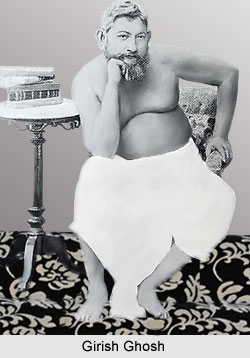
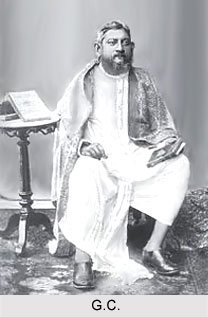
 Girish Chandra Ghosh, born on 28th February 1844, was a prominent actor, playwright, director, and producer of Bengali theatre. He is fondly referred to as Father of Bengali Theatre. Though he did not possess any formal education but was instrumental in shaping the future of Bengali theatre, and played a crucial role in grooming and bringing up various potential actors and actress, including Bonodini Dasi.
He, in 1872, co-founded the Great National Theatre, the first company for Bengali professional theatre, also wrote about 40 plays and directed and acted in many more. Later, of course, he became a significant disciple of Sri Ramakrishna Paramahansa.
Early Life of Girish Ghosh
Ghosh was born on 28th February in the year 1844 in Bagbazar, and was the eighth child to his parents Nilkamal and Raimani, his father and mother respectively. He received his education at a very early stage from Hare School and later studied under Oriental Seminary in the city of Kolkata. Ghosh retained some of the good qualities of his father, that of generousness and kindness. Due to early demise of his parent Girish went on to educate himself.
Life in Theatre for Girish Ghosh
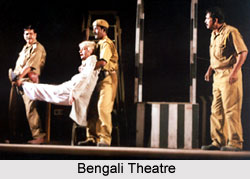
He was initiated into the theatrical world as a composer in popular Half-akhrai music bands, and was later, through his expertise and ingenuity was responsible for the golden age of Bengali theatre. Often referred to as "Father of Bengali Theatre", Girish Ghosh, was closely associated with the Baghbazar Amateur Jatra Party in Kolkata. He scored the music for its 1867 production of Michael Madhusudan Dutt`s Sharmishtha and played Nimchand in Sadhabar ekadashi in 1869 and Lalit in Lilabati in 1871. Both were directed by Dinabandhu Mitra. Girish Ghosh was one of the organizers of the National Theatre in 1872. He left the group on the issue of collecting gate money, but rejoined soon as `a distinguished amateur` in the role of Bhimsinha in Dutt`s Krishnakumari in 1873. He had close contact with the British actress Mrs Lewis and her company during their stay in Kolkata. He dramatized Bankim Chandra Chatterjee`s Mrinalini in 1874 for the Great National Theatre and Dutt`s Meghnadbadh i.e. `Killing of Meghnad` in 1877 for the rechristened National Theatre. His first original script, Agamani i.e. `Advent` in 1877, marked the beginning of a prolific yet illustrious playwriting career. In 1880, he finally gave up his job with a commercial firm to take up management of the National Theatre. Ghosh`s association with different Calcutta stages looks somewhat checked. The National could retain him only till 1883, after which began his periodic shifting within the limited circle of playhouses i.e. the Star in Beadon Street and later Cornwallis Street, Emerald, Minerva, and Classic etc. in endless permutations. He even had the dubious distinction of serving opponent troupes surreptitiously. However, he managed companies professionally, and largely fashioned the grand production style prevalent in Bengali theatre. He hybridized popular folk entertainment with Western notions of dramaturgy as well.
 As a playwright he relied on dramatization of novels by Bankim Chatterjee`s Kapalkundala in 1873, Mrinalini, Bisha-briksha in 1874, Durgeshnandini i.e. "Chieftain`s Daughter" in 1878 and epic poems Meghnadbadh, Palashir Juddha i.e "Battle of Plassey" in 1878. The early attempts failed till Rabanbadh i.e. `Killing of Ravana` in 1881 made a big hit, featuring his improvisation of Gairish metre, named after him. This considerably influenced Bengali dramatists. It might have induced him to write many plays based on the Ramayana. Sitar banabas i.e. `Sita`s Forest Exile` and Lakshmanbadh i.e. `Killing of Lakshman`, both were staged in 1881. Sitar bibaha i.e. `Sita`s Marriage`, Ramer banabas i.e. `Lord Rama`s Forest Exile`, Sitahamn i.e. `Sita`s Abduction`, all were staged in 1882. After briefly experimenting with musical plays like Malinmala i.e. `Tarnished Garland and Brajabihar i.e. `Frolic in Vraj` in 1882, he entered another phase of mythologicals which included Pandaber ajnatabas i.e. `Pandavas` Incognito Exile, Dakshayajna i.e. Pandemonium`, Dhniba-charitra i.e. `Dhruva`s Life`, Nala-Damayanti i.e. `Nala and Damayanti`. All of them were staged in 1883. Some of the plays such as Chaitanya-lila i.e. `Chaitanyas Miracles` in 1884, Prahlad-charitra i.e. `Prahlads Life` in 1884, and Bilwamangal Thakur in 1886, all were box-office hits. The saint Ramakrishna`s arrival at a performance of Chaitanya-lila deepened spiritual yearnings in Ghosh and also lent him and the Bengali stage respectability.
After dabbling in social plays like Nasiram, Purnachandra, and Bishad, he finally struck his best in Praphulla in 1889. His spent his last period as a dramatist at Minerva Theatre. He saw scripts like Shakespeare`s Macbeth in translation, Abu Hosain and Jana, Pandab gaurab i.e. `Pandavas` Glory` in 1900, Satnam in 1904, proscribed by the British government, etc.
Balidan i.e. `Sacrifice` and Sirajuddaula, Jaysa-ka-taysa i.e. `Tit for Tat`, after Moliere, and Shasti ki shanti i.e. `Punishment or Peace` in 1908 were produced with great success. The nearly eighty plays written by him represent all the popular theatrical modes of Bengal. From light farces and musicals to elevated historical, mythological, and social drama including provocative works on nationalist themes. Girish Chandra Ghosh was a champion of stylized acting, Ghosh was dubbed the `Garrick of the East`, and the highest esteem an actor could have hoped for in those days. His essays on theatre dwell on the art and technique of acting of which he was reportedly an excellent coach. Girish Ghosh has also written on the personalities and problems of Bengali Theatre. This legendary figure died in the year of 1912.
Personal Life of Girish Ghosh
Girish, after receiving immense set back in his personal life, became an atheist, till of course he met Ramkrishna. He lost both his wives, two daughter and sons, whom he loved very much. He was a hard working man, and would practise theatre in the evening after returning home at three or four in the morning. It is after the death of his first wife, Pramodini, which is disbelief in god hardened.
Influence of Sri Ramakrishna
When Girish first met Sri Ramkrishna, he was not very cordial to the Indian saint. But with time he became very affectionate towards Ramkrishna, and often referred to him guru. Ramkrishna, during his visit to Kolkata, would go down to Star Theatre to watch Ghosh`s play.
Relationship with Swami Vivekananda
Girish Ghosh, despite a difference in age, was extremely friendly to Swami Vivekananda. They shared immense respect for each other. Vivekananda thoroughly loved watching the plays of Ghosh and referred to him as "G.C".