





 Gatka is a formalized Sikh in the Indian state of Punjab and Himachal Pradesh. It is a unique spectacle, physical as well as spiritual, to see hundreds of Nihang which is a warrior sect. Gatka is focused primarily on weapons, especially swords and stick fighting. Gatka martial artists consider this ancient martial arts style as the “mother of all martial arts”. The art form of Gatka can be practised either as a sport or a ritual; the sport form is played by 2 opponents wielding wooden staves called gatka. These sticks may be paired with a shield. Gatka is a formalized Sikh in the Indian state of Punjab and Himachal Pradesh. It is a unique spectacle, physical as well as spiritual, to see hundreds of Nihang which is a warrior sect. Gatka is focused primarily on weapons, especially swords and stick fighting. Gatka martial artists consider this ancient martial arts style as the “mother of all martial arts”. The art form of Gatka can be practised either as a sport or a ritual; the sport form is played by 2 opponents wielding wooden staves called gatka. These sticks may be paired with a shield.
History of Gatka History of Gatka suggests in a great detail that after the second Anglo-Sikh War from 1848 to 1849 and the setting up of British Rule, this sport suffered a major setback. The effect was so extreme that even farming equipments and tools were also banned. British Government in India regarded the Akali Nihang to be anti colonist. Above 1,500 nihangs were killed by the British Empire for conspiring rebellion. According to the folklore, some actually escaped and spent the rest of the lives in the northern mountains. Later of course, the Sikhs helped the British during the revolt of 1857, and the use of various technique of gatka came into play. Development of Gatka After historical, political and cultural changes through the ages, development of Gatka has been immense and has now become a performing art rather than the original art of self-defence. The akhara or the arena, is a pit dug in an open field or in the grounds of a gurdwara. In that, one hears devotional hymns from the holy scriptures of Sikhism, Sri Guru Granth Sahib, and witnesses the enactment of religious poems. Beginning with the hymn "O Lord, give me so much power that I never fear performing a good deed", the men, pledged to celibacy, perform the Fateh namah i.e. worship of weapons, derived from the doctrine of Guru Gobind Singh (1666-1708) that weapons symbolize divine power. 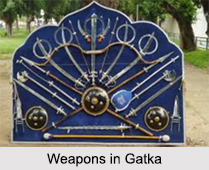 Art of Gatka Art of Gatka
After this, they undertake a repertoire of martial exercises and technique of Gatka. The art of Gatka actually incorporates the techniques of Gatka. In the first individual exercise, double-edged spears or two swords are dangerously but rhythmically swirled around the body. In the second, kamandkoda, which is a 2 ft long pipe attached to a 30 inch chain with half a kilogram of weights connected to its end is manipulated in a dance with vigorous movement and jumps. Groups in Gatka Dual and group patterns include pharisoti i.e. "catch the stick", an attack-and-defence exercise using a shield made of a cushion and a stick with steel handles. An extension of this is a stylized performance of a war scene. In the similar safajiing dhal i.e. "plain war shield", an axe-shaped weapon replaces the stick. The weapons in Gatka were used during the warfare in medieval era and are the crucial part of the game. In another exercise, one "warrior" fights 4 or 5 people with swords and shields. Alternately, they attack him with stones and he defends himself using shield and sword. Climax in Gatka The climax of the exercises in Gatka occurs when a blindfolded warrior applies kohl to his partner's eye with a sharp-edged sword, while nagaras build to a crescendo, leaving the audience astounded. The training exponent begins with the Fateh nama, and the weapons used in Gatka are also of many types. 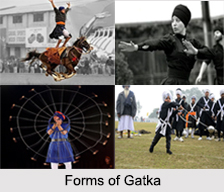 Use of Long Sticks in Gatka Use of Long Sticks in Gatka
The long sticks used for training are laid on a ceremonial cloth sanctified by drawing a "magical" circle around it. This is followed by a parikarma i.e. circumambulation by all trainees. During the parikarma their eyes focus on the sticks, creating a bonding. To the drumming sounds of dhol (drums) and nagara, they move towards the sticks in a stylized, vigorous manner and gracefully pick up the weapons, then move away from the centre with a forceful jump to establish their positions. After this they swirl the sticks in salutation to all four sides, seeking the blessing of the four corners of the cosmos through chants and prayers. Movements in Gatka A figure of eight is the basic matrix through which the more complex movements evolve. This is done by drawing four circles on the ground in an imaginary square format. Movements in the diagonal circles create the 2 figure-of-8 patterns in which the performers work. This is also the preparation for confronting opponents, who first greet each other by the Fateh nama. During the entire process of this stylized duel one's eyes are fixed on the other's, trying to read the other's mind and anticipate the next move, leading to immense concentration, alertness, and speed. The training is an experience to watch as surreal, exaggerated images are formed by the magnificence of their skill combined with the drama created by their clothing lit up by the glare of flaming torches and nowadays the headlights of trucks. Practitioners in Gatka Guru Hargobind, Emperor Akbar, Guru Gobind Singh, Bhai Daya Singh, Sahibzada Ajit Singh, Sahibzada Jujhar Singh, Kapur Singh, Mai Bhago, Baba Deep Singh and Phula Singh are the famous Gatka practitioners in India. The Punjab Gatka Association is a registered body and has, for the first time, standardized and formulated exhaustively, the rules and regulations in September 2009 for playing of Gatka - a martial art game. |
| ||||||||||||||||||||||||||||

