


 Mahayana and Vajrayana Buddhist art frequently makes use of a particular set of eight auspicious symbols, ashtamangala, in household and public art. These symbols have spread with Buddhism to many cultures and arts, including Indian, Tibetan, Nepalese, and Chinese art. Mahayana and Vajrayana Buddhist art frequently makes use of a particular set of eight auspicious symbols, ashtamangala, in household and public art. These symbols have spread with Buddhism to many cultures and arts, including Indian, Tibetan, Nepalese, and Chinese art.
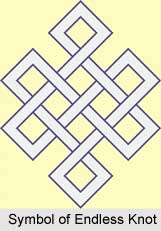
The symbols include: 1. Endless knot, or, the Mandala - symbolising money. 2. Lotus flower - symbolising enlightenment. 3. Victory Banner - symbolising a victorious battle. 4. Wheel of Dharma or Chamaru in Nepali Buddhism - symbolising knowledge. 5. Treasure Vase - symbolising inexhaustible treasure and wealth. 6. Golden Fish pair - symbolising conjugal happiness and freedom. 7. Parasol - symbolising the crown, and protection from the elements. 8. Conch shell - symbolising the thoughts of the Buddha. Endless Knot, Buddhist symbol The endless knot or eternal knot is a symbolic knot found in Tibet and Mongolia. The motif is used in Tibetan Buddhism, and may also be witnessed in Chinese art as one of the Eight auspicious symbols. The endless knot has been described as "an ancient symbol representing the interweaving of the Spiritual Path, the flowing of Time and Movement within That Which is Eternal. All existence, it says, is bound by time and change, yet ultimately rests serenely within the Divine and the Eternal". Various renderings of the symbol are: 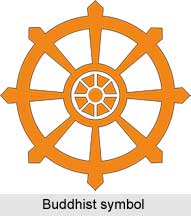
Mandala, Buddhist symbol Interpreted in various ways in the modern times, mandala means the core concentration into something grand. Mandala literally means "essence" "having" or "containing". It is also translated as "circle-circumference" or "culmination", both derived from the Tibetan term dkyil khor. Mandala is of Hindu origin, the term always employed for the books of the Rig Veda, but is also used in other Indian religions like Buddhism. In the Tibetan branch of Vajrayana Buddhism, mandalas have been developed into sandpainting. They are also a cardinal part of anuttarayoga tantra meditation practices. In various spiritual traditions, mandalas may be utilised for concentring attention of aspirants and virtuosos, as a spiritual teaching tool, for founding a sacred space, and as an assistance to meditation and trance initiation. In everyday use, mandala has become a standard term for any plan, chart or geometric pattern that symbolises the creation metaphysically or symbolically, a microcosm of the Universe from the human point of view. The mandala can be found in the form of the Stupa, and in the Atanatiya Sutta in the Digha Nikaya, part of the Pali Canon. This text is chanted quite often. Mandalas are seen as hallowed places which, by their very presence in the world, makes a viewer recall of the immanence of sanctitude in the Universe and its potency in his or her self. In the circumstance of the Buddhist path, the function of a mandala is to put an end to human suffering, to achieve enlightenment and to attain a right view of Reality. It is a means to discover divinity by the recognition that it rests within one's own self. A mandala can also symbolise the entire Universe, which is traditionally represented with Mount Meru as the axis mundi (also called cosmic axis, world axis, world pillar and center of the world, 'axis mundi' is an omnipresent symbol that crosses human cultures. The image shows a point of connection between sky and earth where the four compass directions meet.) in the centre, surrounded by the continents. A 'mandala offering' in Tibetan Buddhism is an emblematic offering of the entire Universe. Every elaborate detail of these mandalas is fixed in the tradition and has specific symbolic meanings, often on more than one level. The mandala can be shown to symbolise in visual form the cental essence of the Vajrayana teachings. In the mandala, the outer circle of fire usually symbolises wisdom. The ring of 8 charnel grounds likely represent the Buddhist exhortation to always be aware of death and impermanence with which samsara is overspread. Inside these rings lie the walls of the mandala palace itself, particularly a place inhabited by deities and Buddhas. Lotus Flower- Padma, Buddhist symbol 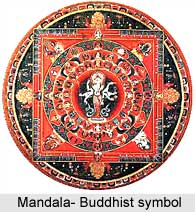 Padma (nelumblum speciosum), the sacred lotus, is an aquatic plant that plays a primal role in Indian religions like Hinduism, Buddhism, and Jainism.
The lotus and lotus flower is an ancient polyvalent (denoting something which has many values, meanings or appeals) symbol. The lotus flower is one of the Vajrayana Ashtamangala, inetgral to Buddhists. It is representative of macrocosm and cosmic renewal and shares in the chakra and mandala symbolism of the Dharmachakra. It also symbolises sinlessness, as its flowers grow on long stalks, which are rooted in the mud. It is also symbolic of withdrawal, as drops of water easily glide off its petals. Victory Banner- Dhvaja, Buddhist symbol Dhvaja means banner or flag. The Dhvaja is incorporated amongst the Ashtamangala, the 'eight auspicious symbols' in Buddhism. Makara Dhvaja later become an emblem of the Vedic god of love and desire - Kamadeva. As the 'tempter' (Sanskrit mara), or 'deluder' (Sanskrit: Maya (illusion)), Kamadeva was the Hindu counterpart of the Mara, the 'evil one', who sought to impede the Budda from attaining enlightenment. In early Buddhism the concept of Mara as a fiendish thwarter to spiritual progress was presented as group of four 'maras' or 'evil influences'. As a symbol of the Buddha's victory over the four maras, the early Buddhists borrowed Kamadeva's emblem of Makara Dhvaja (also called makaradhvaja), and four of those banners were hoisted in the fundamental directions surrounding the enlightenment stupa of the Tathagata or Buddha. Treasure Vase, Buddhist symbol The treasure vase or bumpa (in Sanskrit) is the 'long-life vase, the 'precious vase' or 'wisdom urn' of the ashtamangala belief in Buddhism. The treasure urn is a sign of the inexhaustible riches available in the teachings of Buddha, but also typifies long life, wealth, affluence and all the comforts of this world, and the phenomenon of space. Indeed, to elucidate further, "Space" (Sanskrit: akasha) is an interpretation of the particular reference of the element of the 'mahabhuta' (Sanskrit; English: "Great Elements") and the Five Pure Lights. Space is that "elemental matrix" which contains, holds and carries on every phenomena. Space is the depository and conduit of everything that is apparent, corporal or incarnate; the vase symbolises Sunyata (Sanskrit); the iconographic representation of the 'wisdom urn' is frequently very similar to the 'water pot' (Sanskrit: Kumbha) which is one of the few permissible possessions of a Theravadin bhikku or bhikkuni; the wisdom urn or treasure vase is used in many Vajrayana empowerments and inductions. There even exists a practice which requires burying or stashing treasure vases at specific locations to generate wealth, eg. for monasteries or dharma centres. Golden Fish pair, Buddhist symbol The 'two goldfish', symbolising the state of 'fearless suspension in a harmless ocean of samsara', metaphorically often refer to 'buddha-eyes' or 'rigpa-sight'; the pair also symbolise the auspiciousness of all living beings in a state of fearlessness without the peril of submerging in the Samsaric Ocean of Suffering, and migrating from place to place and teaching freely and instinctively, just as fish swim freely without fear through water. 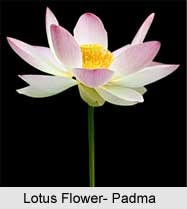
Parasol, Buddhist symbol The Precious Parasol (Sanskrit: Chhatra) or Sacred Umbrella is similar in ritualistic function to the baldachin or canopy. The Sacred Parasol was originally used as a symbolic portrayal for sacred medicinal and hallucinogenic mushrooms of the Himalayan pharmacopeia, exemplifying the protection of beings from harmful forces, illness; the parasol also represents the covering or firmament of the sky and thus the expansiveness and flowering of space and the element ether; it represents the expansiveness, flowering and protective quality of the sahasrara. Buddhist are of the faith that everybody takes recourses to the Dharma under the lucky omen of the precious parasol. Conch-shell, Buddhist symbol The right bended white conch shell (Sanskrit: Sankha), representing the beautiful, unfathomable, tuneful and enveloping sound of the Buddhadharma which being apt to different natures, inclinations and aspirations of disciples, arouses them from the dormancy of ignorance and impels them to achieve their own welfare and the welfare of others. The Conch is a primary divine attribute of Lord Vishnu as is the Wheel. Vaishnavism holds that Shakyamuni Buddha is an incarnation of Vishnu. |
| |||



Eight Auspicious Symbols
| Buddhists make use of a set of eight symbols in every kind of art, considered hugely promising. |
| ||||||||||||||||||||||||||||

