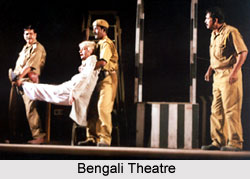
Dramatic Performances Act was implemented by British legislation to `better control` subversive Indian theatre. The birth of professional Bengali theatre with the National Theatre`s Nildarpan in 1872 brought anti-British subject matter to the general public. It also shows colonial planters ruthlessly oppressing poor peasants, though Dinabandhu Mitra had written it in 1860 and the publisher of the English translation, Rev. James Long, had been fined and imprisoned in 1861. In 1875, the same production created a furore on tour in Lucknow, where incensed British soldiers in the audience stopped the performance. The administration followed such incidents closely, realizing that the public stage as opposed to the limited reach of the private stage could prove a veritable tinderbox.
In 1876, soon after Edward, the Prince of Wales, visited Calcutta, the Great National Theatre presented a blatant persiflage titled Gajadatianda o jubaraj i.e. `Gajadananda and Crown Prince`. It was staged for targeting a lawyer, Jagadananda Mookerjee, who had obsequiously invited the prince into his family zenana. This term was unheard of in upper-class Bengali circles. The police proscribed the play, but the company repeated it the following week under another name, only to meet the same fate. The Governor-General promulgated an ordinance prohibiting performances `prejudicial to the public interest`. The next day, the theatre responded in kind, flagrantly violating the order by staging Upendranath Das`s earlier inflammatory Surendra-Binodini i.e. `Surendra and Binodini`, in which the hero thrashes a British magistrate who attempts to rape a Bengali woman, on a joint bill with The Police of Pig and Sheep. They did it burlesquing Calcutta Police Commissioner Hogg and Superintendent Lamb. Predictably, the police rounded up the culprits, on a charge of obscenity in Surendra-Binodini. However, the High Court threw out the case.
Although prominent citizens and the press protested a proposed bill to prevent provocative theatre, the government passed the DPA on 16 December 1876, empowering it `to prohibit Native plays which are scandalous, defamatory, seditious or obscene`. The police could `enter, arrest, and seize scenery, dresses, etc`. Also, public dramatic performances `in specified localities` had to receive a license, so `a copy of the piece, if written, or a sufficient account of its purport, if it be in pantomime, shall be previously furnished to the proper authorities`. As a result, scripts had to be deposited in advance with the police in many parts of India, ironically turning some police offices into archives of Indian drama. Since political plays were effectively stifled, authors exploited the loopholes in the Act and took recourse to subtler methods, commonly addressing nationalistic passions by dramatizing stories of subjugation and rebellion from mythology or history. Even these sometimes became too obvious, for the British banned many works.
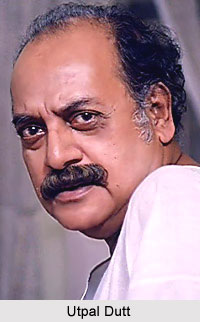
Some of the important among them can be mentioned as, in 1910 K. P. Khadilkar`s Kichakavadh i.e. `Killing of Kichaka`, in which Bhima slays the tyrant, and in 1911 Girish Ghosh`s Sirajuddaula, about Bengal`s last independent Nawab. Curiously, after Independence in 1947 the DPA remained in effect, most states introducing their own amended versions, some of which, like the Bombay DPA in 1950, actually gave more power to the administration. In 1953, the Calcutta Police served a notice on the Indian People`s Theatre Association in West Bengal to submit manuscripts of over fifty plays, including Nildarpan and Nabanna in 1944. The same year, Kerala banned Thoppil Bhasi`s Ningalenne Communist akki i.e. `You Made Me a Communist` in 1952 and members of his group were arrested for defying it. After an appeal, the ban was lifted, and the DPA locally replaced by the Madras DPA in 1954. In Tamil Nadu, political parties in power invariably blocked pro-opposition drama. The Punjab DPA was modified in 1964. Only in West Bengal was the DPA repealed, in 1962, under persistent lobbying from artists, and the proposed state bill dropped, though theatre workers like Utpal Dutt faced prosecution under other laws, such as Section 124A (sedition) for Duhswapner nagari i.e. `Nightmare City` in 1974.
In more recent times, P. Antony`s award-winning The Sixth Holy Wound of Christ in 1986 was an adaptation of Nikos Kazantzakis`s The Last Temptation of Christ. This was prohibited from performance invoking the Kerala DPA in 1962, for showing Christ as manic-depressive. The Supreme Court upheld the ban. When Antony received life imprisonment on an unrelated murder charge in 1989, the church reportedly claimed it was `God`s wrath`. The India Code Compilation of Unrepealed Central Acts in 1993 considered the DPA one of the `obsolete laws`. Bangladesh, whose theatre community regarded it as notorious, finally repealed it in 2001.