


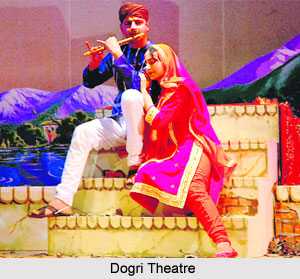
 Dogri Theatre is prevalent in the Indian stateof Jammu and Kashmir, and in the adjoining areas of Himachal Pradesh and Punjab, where Dogri language is commonly spoken. The theatre is varied and rich with performances of cultural folklore revolved around the Baghtan - a tribe of singers and actors who regularly arrived from regions of Sialkot with large stock and repertoire of Raslila and Ramlila, narratives inherently rhythmic in movement. Help at the Dogra royal court helped shows of Baghtan to accelerate in temple city of Jammu and reach other towns and cities like Punch, Ramnagar in Udhampur districtand Basoli in Kathua district. Dogri Theatre is prevalent in the Indian stateof Jammu and Kashmir, and in the adjoining areas of Himachal Pradesh and Punjab, where Dogri language is commonly spoken. The theatre is varied and rich with performances of cultural folklore revolved around the Baghtan - a tribe of singers and actors who regularly arrived from regions of Sialkot with large stock and repertoire of Raslila and Ramlila, narratives inherently rhythmic in movement. Help at the Dogra royal court helped shows of Baghtan to accelerate in temple city of Jammu and reach other towns and cities like Punch, Ramnagar in Udhampur districtand Basoli in Kathua district.
Origin of Dogri Theatre In the year 1898, Maharaja Pratap Singh called upon the "Victoria Company", Mumbai, to enact at a family ceremonial in the Green Hall of his palace in Jammu. This particular event actually inspired proscenium theatre in Dogri. In the year 1914 came up the, Sanatan Dharam Natak Samaj, its focal point of activities die Dewan Mandir at Kachi Chawni, Jammu, where a playhouse still exists. Two of the most popular names of Bollywood or Hindi cinema that have come up from this organization are; actor Om Prakash, and singer-actor K. L. Saigal. Performances of Dogri Theatre Friends Club copied the Parsi theatre in such manner as Dard de Jiga or "Bleeding Heart" and Mobabbat Ke Phul i.e. "Flowers of Love". For the coronation of Maharaja Hari Singh in 1925-6, many troupes presented command performances,  including local folk groups, Baghtan from Sialkot, Suraj Vijay Company and Amateur Dramatic Club from Mumbai, and Madan Theatres from Kolkata. The start of the Dogri Theatre can be picked up with the staging of Vishwanath Khajuria's social satire Achut i.e. "Untouchable" in 1935, directed by him at the Middle School, Ramnagar, followed by D. C. Prashant's Devaka janam i.e. "Birth of the Gods". The Dogri Sanastha formed in 1944 under Ramnath Shastri and Dinubhai Pant, both literary personalities, proved a boost for theatre. After of course the Dogri regime fell in the year 1947, with the birth of Indian democracy, Dogri psyche sagged but for Shastri's Bawajitto, produced at the Kisan or farmers Conference at Tikri in Jammu, 1948. Prashant and Khajuria also separately dramatized this folktale about the fifteenth century heroic martyr. A development of children's theatre in Indiaoccurred when Narender Khajuria began to write plays for performance by children. including local folk groups, Baghtan from Sialkot, Suraj Vijay Company and Amateur Dramatic Club from Mumbai, and Madan Theatres from Kolkata. The start of the Dogri Theatre can be picked up with the staging of Vishwanath Khajuria's social satire Achut i.e. "Untouchable" in 1935, directed by him at the Middle School, Ramnagar, followed by D. C. Prashant's Devaka janam i.e. "Birth of the Gods". The Dogri Sanastha formed in 1944 under Ramnath Shastri and Dinubhai Pant, both literary personalities, proved a boost for theatre. After of course the Dogri regime fell in the year 1947, with the birth of Indian democracy, Dogri psyche sagged but for Shastri's Bawajitto, produced at the Kisan or farmers Conference at Tikri in Jammu, 1948. Prashant and Khajuria also separately dramatized this folktale about the fifteenth century heroic martyr. A development of children's theatre in Indiaoccurred when Narender Khajuria began to write plays for performance by children.
Modern Dogri Theatre With the continuation of Sanatan Dharam Natak Samaj its pursuits and the Culture and Languages, Jammu and Kashmir Academy of Art was established in 1958, the Dogra cultural identity re-emerged. New clusters or groups appeared besides the renewal of Friends Club in 1965. Dogri Sanastha and Dewan Mandir became the hub of activity. Economic assistance from the Academy sustained most of the groups and supported multilingual theatre festivals, still in rage. In the later part of 1970's, some of the significant plays included those by Narsingh Dev Jamwal, Madan Mohan Sharma, and Puran Singh. During the early and middle of 1980s, Dogri theatre earned acknowledgment and fame beyond Jammu and Kashmir through young artistic directors like Balwant Thakur, who heads the popular group Natrang. |
| |||



Dogri Theatre
| Dogri theatre is rich is tradition and heritage, and brings out the best of the Dogri language. |
| ||||||||||||||||||||||||||||

