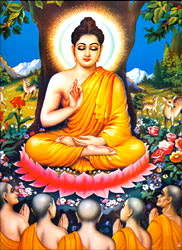
 In Buddhism, buddhahood is the state of perfect enlightenment attained by a buddha, or the `awakened one`. In Buddhism, the term `buddha` normally refers to one who has become enlightened (i.e., awakened to the truth, or Dharma). The degree to which this manifestation requires withdrawl from ordinary life (ascetic practices) varies from none at all to an absolute necessity, depending on doctrine. In Theravada Buddhist traditions, it is held that the person reaches this state on their own, without a teacher to point out the Dharma, in a time when the teachings on the Four Noble Truths or the Eightfold Path do not exist in the world. These enlightened beings go on to teach it to others even. In contrast, in certain Mahayana Buddhist traditions (especially those that consider the teachings of the Lotus Sutra to be predominant, which contains this concept) Buddhahood is considered as a universal and intrinsic property of absolute wisdom that is revealed in a person`s current lifetime through Buddhist practice, without any particular renouncement of pleasures or "earthly desires". Hence, there is a highly broad scope of opinion on the universality and method of accomplishment of Buddhahood, which is correlated to which of Shakyamuni Buddha`s teachings that a school of Buddhism abides by.
Further extensively, Buddhahood is occasionally used to refer to all who attain nirvana. In this more panoptic sense it is equivalent to Arhat. According to Theravada Buddhism, all Arahants (or Buddhas in the broader sense) are the same in the most rudimentary aspects of Liberation (Nirvana), but differ in their practice of perfections paramis (popularly known as Paramitas in Buddhism, it refers to the perfection or culmination of certain virtues). Mahayana Buddhism however considers that there is a basic difference between Buddhas and ordinary arhants. On the way to becoming a Buddha, a buddhist proceeds bodhisattva stages. Buddhists do not consider Siddhartha Gautama to have been the only Buddha. The Pali Canon refers to many previous ones, whereas the Mahayana tradition additionally has many Buddhas of heavenly, rather than historical, origin. A common Theravada and Mahayana Buddhist belief is that, the next Buddha will be one named Maitreya (Pali: Metteyya).
Kinds of Buddha - Buddhahood, Buddhism
In the Pali commentaries, three types of buddha are referred:
1. Sammasambuddhas attain buddhahood, then resolve to teach others the truth they have chanced upon. They guide others to awakening by teaching the Dhamma in a time where it has been forgotten. Siddhartha Gautama is considered a sammasambuddha.
2. Paccekabuddhas, sometimes referred to as `silent Buddhas`, are similar to sammasambuddhas in that they achieve nirvana and acquire many of the same powers as a sammasambuddha, but are incapable to teach what they have chanced upon. They are considered second to the sammasambuddhas in spiritual development. They do ordain others; their reprimanding is only in reference to good and proper conduct (abhisam?c?rikasikkh?). In some texts, the paccekabuddhas are described as those who apprehend the Dhamma by their own efforts, but obtain neither omniscience nor mastery over the `fruits` (phalesu vas?bh?vam).
3. Savakabuddhas attain nirvana after hearing the teaching of a sammasambuddha (directly or indirectly). The disciple of a sammasambuddha is called a savaka ("hearer" or "follower") or, once enlightened, an arhat. These terms have somewhat varied meanings, but can all be used to identify the enlightened disciple. Anubuddha is a seldom used term, but is used by the Buddha in the Khuddakapatha to refer to those who become Buddhas after being imparted instruction. Enlightened disciples attain nirvana and parinirvana as the two types of Buddha do. Arhat is the most commonly used term for them, though it is also applicable to Buddhas.
In the Pali Canon itself, the first two are mentioned by the above names, whereas several examples of the third type occur, without that name. There is no mention of kinds of buddhas, though the word buddha does sometimes appear to be used in an extensive sense covering all the above.