The weddings among Indian tribals have become more modernized these days, but the traditional regulations of marriage still prevail. The Gaddi tribe in the Kangra valley practices strange rituals during the nuptials. The groom is seen dressed in a yellow dhoti with ash smeared on his forehead, a bow and arrow in hand and in away that his appearance is similar to Lord Shiva. Marriage is very important among Gaddis. If one does not marry, he or she is doomed to die a devil`s death, as the community believes. Wedding festivities are spread over three days, but it is on the second day that the actual ceremony really begins.
On this day, women perform the rituals. The ceremony begins with the groom begging his mother for a probability to lead his own life. He has to go to her with a pleading bowl, asking for her permission to go ahead with the wedding. In keeping with a well-rehearsed script, the mother must send him away with the best food, which means that his wish has been granted.
Wedding dress among Indian tribes - In the luxuriant hills of the Kangra valley, a marriage ritual is a colorful affair. The bright colors of the costumes are in sharp distinction to the green of the surroundings. The women wear themselves with heavy jwellery. Big nose rings, heavy silver chanderhars, jo-malas and kapor-ki-malas are common ornaments. The hair is decorated with a central chiri and a pair of smaller pieces of jewellery is worn behind the ears. A silver chaunk is thought to be important headgear. Bangles are compulsory, for no self-respecting women will be seen without them. Most of the jwellery is made from silver and the use of gold is usually rare. The Gaddi woman likes to boast her jwellery and costumes and a marriage is the ideal occasion to showcase them.
Wedding feast among Indian tribes - On the first day of the celebrations, Gaddi women sing conventional songs invoking various Gods as well as the sun, moon and the earth. After much singing and festivities, the feast begins. The menu for a wedding usually consists of food items like babroo, lahoda or fried blood cutlets, vegetables, fried mutton, and tea or sur or alcohol. As a rule, mutton is not prepared at the bride`s place. For breakfast, halwa or any other sweet is a must.
The Gaddi marriage is a fascinating re-enactment of the wedding rituals following the marriage of Shiva and Parvati. The ceremony begins with Samhut where the purohit worships all the Gods-Brahma, Vishnu, Navgraha, the kuldevata (the family god) and Kumbha. After the ceremonial bath in the patio, the groom, covered in a blanket is made to thrust an earthen plate containing burning charcoal and mustard. This simple ritual is believed to ward off the evil eye. The groom has some false choices to make as well. The priest asks him to choose between a worldly life or jatera or the life of an ascetic or matera. To opt for the former, he symbolically rejects the clothes of a jogi. Then, he takes a ritual bath at Badrinarayan, Trilokinath and Manimahesh by washing his hands, feet and face with water from a vessel kept at the doorway. The purohit and the nai or the barber dresses him. The sehra is presented by the maternal uncle and is tied to the turban by all the gotris or the close relatives.
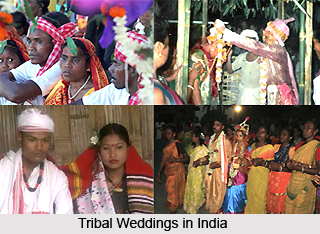 Traditionally, the groom was carried off in a palki, a far cry from the Maruti 800, which was arranged for this wedding. At the auspicious hour, the bridegroom is taken to the toran, a ceremonial gate specially created for the occasion, where the bride`s parents and purohit receive him. The actual ceremony takes place in a mandap-like structure called the bedi. The bedi is decorated with geometrical figures made of rice flour, turmeric and vermilion.
These days, there are variations in the kinds of marriages that take place amongst the Gaddis. The most authentic of them all is dan-pun or dharampun, where the parents without any pre-conditions arrange the marriage. However, the most commonly practiced ritual is the bata-sata or marriage by exchange, in which a boy gets a wife in exchange for a girl married to his wife`s brother. Ghar Jawatri or Kamash is one of the unusual forms in which a boy, usually from a poor family serves his would-be in-laws for a period of time, almost like an unpaid domestic help. This form of marriage is not practiced nowadays.
Festivities and merry-making are an essential part of Indian tribal weddings. For this bold, sincere and hard working community is a perfect occasion to let its hair down. Late at night, when the havan fires had died down, the grandfather of the groom comes into the gathering in an intoxicated condition and takes part in the celebrations.
More on Wedding in Modern India
More on Indian Wedding Accessories
More on Indian Religious Weddings
More on Types of Marriages
See also