Telugu Wedding is a sophisticated affair and is made up of a variety of rituals and ceremonies that expand over several days. It may be noted that there may be certain regional and caste alterations in rituals regarding ceremonies related to Telugu wedding ceremony. However, the Telugu people have their highest regard for the association of marriage.
Match Making in Telugu wedding
Telugus strictly believe in choosing their partners within their community only. The match between Brahmin and non-Brahmin is usually not made unless the girl or the boy is exceptionally eligible. Matches are first fixed by the word of mouth among known people. If it doesn`t work out only then, advertisements are given in the newspapers.
Costumes in Telugu wedding
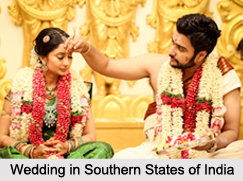
The bridal dress in Telegu Wedding is the saree. In majority cases, the saree is a red one or sometimes other bright colours. Usually the bride wears gold and pearl jewellery. Pearl is exceptional as it is a product signifying Hyderabadi specialty. The bride would adorn her hair with special flowers.
The grooms of Andhra Pradesh wear the dress of South Indian dhoti and a shirt in their traditional style only. In case the groom is Brahmin, he does not wear the shirt during marriage.
Pre-Wedding Rituals in Telugu Wedding
Muhurtam
Muhurtam is an important ceremony where after a propitious period of worshipping, the day is selected for the marriage. The Telugu marriage rituals are basically Hindu marriage rites only.
Pendlikoothuru
This ritual takes place a day or two just before the marriage. In this the boy and the girl are besmeared with oil and turmeric for purification. They take bath and both wear new clothes. All the assembled married women are gifted with the betel leaves, sweets, flowers and bangles.
Snathakam
Snathakam is an essential ritual that takes place a few hours before the actual Muhurtam. It involves only the bridegroom, as he has to wear a silver thread on his body.

Kashi Yatra
Kashi Yatra is a unique ceremony, which has the boy saying at the end of the thread ceremony that he has left behind all the worldly pleasures and going to Kashi. This strange but very applicable ceremony and is called "KashiYatra" or the journey to Kashi. To stop him from the symbolic departure to Kashi, the girl`s brother asks him to stay on. For this he also offers his sister in marriage.
Mangala Snaanam
Mangala Snaanam is the auspicious bath that takes place at dawn of the wedding day. Both the bride and the groom take this bath individually.
Aarti
This ritual involves the family members applying the groom and the girl with oil and doing aarti around them. It is done for several reasons; one of them being to defend the couple from evil planetary influences, evils omens and other troubles.
Gauri Pooja
After having the holy bath, the bride worships the goddess Gauri for invoking peace. Gauri is the Goddess Durga symbolizing divine power, energy, womanpower, fertility, etc.
Ganesh Pooja
When the bride performs the Gauri Puja, the groom at the same time participates in the Ganesha puja. Ganesha puja is considered propitious for any significant occasion as it ensures the success of the work at hand.
Telegu Wedding Rituals
Kanyadaan
The Kanyadaan rite in Telugu marriage ceremony is striking as well as wonderful. It is the girl`s maternal uncle, who carries the bride in a bamboo basket to the mandap or wedding place. According to the custom the girl should always carry some betel leaves, betel nuts, a coconut, a sandalwood stick and a red pumpkin. The procedure of the marriage is such that a curtain is placed between the bride and groom, so that they do not see each other till the wedding is completed.
After the marriage, the father and mother of the bride washes the boy`s feet with water. This ritual is also associated with the practice of gifting a virgin to the groom who is no less than Lord Vishnu.
Madhuparkam
Madhuparkam is the custom, where the boy and the girl wear a white dhoti and sari respectively, with a bright red border. The garments are made of pure cotton.
Mangalsutra
The Mangalsutra is usually a golden chain with alternate black beads. The married women in a number of communities in India wear it. In the Telugu community, the groom ties the Mangalsutra around the neck of the bride with three consecutive knots.
Akshata
At the end of the Mangalsutra ceremony, the couple exchange garlands around each other`s necks. And all those gathered shower flower petals and rice. This is called Akshata, the offering of uncooked, turmeric-coloured rice.

Saptapadi
Saptapadi is a ritual that includes the bride and the groom taking seven steps together around the fire. In each round they utter mantras, which add to reinforce the marriage. As they take the pheras, the bride`s saree and groom`s dhoti ends are tied into a knot indicating eternal association.
Post Wedding Rituals in Telegu Wedding
Griha Pravesh
After the marriage is over the bride is escorted to her new marital home and is welcomed with great warmth. The two mangalsutras are united in a common thread 16 days after the wedding, with some of the black or golden beads between the two plates, so that they do not clash with each other.
Jeelakarra-Bellamu is a strange ritual especially featuring in the Telugu Marriage, where a paste of cumin seeds and jaggery is made. The bride and the groom luxuriously apply this paste on each other`s hands signifying the idea that the two diverse components coming together and united as one indissolubly and forever.
Thus the Telegu Wedding exhibits rich Indian tradition.
More on Marriage System in Indian States
More on Indian Wedding Accessories
| Wedding Music | Wedding Songs | Traditional Indian Wedding Dresses |
| Bridal Jewelry | Bridal Make Up |
More on Indian Religious Weddings
| Sikh Wedding | Buddhist Wedding | Christian Wedding Rituals |
| Sindhi Wedding | Jain Wedding | Hindu Wedding Rituals |
| Parsi Wedding | Jewish Wedding | Muslim Wedding Rituals |
More on Types of Marriages
| Prajapatya Marriage | Gandharva Marriage | Asura Marriage |
| Rakshacha Marriage | Paishacha Marriage | Arsha Marriage |
| Daiva Marriage | Brahma Marriage |
See also