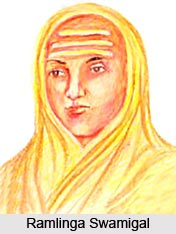
 Ramlinga Swamigal was most popularly known as Vallalar and he was one of the greatest and most notable saints and mystics of the 19th century in India. He was from the line of "gnana siddhars" of Tamil saints. Through the notion of Suddha Sanmarga Sangam, the saint endeavoured to eliminate the menace of caste. According to this notion the only aspect of life should be love related with charity and devout practices that helps gaining the purest form of knowledge.
Early Life of Ramlinga Swamigal
Ramlinga Swamigal was born on 5th October, 1823 to Ramiah Pillai and his sixth wife Chinnamaiar in Marudur in South Arcot district. He lost his father at the age of only six months. As he lost his father at such an early age, he was brought up under the generous guardianship of his elder brother, who had a very good knowledge about the religious matters and also about spiritualism.
Swamigal got attracted and interested towards Lord Shiva Bhakti from his very early childhood and he was aware of numerous scriptures and literature, in spite of not getting any formal education.
Philosophy of Ramalinga Swamigal
Ramlinga Swamigal got married to Danammal at the age of 27 years but the marital life could not distract him from his religious duty and he soon moved to Vadalur, where he set the Gyana Sabha and Dharma Sabha. He continuously criticized the practices based on birth, class, status or privilege in the society and he had no regard for the `Puranas`, `Vedas` or the `Agama`. He raised his voice against the negative aspect that affects the society due to the caste system.
In the year 1865 Ramalinga established `Samarasa Suddha Sanmarga Satya Sangam`, meaning of which is `Society for pure truth in universal self-hood`. He then founded a free eating house named The Sathya Dharma Salai` in the year 1867.
Literary Works of Ramalinga Swami
Ramalinga Swamigal composed 5818 poems dipped into universal love and peace. These poems are together collected in a book titled Thiruvarutpa. Another work is the Manumurai Kanda Vaasagam which describes the life of Manu Needhi Cholan. He also composed Jeeva Karunya Ozhukkam.
He disappeared on 30 January, 1874. It is considered this saint gained a divinization of the physical body. He attained a total of 3 transformations.