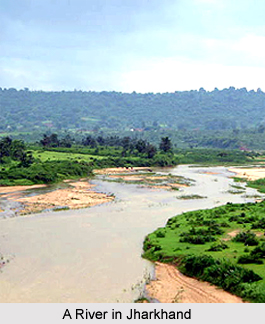
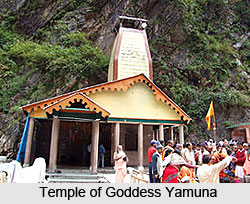
 This River originates from the Champasar Glacier at an altitude of 4421 m in the state of Uttarkhand, the respected Yamuna is specially mentioned in the Hindu mythology as a mythological river. Some say the source of the river is the Saptarishi Kund, a glacial lake, where a sacred shrine of Yamunotri or Yamnotri is constructed. There is also a temple dedicated to the Goddess Yamuna, which remains closed from November to May. At Hanumanchatti, the Hanuman Ganga converges with Yamuna River. According to a legend, this remote hilly spot was the home of an ancient sage, the Asit Muni.
he religious books say that, Yamuna is the companion of Lord Shri Krishna. Gokula, the divine dwelling of the Lord is the home of Yamuna. It is that, the river first went round Shri Krishna before descending down to earth according to the order of her Lord. River Yamuna came to be Tcalled as "Kalindi" as she touched the peak of Kalind
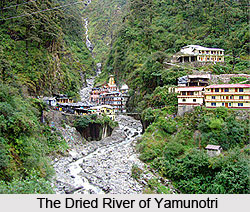 Then she descended down the hills and reached the plains at Khandav Vana, which has been urbanized as Delhi city now.
According to tradition, Yamuna and Yama are believed to be the daughter of Sun God `Surya`. Hence she is considered pure and whoever takes a dip in her holy waters of the source stream of Yamuna may not have fear of death. The rivers Ganga and Yamuna along with the now dried Saraswati are the most revered rivers in India. Yamuna, according to the legends, is the daughter of the Sun God and the sister of Yama, the God of Death. This river is also closely associated to Mahabharata and Lord Krishna. His father Vasudeva, crossed the Yamuna with baby Lord Krishna for a safer place. It is said that Lord Krishna played along with his cowherd friends on the banks of river Yamuna during his childhood.