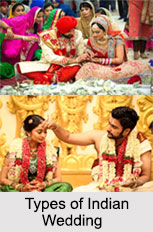
 Types of Indian Weddings are varied across the subcontinent but one thing that is common to all the Indian Weddings is the essence of commitment. India is a land of multiple religions and languages, and almost all the religions of India consider wedding to be one of the most serious affairs of life. Indian marriages are one of the indispensable customs of the Indian society. It is more a religious ritual than just a social or legal obligation. It is a way to unite two souls. In fact it can be said that Indian weddings are a perfect combination of tradition as well as celebration and revelry.
Indian Wedding does not necessarily mean a Hindu wedding rather it is a melting pot for almost all religious weddings like Islam, Jewish, Jainism, Buddhism, Christianity, Sikhism and Zoroastrianism. Apart from different religious weddings, Indian weddings also vary according to different regions. The different types of Indian wedding based on the regions are namely the North Indian Wedding, the East Indian Wedding, the North East Indian Wedding, the South Indian Wedding and the West Indian Wedding. 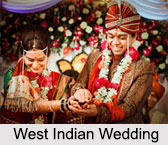
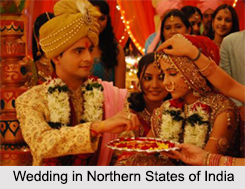
North Indian Weddings
The North Indian Weddings have their own style of grandeur and magnificence and has gained immense popularity across the nations. Apart from the grandeur that is attached to the north Indian Weddings, another important feature of North Indian weddings is their loyalty to customs and traditions. North Indian Weddings have a lot of common features with the other parts of India. North Indian wedding traditions include many rites and rituals performed on the main day.
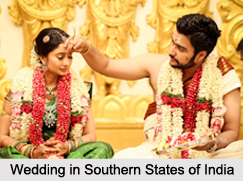
South Indian Weddings
The most striking of the South Indian Weddings are its flowers and fragrance. The gates of the wedding hall are decorated with full-grown plantain trees. The significance of mango leaves festoons is an evergreen relationship between the couple. Notes of Nadaswaram are recited loud and clear to suggest that the union is scared and divine. Kolam designs are made at the doorsteps to display the colourful and the happy mood of the occasion. A hearty welcome is given to the guests who arrive for the function by sprinkling rose water on the guests and offering of flowers to female guests.
East Indian Weddings
 The East Indian weddings strictly adhere to the Vedic rules and regulations instructed. The states like West Bengal, Bihar, Odisha and Jharkhand reflect the most important rituals and traditions of East Indian marriage. In the East Indian weddings, the rituals and traditions are thought to be the principle component of marriage. The east Indians strongly believe that "Grihastha Ashram" or the householder stage, the second of the four stages of life, as per the Vedas, begins when a man and a woman enter the holy bond of matrimony to start a household. In case of East Indian marriages, the only way to continue the family and thereby repay his debt to his/her ancestors is marriage. East Indians believe that marriage is essentially a path towards spiritual growth.
North East Indian Weddings
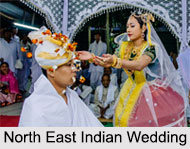
The wedding ceremonies of the North East India are full of interesting rituals and customs which make the wedding unique, elaborate and colourful. The marriages in these states demonstrate the cultural diversity and beliefs of the tribal people. The women of the North East belonging to the hills or otherwise hold an honourable position in the society. They have far greater freedom in marriage, divorce and other matters in comparison to that of a traditional Hindu society.
West Indian Weddings
The West Indian weddings reflect the collective culture of the Indian states like Gujarat, Maharashtra and Goa. The culture of West India may be different but the wedding rituals are more or less similar to the rest of the nation. In West India there is no greater event in a family than a wedding.
Hence it can be concluded saying that India witnesses different types of nuptial knots based both on religion and region but all forms of marriage render the spirit of celebration and happiness among members of the community.
Types Of Indian Wedding
Types of Indian Weddings are varied across the subcontinent. Indian weddings are witnessed with a variety of marriage ceremonies based on religion as well as region.