


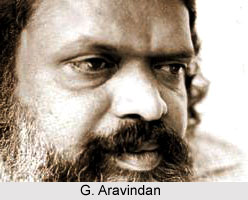
 G. Aravindan is described in India as a "philosopher-poet of the Seventh Art" owing to the meditative dimension of a work that gets renewed thematically each time, in the course of the solitary career, which did not especially worry about the reactions caused by his films. His films are pervaded by a spiritualistic visual lyricism rooted in Indian religious traditions. G Aravindan's humanistic vision is uncompromising. The filmmaker clings to the inner world of beings while putting back cinema among other forms of art, painting, dance, drama, literature, etc. in his career span G Aravindan has directed 11 films. G. Aravindan is described in India as a "philosopher-poet of the Seventh Art" owing to the meditative dimension of a work that gets renewed thematically each time, in the course of the solitary career, which did not especially worry about the reactions caused by his films. His films are pervaded by a spiritualistic visual lyricism rooted in Indian religious traditions. G Aravindan's humanistic vision is uncompromising. The filmmaker clings to the inner world of beings while putting back cinema among other forms of art, painting, dance, drama, literature, etc. in his career span G Aravindan has directed 11 films.
It was almost by chance and under peer pressure of his friends of the Calicut Film Society that the inexperienced Aravindan made his first film, Uttarayanam in 1974. It is about a disillusioned youth, Ravi, who discovers that the idealism of the nationalist struggle has given way to cynicism and selfishness. Disappointed with everything he leaves for the mountains to find some peace in nature and mysticism. His next project was Kanchana Sita (1977). The film was based on a play by the contemporary Malayalam playwright, CN Sreekantan Nair, taken from the great popular epic, the Ramayana. Kanchana Sita is a visually dazzling film illustrating this long mythological episode potentially rich in dialogue but of which G Aravindan has chosen to make a non realist, virtually silent and contemplative film by calling up a tribal population to portray the mythological characters. Described as avant-garde, Thampu (1978) is an amazing film in black and white supported by a quasi-documentary look, profoundly humanistic and supported by superb poetic images of Shaji Karun at the camera. The film has superb performances by one of the great Malayalam actors, Gopi. The narrative remains focused on tiny events, marking the social and cultural and social realities of the village. Based on popular tales of Kerala and sometimes catalogued under films for children and adolescents, Kummatty (1979) by G Aravindan is an imaginative creation full of charm. It portrays a well-known type of legendary itinerant magicians. His next film was Estheppan (1979-80). It is a fascinating and strange movie, which borders on the popular tale and on myth to try to define Estheppan, an enigmatic character credited with having lived at different epochs. Refusing to endow him with an identity of his own the film interwar eaves several stories. One of Aravindan's most poignant films and the most difficult to understand is Pokkuveyil (1981). It has been conceived as a single 'raga', intentionally monotonous by engaging itself into a non-narrative. Literally the raga is the state of mind which gives rise to feeling in music and art. Supported paradoxically by splendid colours, Pokkuveyil accounts for the drift of Balu, a sensitive young man and a poet, towards withdrawal into himself and abstraction, in particular, during his long, solitary and restless wanderings alongside the lagoons of Kerala. The entire story is constituted on flashbacks. Chidambaram (1985) is the name of a town in Tamil Nadu. It is famous for its temples as it was here that Lord Shiva manifested himself in the form of 'Nataraja'. It is a superb story of passion and betrayal which ends tragically. The film is a reflection on the beauty and the sensual power of nature as well as a profound philosophical reflection about what is real and what is illusory in life. The film stars Suresh Gopi and Smita Patil. In 1986 G Aravindan released Oridathu (1986). It is a Malayalam film in which episode follows episode as in a comic strip. Humour and intensity characterise this fable that is set in 1950s, just after the Independence of India. Another film, Vastuhara (1990), his last film, saw a change in theme from his regular style. The film's cast comprised one of the greatest Malayalam actors, Mohanlal. His other films are Marattam and Unni. The individualistic style of G Aravindan established him as one of the greatest exponents of Malayalam as well as Indian cinema. |
| |||



Home > Movies & Entertainment > Indian Movies > Movies in India > Indian Movie Directors > G Aravindan
G Aravindan
| G. Aravindan`s films are pervaded by a spiritualistic visual lyricism rooted in Indian religious traditions. He is described as "philosopher-poet of the Seventh Art" as his work reflected renewed thematically each time. |
| ||||||||||||||||||||||||||||

