 The history of Assamese drama begins with the plays of Sankaradeva (1449-1568) written in the early sixteenth century. These plays are popularly known as Ankiya Nats and their staging is known as bhaona. Anka and nat both means nataka. Sankaradeva has to his credit six plays written between 1518 and 1568. They are Patni Prasad, Kali Daman, Keli Gopal, Rukmini Haran, Parijat Haran and Ram Bijoy. The inspiration for the plays was drawn mainly from the Bhagavata except for the last play, Ram Bijoy the theme of which is drawn from the Ramayana. He has not deviated from original sources in any play, but has only added some minor incidents here and there to produce local colour and necessary dramatic effect. Before writing these plays Sankaradeva is said to have organized a dramatic performance.
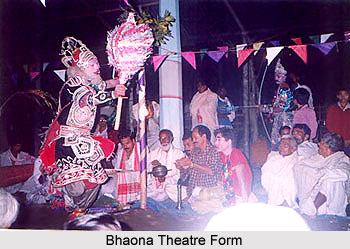
Ankiya Nat or Bhaona, the neo-Vaishnava Assamese theatre form, is intimately connected with the distinctive genre of vernacular drama created by Sankaradeva in the sixteenth century, which had originally been variously called Yatra (processional), nata (play), and anka (a single act). Later this came to be designated as Ankiya Nat. Bhaona represents the applied aspect of plays written on the Ankiya Nat model. Although the tradition of writing such scripts has continued since the days of Sankaradeva and Madhavadeva, who followed in his footsteps, normally only plays written by this duo are accepted as Ankiya Nat proper. The presentation of such drama in the orthodox style is called Ankiya Bhaona, whereas that of any other play written in the same format and staged in near-identical fashion is called simply Bhaona. The language of the typical Ankiya Nat is Brajabuli that is locally called Brajawali. Nowadays, however, plays are often written in contemporary standard Assamese and their production popularly termed matribhashar i.e. of the mother tongue or asamiya i.e. Assamese Bhaona.
"Ankiya" means one act and "Nat" means drama. These one-act plays are characterized by the glittering white costumes of the orchestra and the rather fanciful effigies of demons and animals. In Ankiya Nat, performance begins in the morning with singing and dancing to the music of drums, the entourage emerging from the "Agni-Gad" i.e. archway of lights opposite the shrine. After the distribution of prasada or sacred food to the musicians, the "Sutradhar" or narrator makes his entrance, and after paying his respects to the god, recites a verse from the play at hand and presents a song.
The participants perform this art form by wearing large masks of gods, goddesses, demons and animals. The masks used for plays are huge in size, sometimes reaching up to the waist of the performer. Some masks are even of size up to 15 feet in height, which give a huge look to the overall theatre performance. Artists are required to give appropriate movement to their individual masks, since they have to enter inside a mask and take overall weight on their shoulders. The masks contain thin clothes in the front to enable the artists to see through them. Due to the heavy weight and almost immobile nature of these masks, the characters depicted by them are usually restricted to demons and snakes having very limited movements.
The theme of Ankiya Nat should be related to Krishna. Only after Lord Krishna has appeared on stage and danced across to the shrine can the play begin. The events are those of Lord Krishna`s life and the actors who play Krishna and Balaram i.e. Krishna`s brother are believed to be temporarily possessed by the gods. The Sutradhar remains on stage to prompt the actors and explain events to the spectators. Giant effigies of demons and animals are made out of bamboo and covered with painted papier-mache. These figures can be as tall as 15 feet and need several actors to manipulate them. Animal masks are worn as well. Religious occasions of any kind are sufficient reason to stage an Ankiya Nat such as Krishna`s birthday "Janamashtami". This is the memorial day of the saint Sankaradeva and a full moon night.
Scholars like Kaliram Medhi, Birinchi Kumar Barua, and Maheswar Neog have convincingly asserted that in formulating the Ankiya Nat genre, Sankaradeva must have drawn elements from indigenous theatrical and semi-theatrical institutions like Dhuliya and Oja-Pali, and integrated them with classical Sanskrit dramatic ideals. In this he must have been steeped, as an erudite scholar in Sanskrit language. The plays, however, exclusively deal with mythological or legendary stories connected to the various avatars of Vishnu, since Sankaradeva`s express purpose was to propagate Vaishnavism as well. Ankiya Nat is a dance-drama in which vernacular songs and dialogue are interspersed with slokas and other pieces in Sanskrit literature. No as such act or scene divisions are there. The various components are strung together through the activities of the sutradhara, who plays a pivotal role throughout. Sutradhar introduces the theme, announcing entrances and exits of the characters, explaining the different situations, leading the benedictory singing, and so on. The characters enter and exit with typical dance steps; dialogues are delivered in a conventional stylized manner along with dance-like movements. Previously, it was customary for young boys to take women`s roles. While benedictory pieces occur at the beginning and end, songs or geet set to specific ragas and talas come at frequent intervals.
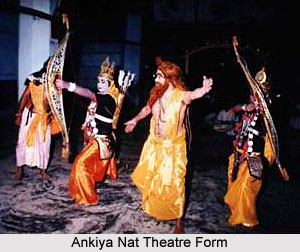 The orchestra, known as gayati-bayan i.e. "singers and instrumentalists", not only provides musical accompaniment and effects but also is responsible for the elaborate preliminaries. Lighting used to be provided by chandeliers, torches i.e. ariya, mahald, and pyrotechnic devices i.e. mahata or mata, but Petromax pressure lamps and electric lights are freely available today. While the use of masks for demons and animals is very common, often elaborately crafted effigies and accessories are utilized, so the green room is called cho-ghar. According to some hagiographic biographies, Sankaradeva staged his first drama, "Chihna-Yatra" against the backdrop of painted scenery depicting the heavens i.e. vaikuntha. However, the text has never been found, and scholars believe that the presentation was more like a tableau, without any written text. In any case, painted scenes have not been a feature of Bhaona in the remembered past.
The venue for Bhaona is usually the nam-ghar or occasionally a temporary structure i.e. rabha. Regular rehearsals sometimes extending to over one month begin with a formal ceremony called nat mela. In some villages of Sonitpur and Nagaon districts there is an unusual vogue of organizing Bhaona on a grand scale. A number of troupes sometimes over twenty present separate performances simultaneously in different arenas under a single huge canopy specially erected for the purpose. This is known as Baresahariya i.e. "from various towns" or Hejari Bhaona. Such occasions offer a grand spectacle put up by the collective efforts of a cluster of villages, and also serve as big fairs. Although in the orthodox neo-Vaishnava circle Bhaona is a ritual and act of piety, it is seen more and more as an art form, and adapted for the proscenium theatre and modern audiovisual media. Gahan Chandra Goswami was a leading performer, winning the Sangeet Natak Akademi award in 1969.