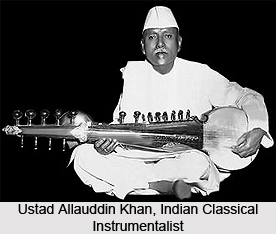
Ustad Allauddin Khan, Indian Classical Instrumentalist - Informative & researched article on Ustad Allauddin Khan, Indian Classical Instrumentalist
  Indianetzone: Largest Free Encyclopedia of India with thousand of articles Indian Music


in  
Art & Culture | Entertainment | Health | Reference | Sports | Society | Travel
Forum  | RSS Feeds  | Free E-magazine
Indian Music : Indian Music l Traditional Indian Music l History of Indian Music l Indian Musicians l Gharanas Of Hindustani Vocal Music l Bollywood Music l Pop music l Western Music in India l Indian Classical Instrumentalists l Indian Music Bands l Indian Classical Vocalists l Indian Musical Instruments l Raaga
Home > Movies & Entertainment > Indian Music > Indian Classical Instrumentalists > Ustad Allauddin Khan
Ustad Allauddin Khan, Indian Classical Instrumentalist
He is truly a divine-incarnate to have mastered so many musical forms in just one lifetime.

Ustad Allauddin Khan is a legendary human to have ever brushed across the Indian classical musical genre. With an early life, as good as a novel, it had contributed much to what he had become in his later years. By his terrible attachment to music, he fled from home and parents and landed up in Calcutta on the footsteps of Nannu Gopal, under whom he trained for a long period. Evading marriage, Allauddin, by his sole determination to reach the top, he came in touch with Amritlal Datta, and ultimately Ustad Wazir Khan, the then legend in the classical arena. The Ustad was hugely aloof and indifferent towards Allauddin, but he was not a man to give up so easily. He triumphed in arresting the Ustad`s attention, and through rigorous and exhaustive training, Allauddin was successful in capturing every subtlety to heart. Baba, as he is called by his students, was not only a master of sarod, he had absorbed every form of classical music - vocal and instrumental. He regarded musical sadhana as life and was totally devoted to it like venerating the Almighty. Whatever he touched turned to gold, enthralling and enrapturing every listener.

Ustad Allauddin Khan, Indian classical instrumentalistUstad Allauddin Khan, or Baba as he was referred to, by his students, was not only oen of the greatest sarodiyas of this country, but also an innovator and teacher of genius. He is the founder of the Senia-Maihar gharana, one of the greatest gharanas of instrumental music of the 20th century. A superlative musician, an amazing personality, a moulder of students of genius, Baba Allauddin Khan has been hailed by all who knew him as a saint-musician.

Though a Muslim by birth, Baba`s forebears, who hailed from Tripura, were Vaishnavites and vegetarians. His father was an ardent devotee of Shiva as also a sitarist, who learnt under Qasim Ali Khan of Senia gharana. His unworldly father remained immersed in the world of music, whiel his more pragmatic mother ran the household. Having heard the strains of sitar right from his childhood, the tone and rhythm of Hindustani classical music mingled with Baba`s blood-stream. He was sent to the local school from his fifth year; but the lad`s mind was in the world of melody. His gradual aloofness from studies and absentmindedness on his way to school infuriated his mother, was prepared to thrash him, but was forbade by his father, who sensed his son`s hidden inclinations. Allaudidn Khan was compelled to attend classes from this point on, yet he soon resumed his old habit of spending his time immersed in music and sitar. And, this time he was soundly beaten by his mother. Some time later she fell ill; but soon after she recovered, the young Allauddin ran away from home at the age of 11.

He reached Calcutta, and with a bit of luck, became a student of Nannu Gopal, a leading singer in the city. The guru accepted the lad on the condition that he would do what he bid him to for the next 12 years. A stern teacher of the old cast, Nannu Gopal would make students practice raaga scales or about eight years to make their voices flexible. Allauddin was a keen student and picked up what his teacher taught him swiftly. However, he was traced by his brother, and was yielded to return back home. Baba had to consent, where he came to know about his family`s secret wish to marry him off, and again scampered away from home on his wedding night. However, on coming to Calcutta, he was shocked to hear about his guru`s untimely demise.

Allauddin Khan soon turned to Amritlal Datta, one of Swami Vivekananda`s brothers. A versatile musician, Amritlal was proficient in several instruments. He arranged for Allauddin to be taught the violin, the shenai and the clarinet. During one of his tours, he happened to hear the sarod recital of Ustad Ahmed Ali Khan and was deeply drawn to the instrument. After the recital, he fell at the Ustad`s feet and refused to get up until the latter had accepted him as his disciple. After a great deal of persuasion from the people gathered there, Ahmed Ali very reluctantly accepted him as his disciple. But Allauddin soon realized that the Ustad had no intention of teaching him a thing. Through a series of misunderstandings and phases of furiousness, Allauddin soon vowed to become the student of none less than Ustad Wazir Khan, the brightest jewel in the Rampur court. Ustad Wazir Khan, who traced his lineage back to Tansen, was, during the early part of the 20th century, considered to be the greatest musician and instrumentalist in North India, as also the favourite of the nawab. After reaching Rampur, Allauddin Khan tried in vain for nearly five months to meet this regal musician. But, his every effort proved futile, as the Ustad, being the traditional cast, passed in his knowledge to his progeny and close relatives only. Allauddin was now at the end of his tether. He had dreamt of attaining perfection under the greatest gurus, but bow all avenues to that distant goal seemes closed. He thus resolved to end his life, but was forbid by a kind-hearted moulavi of the nearby mosque. Thus, through a series of remarkable incidents, Allauddin was able to draw the attention of the Nawab, who was naturally mesmerized by Baba`s versatility both in vocals and instruments. He personally suggested Baba to the Ustad. However, Baba could very well notice Ustad Wazir Khan`s coldness towards him, because he was outside the Ustad`s familial purview. This did not deter him from pursuing after his aim to turn the master musician.

In the meantime, the girl who was married to Allauddin was morose and depressed much, at her husband`s bizarre attitude, and thus addressed a letter straight to the Ustad himself, who was shocked to read it. He immediately summoned Allauddin and rebuked about his behaviour with his newly wedded wife. However, Allauddin finally let out his secret of vowing celibacy to not touch any woman until his sadhana was fulfilled. And his ultimate decision depended on the Ustad`s decision, whether to tutor him or not. Deeply moved by Baba`s resolve, Wazir Khan immediately gave orders ot his sons to thoroughly train Allaudidn in the traditions of his gharana. What followed for the next five years was intense musical tapas. Wazir Khan personally instructed him from time to time. Allauddin steadily mastered the master idioms of the gharana and soon flowered into an expert sarodiya. Pleased with his mastery, the guru instructed Allauddin to undertake a tour through all the courts and absorb the best from all that heard.

After long tours, Allauddin arrived in Calcutta, where the King of Maihar heard him and immediately hired him as a court musician and also became his student. Maihar was a small princely state in Madhya Pradesh and Allauddin Khan moved to the court. His long-cherished dream of becoming a master musician was realized when he had reached a matured age. And, during this point of time, his brother immediately brought Allauddin`s first wife over to the court and Baba gladly accepted her. He was now ready to start a family. His wife, Madina Begum, though not from a musical family, was much inclined to singing. She was tutored by her husband, who was greatly amused by her `free` style of playing. In this manner, their children came to being, among whom were the tow greatest instrumentalists the 20th century had ever seen - Annapurna Devi and Ali Akbar Khan. Through rigorous training he made both of them into outstanding instrumentalists. Through a series of exceedingly painful happenings, Baba was literally shattered. But what prompted him to go on with his life was his single-minded devotion to god and music. When transported to ecstasy during performances, he would utter divine chants like `Allah Allah`, `Ma, ma` or `Ram, Ram`. But Allauddin Kahn`s saintliness was not confined to his spiritual beliefs alone. He led a simple and austere life, who never chased wealth. He only considered the disciples he moulded to be his sole treasury. All that he looked for in a disciple was arhata or worthiness to accept the rich legacy he so lavishly lent with both hands. All his great disciples like Ali Akbar, Ravi Shankar, Annapurna, Bahadur Sen and in his later years, Nikhil Banerjee, Timir Baran Bhattacharya, Pannalal Ghosh, Indraneel Bhattacharya and Jitendra Pratap bear testimony to this fact.

Baba had made a few recordings. Of these, a good number of the longer recordings are releases from the AIR archives, brought out by T-Series. Unfortunately, they were recorded in his extreme old age and show signs of fatigue. He had a supreme command over all forms and aspects of Hindustani music. Be it dhrupad, dhammar, khayal, light classical forms and all kinds of musical instruments, Indian and Western, Baba was their indisputable master. This wide-ranging musical instinct prompted him to pick up a relatively minor raaga like Revathi from the Karnatic tradition and adept it to the North Indian style as Bairagi. He even went on to pioneer a musical orchestra at Maihar, which survives to this day. Baba also created a few raagas. Of these, Hemant and Hem-Bihag remain popular with all his students. Allauddin Khan also possessed an immense knowledge of the rhythmic components of Hindustani music. In fact, he was one of the first instrumentalists who revived and popularised rhythmic cycles like roopak, jhap, matta and dhammar taals in concerts. This historical personage of Indian classical music is reputed to have crossed 100 years at the time of his death. His life and music combined the simplicity and depth that befits a Sufi saint.

(Last Updated on : 7/01/2009)
  More on Indian Classical Instrumentalists...
 
Ustad Zakhir Hussain Kanchipuram Nayana Pillai Ustad Zia Mohiuddin Dagar
Ustad Asad Ali Khan Ustad Imrat Khan Pt. Nikhil Banerjee
Ustad Vilayat Khan Ustad Allauddin Khan Ustad Ali Akbar Khan
Ustad Amjad Ali Khan Ustad Bundu Khan Pt. Ram Narayan
Pt. Pannalal Ghosh Ustad Bismillah Khan Pt. Shiv Kumar Sharma
Pt. Ravi Shankar    
Recently Updated Articles in Indian Music
  • Indian Classical Music
    Indian Classical music originated in the Vedas and later branched into two streams of Carnatic and Hindustani music.
  •  
  • Music in Medieval India
    Music in medieval India has great impact in the history of Indian music.
  •  
  • Music In Modern India
    Music in Modern India has developed in almost all aspects and a new genre has been introduced.
  •  
  • Indian Music Bands
    Indian Music Bands have created an upheaval of modernised music and concerts among the young generations of the nation.
  •  
E-mail this Article | Post a Comment
Free E-magazine
Subscribe to Free
E-Magazine on Indian Music

 
Ustad Allauddin Khan, Indian Classical Instrumentalist - Informative & researched article on Ustad Allauddin Khan, Indian Classical Instrumentalist
Sitemap
Contact Us   |   RSS Feeds
Copyright © 2008 Jupiter Infomedia Pvt. Ltd. All rights reserved including the right to reproduce the contents in whole or in part in any form or medium without the express written permission of Jupiter Infomedia Pvt. Ltd.
