


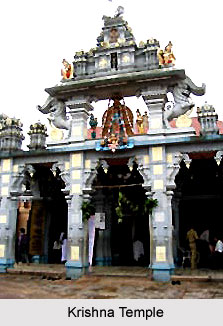
 Udupi is one of the seven Mokshapuris and highly revered in the land of Parasurama. This holy city is accessible from Mangalore, Hassan and Dharmasthala. The sacred idol of Lord Balagopala installed by Sri Madhwacharya was originally worshipped by Devi Rukmini in Dwaraka in the Dwapara Yuga. Udupi is one of the seven Mokshapuris and highly revered in the land of Parasurama. This holy city is accessible from Mangalore, Hassan and Dharmasthala. The sacred idol of Lord Balagopala installed by Sri Madhwacharya was originally worshipped by Devi Rukmini in Dwaraka in the Dwapara Yuga.
The tales from Puranas narrate that the advent of Lord Krishna to this divine land is dramatic. Long ago, once when Sri Madhwa was meditating near the Malpe Beach (5 km from Udupi), he saw a ship in danger due to severe storm. He saved the ship by his yogic power. As the Swamiji knew beforehand that the ship carried the idols of Krishna and Balarama, he accepted Gopi Chandana pieces that the ship's captain offered. He installed the Balarama idol in Vada Pandeshwara village near the shores and the Krishna idol at Udupi near the Chandramouleeswara shrine. The idol of Krishna holding the churning rod in one hand and the rope in the other with a smile on his lips envisages the childhood pranks of the Lord in His Gokul days. Krishna is believed to have asked Viswakarma to make this idol for Rukmini, who adored it till the end of Krishna avatar. Arjuna had later hidden the image in the gardens of Dwaraka. It reached Udupi in course of time along with Gopi Chandana. In ancient times, Udupi was known as Sivalli and Rajathapeetapuram. According to a legend, Chandra, the Moon God, who did penance in a forest here, was redeemed from the curse by Daksha Prajapati. In Sanskrit, 'Udu' means star and 'Pa' means leader. As Chandra was the head of the stars the place came to be known as Udupi. Lord Shiva is worshipped as Chandramouleeswara. The shrine opposite to Krishna temple enshrines the Swayambu Lingam. The Lingam changes colour thrice during the day-- black in the morning; blue at noon and white at night. The temple tank is known as Chandra Pushkarni or Madhwa Sarovar. There is another temple dedicated to Lord Ananteswara. When Parasurama redeemed the land from sea he crowned his devotee Ramabhoja as a king of this land. He performed Ashwamedha Yagna on this holy soil. While ploughing the land prior to the yagna, he killed a snake accidentally. To redeem himself from 'Sarpa dosha', he made a silver peetam (Rajatha Peetam) with images of snake carved on it. Hence the name of the place is Shivalli or Shiva-belli. In the sanctum, Parasurama is worshipped in Linga swaroopa on this silver peetam as Ananteswara. There is a 40 foot high Deepa sthamba outside the shrine. Udupi is also considered the seat of Vaishnavite cult. The Advaita Siddhanta of Sri Madhwa is propagated as a glorious tradition by the 8 mathas established by the Guru at Udupi. These are Palimar Matha, Krishnapura Matha, Sothe Matha, Puthige Matha, Sirur Matha, Kaniyur Matha, Admar Matha and Pejawar Matha. The heads of these mathas take full responsibility of the various pujas and rituals of Sri Krishna Temple. Only Bala Sanyasis are selected to head the mathas and perform the religious rituals at the temple. Each of the eight mathas is given a 2 year term by turns in service of Lord Krishna. The Paryaya festival, the most important one in the temple, is held once in two years around January. During this there is a ceremonial change of the head priest, called the Paryaya Swamiji. A unique feature of Sri Udupi Krishna Temple is that the Lord is worshipped only through a window with nine holes (Navagraha Window). It is fully silver-plated and exquisitely carved. Situated to the west of this is the Kanakadasa Mandap. When Kanakadasa came to this village he could not enter the Krishna shrine because he belonged to a low caste. He continued to worship the Lord, standing outside and singing His glory. One day, to the surprise of all, the western wall gave way on its own and the Lord's image turned towards this opening. Kanakadasa had the special privilege of worshipping Sri Krishna in full view. Since then the tradition here has been to worship the Lord only through the window. From this window outside, one can any time have a good darshan of the Lord. The day at Udupi temple begins at 4 a.m. to the accompaniment of conch and Nagari sounds and Vedic chants. A series of pujas and abhishekas are performed to the Lord. Evening pujas start at 4.30 p.m. These include Samara Seva, Ranga Seva and Seevili Seva. The deity is then kept on a silver palanquin and taken in a procession round the sanctum. This is known as Ekantajpuja when the Lord is kept on a silver bed. Other temples here include Chenna Kesava Shrine. This shrine is situated behind the sanctum. Here the Lord is seen with Shankha, Chakra, Gada and Lotus on His hands, as He gave darshan to Kanakadasa. Behind this is the eastern entrance of the sanctum which is opened only on Vijayadasami day. On the prakaras, there are images of Garudalwar and Hanuman. The two prakaras, Suryachala and Chandrachala, are used for cultural and religious purposes. A Tulsi Brindavanam, situated near the Dwajasthamba, is held in high reverence. Sri Madhwa shrine: The shrine of the founder of Udupi temple is situated next to the sanctum. There are images of Sri Vadiraja and Lord Subramanya on the outer prakara. The silver Simhasana, used by Sri Madhwa, is held very sacred. Only the Paryaya Swamiji will be seated on this while blessing the devotees. Madhwa Sarovar: The holy Ganga is said to appear in this tank once in 12 years. During January, a 7 day grand festival, is celebrated. It is known as Saptotsava. These include daily car and float festivals. On Makar Sankranti day, 3 Rathas carrying the images of Krishna, Chandramouleeswara and Ananteswara are taken out in processions. The 7th day car or ratha is known as Brahma Ratham. On this day all idols are kept near the Krishna image and all the eight Matathipathis perform pujas and the ritual of Aarattu (holy dip of the images) in 'Madhwa Sarovar'. Golden flowers are showered on the idol of Sri Krishna. This is known as 'Swarnotsavam.' The practice of arranging timber in the form of enchanting chariots is peculiar to Udupi. The other festivals include Laksha Deepa, Tulsi Puja, Madhwa Navami, Navaratri, Deepavali, Krishna Janmashtami and Sri Ramanavami. Shakti and Subramanya Temples: King Ramabhoja established 4 Shakti temples and four Subramanya temples at Sivalli. The Shakti temples are at Puttur, Kannarpadi, Bailur and Kadiyali. The Subramanya temples are at Tangodu, Mangodu, Aritodu and Muchilkodu. Durga Shrine: There is a shrine dedicated to Durga on a hillock. This particular pilgrim center is around 5 kilometer from Udupi. Indra's consort Shashidevi is believed to have performed penance here. Paajaka Kshetra : This is the birthplace of Sri Madhwacharya, situated 12 km from Udupi. Sri Madhwa is also considered a reincarnation of Hanuman. There are shrines for Bheema, Pancha Pandavas and Vayu. Subramanya Temple: The Lord Subramanya Temple is situated in picturesque surroundings. The sacred hill is known as Kumara Parvat and rivers Kumaradhara and Tharpana originate here. In the sanctum, Lord Shanmukha is seated on a peacock. Images of Vasuki and Adi Sesha are installed below the lord. The sanctum is full of ant hills. A Garuda sthamba, installed in front of the sanctum, is believed to ward off the poisonous breath of Nagas. There are shrines dedicated to Lord Uma Maheswara and Kukke Lingam (basket). According to a legend, a basket full of Lingams was once found here, which gives this place the name of Kukke Subramanya. There is a Narasimha shrine of great importance in this temple. Images of Vittal, Rukmini, Lakshmi Narasimha and a box with Saligramams are worshipped. The Saligramams are said to have been given by sage Vyasa to Madhwacharya. He gave them to his disciples. The box is always kept closed. There is a Madhwa matha in the shrine too. Legend says that Garuda was once chasing Vasuki, the Naga king, who took shelter in a cave. Lord Subramanya gave protection to Vasuki. It is said that even today, Garuda is never seen in this place except during the Ratha Festival, when the divine bird is seen circling the car thrice. Adi Subramanya Shrine: This ancient shrine is on the other side of river Tharpana. The Lord is said to have done penance to get rid of the sin of Brahmahatti (annihilation of Tarakasura). Lord Subramanya is worshipped in an ant-hill and mirrors and idols of Naga are offered. Shashti, Vaisaka and Narasimha Jayanti are major festivals. Naga Shanti and Sarpa puja are special offerings in the temple. |
| |||



Home > Reference > Indian Temples > Indian Regional Temples > South Indian Temples > Temples of Karnataka > Temples in Udupi
Temples in Udupi
| Udupi is one of the seven Mokshapuris and is famous for its temples. |
| ||||||||||||||||||||||||||||

