Tatah animadi pradurbhavah kayasampat taddharma anabhighatah ca
This is the forty-sixth yogic sutra, which is incorporated in the third phase of the Patanjali Yoga Sutras.

Share this Article:

Tatah animadi pradurbhavah kayasampat taddharma anabhighatah ca, Patanjali Yoga SutraThe forty-sixth yogic sutra states about the supreme power acquired by a yogi, who has the ability to act, transform or move as he wishes to. In other words, he has perfected his body to every kind of experience. By concentrating on the elements solely, (samyama), their characteristics, foms, concurrences, a yogi gains the eight supernatural powers to attain perfect health. He is never a slave to the elements, and uses it to his own will. None of the five elements of nature (earth, water, fire, air, ether) can hamper him anymore, as he is a master of them all.

tatah from it, thence
animadi powers such as minuteness and so forth
Pradurbhavah manifestation, appearance
kaya of the body
sampat perfection, wealth
tad their, of them
dharma attributes, functions
anabhighatah non-resistance, non-obstruction, indestructibility ca and

From that arises perfection of the body, the ability to resist the play of the elements, and powers such as minuteness.

The yogi can reduce himself to the size of an atom, or even expand. He can become light or heavy. He can cut through rocks, have access to everything and master anything.

From samyama on the elements, their counterparts, forms, conjunctions and fruits, the yogi develops the eight supernatural powers and gains perfect wealth of the body without falling victim to the obstacles posed by the elements. This is believed to be the best wealth of the body - perfection and freedom from all hindrances.

This sutra points that by the conquest of the elements, a yogi gains mastery in three fields. The first is the acquisition of the eight supernatural powers. The second is perfection of the body, which means that earth does not grime him, water dampen him, or fire burn him. Wind cannot move him and space can obscure his body anywhere, at any time. The third is immunity from the play of the elements and their characteristics, and from the obstructions and disturbances which they create. (1.30, 31, 40; 11.55.)
Share this Article:

Related Articles

More Articles in Yoga


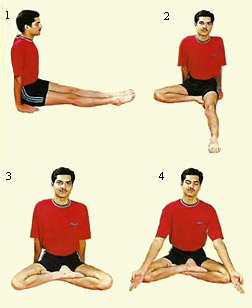
Meditative Asanas
Meditative Asanas are essentially designed to aid one’s meditation and concentration, and formed the basis for several other Asanas in creating a complete physical culture.
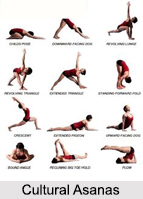
Cultural Asanas
Cultural Asanas refer to the daily physical exercise postures that train the body and mind in Yoga Practice.
Soma Chakra
Soma Chakra is a minor chakra in the seventh chakra which is located above the third eye, in the centre of the forehead.
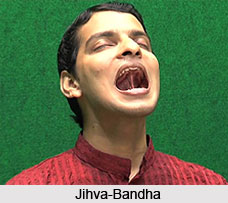
Jihva-Bandha
Jihva Bandha is one of the cultural asanas that improves the nervous and circulatory system. It means tongue-lock which strengthens the muscles of the neck and the cervical nerves.
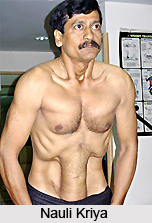
Nauli Kriya
Nauli Kriya is a cultural asana where the Yogi rotates the abdomen speedily like a rotating whirlpool.
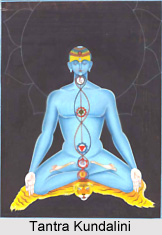
Tantra Kundalini
The Kundalini Tantra is the awakening of the vital force according to the Kundalini.
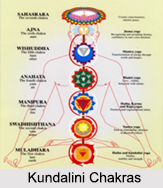
Kundalini Chakras
Kundalini Chakras are psychic energy centres or vortices, which connect between our psychic and physical energy systems.
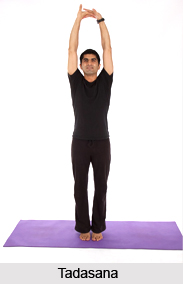
Tadasana Yoga Asana
Tadasana, or the Mountain Pose is a standing Yoga posture with feet together and hands at the sides of the body, and improves one`s height and flexibility.
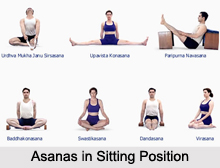
Asanas in Sitting Position
Asanas in Sitting Position help in aligning the spine and develop a sense of stability required for practice of pranayama and meditation.
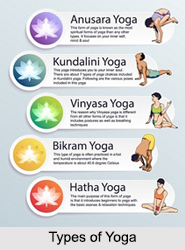
Types of Yoga
Types of Yoga benefits the practitioner mentally, physically and spiritually. However, speculating the right Yoga as per the need of an individual is very important.
Siddhasana Yoga Asana
Siddhasana is one of the most well known meditative postures, and is termed ‘the chief of all Asanas’ in the Hatha Yoga Pradipika.
Asanas in Standing Pose
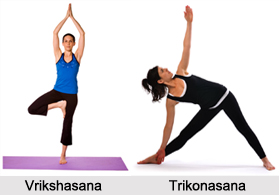
Asanas in Standing Pose are generally held for shorter times than other poses, and tend to be more energetically uplifting and opening.
Patanjali Yoga Sutras
Patanjali’s Yoga Sutras presents a foundational guide to the philosophy and practice of yoga. Through concise aphorisms, it outlines the nature of the mind, the eightfold path of discipline, and the means to attain inner stillness. Its teachings continue to inspire modern yoga, meditation, and spiritual exploration.
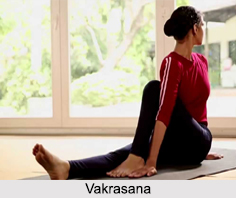
Vakrasana - Yoga Asana
Vakrasana is a simplified form of the Ardha Matsyendrasana, an asana named after Matsyendranath, the founder of Hatha Yoga. It stretches the thigh and tones the abdomen.
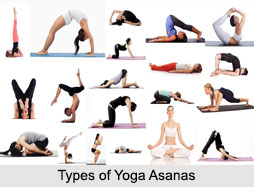
Types of Yoga Asanas
Types of Yoga Asanas are stated on varied bases like postures, methods and objectives. The practice of yoga asanas provides a wide range of mental and physical benefits.
Impact of Yoga on Excretory System
Impact of Yoga on excretory system is indefinable as it not only helps the particular system but the body.
Yoga Asanas
Yoga Asanas are comfortable and peaceful postures that make the physical body ready for the higher and more spiritual levels of Yoga practice.
Surabhi Mudra
Surabhi Mudra is a powerful and effective mudra that helps in breaking barriers and achieving ultimate meditation.
Yoga - Discipline for Complete Health
Yoga is the traditional physical and mental disciplines in India that aims to keep body and mind fit.
Kubera Mudra
Kubera Mudra, a form of Hatha Yoga, leads to the elevation of mental peace and physical relief by proper practice and cleanses frontal sinuses.
Asanas in Lying Position
Asanas in lying position are known as Supine pose which are helpful to relax the body as well as to strengthen the muscles.