


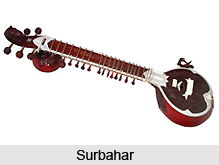
 Surbahar has an interesting legend behind it. It is said that it was made out of a man's sheer revenge force and determination. However, in practicality, the names of Umrao Khan and his disciple Ghulam Mohammed are assigned for the instrument's getting evolved in the 19th century. Though the surbahar bears much similarity to the sitar in its built and look, intricately it differs in several aspects. For instance, the smooth glide and the lingering tone on the rather loosened strings impress more upon the listener. Numerous sitarists prefer for this very reason to play their alaaps, jod and jhala sections on the surbahar. Despite shortcomings, exponents have stayed loyal to this beloved stringed instrument. Surbahar has an interesting legend behind it. It is said that it was made out of a man's sheer revenge force and determination. However, in practicality, the names of Umrao Khan and his disciple Ghulam Mohammed are assigned for the instrument's getting evolved in the 19th century. Though the surbahar bears much similarity to the sitar in its built and look, intricately it differs in several aspects. For instance, the smooth glide and the lingering tone on the rather loosened strings impress more upon the listener. Numerous sitarists prefer for this very reason to play their alaaps, jod and jhala sections on the surbahar. Despite shortcomings, exponents have stayed loyal to this beloved stringed instrument.
Surbahar is structurally quite similar to the sitar, except that it gives a deeper resonance. It is often called a bass sitar. There is a mythical story, which goes that the surbahar was designed by some instrumentalist whose request for discipleship was refused by an exclusivist rudra vainik. As an act of revenge, he thought up an instrument that had the sweetness of the sitar and the stateliness of tone of the rudra veena. Thus, this newly-fabricated instrument slowly usurped the place of the rudra veena - or so the story goes. Leaving legends apart, the surbahar as one knows today came into existence somewhere around the middle of the 19th century. The names of both Umrao Khan and his disciple Ghulam Mohammed are associated with the origins and popularisation of the surbahar. Ghulam Mohammed, in his turn, trained his son Sajjad Muhammed, who proved to be a matchless player of the instrument. The surbahar is more than 130 cm (51 inches) long, uses a dried pumpkin as a resonator, and has its neck made of Cedrela Tuna or teak wood. Its neck has very long frets that allow a glissando of six notes on the same fret by the method of pulling. The instrument has four rhythm strings, four playing strings and 15 to 17 unplayed sympathetic strings. All these strings lie on a flat bridge. The strings are played by the mizrab. Three metallic plectrums are used to play the dhrupad style of alaap, jod and jhala on the surbahar. In the first style of its playing, the instrument is played in accompaniment with the pakhawaj. Though constructed like the sitar, the surbahar's strings are thicker and more slackly drawn over the frets. These features enable the player not only to dwell on the lower octave with great effect, but also enable him to execute beautiful meends or glides with ease. The sound produced has a sustained quality given that the plucked tone does not subside easily. Some instrumentalists, especially sitarists, prefer to do their opening alaap on the surbahar as its resonant strings lend a dignity to the presentation. After doing the alaap-jod-jhala on the surbahar, they switch to the sitar to do the faster gats. Some sitarists belonging to the Imadadkhani gharana perform their alaap on the surbahar and then proceed to play the gat section on the sitar. Many rudra vainiks and sitarists were adept in this instrument until the middle of the 20th century. But after their brilliant takeover staged by the sitar in post-Independence India, it lost its commanding position in the music arena, as did the rudra veena. The modern sitar that came into being in the 1940s and 1950s could take on some of the deep tonalities offered by the surbahar. Soon the instrument lost its position as the prime instrument used for alaap and soon was compelled to take the road to extinction. Some of the greatest exponents in the 20th century include such players as Ustad Dabir Khan and Ustad Mustaq Ali Khan of the Seniya tradition. Ustad Imrat Khan is indeed another name. Pushparaj Khoshti, a disciple of Ustad Z.M. Dagar, is one of the few contemporary players of the surbahar. |
| |||



Home > Movies & Entertainment > Indian Music > Indian Musical Instruments > String Instruments > Surbahar Muscial Instrument
Surbahar Muscial Instrument
| Surbahar, though rather similar to the sitar, possesses a distinctness of its own in terms of its continuity. |
| ||||||||||||||||||||||||||||

