Brought up as Christians from infancy, they are characterised by their honourable principles and exemplary conduct and enjoy a high reputation among the Hindus and Muslims with whom they live. In the past they were land-holders, merchants and tradesmen and for their superior-intelligence and fidelity were employed in offices of trust under government in preference to others.
They are governed by a caste system which is akin to that of the Hindus which came from Goa with the early immigrants. The castes are Bamon (Brahmana), Charodi (Kshatriya and Vaishya), Sudra (artisan) and Gaudi (comprising local converts from the original fisher caste). Superimposed on this is another artificial division - that of the `refined` and the `rustic`. The members of the former, consisting of about two hundred families, live in the city, speak English and have adopted western dress and customs.
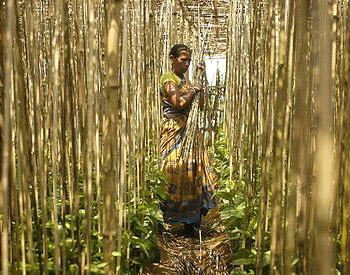
In the rural areas, they are deeply attached to farming either as tenant farmers or labourers. They have hardly any social life. Except for some parochial functions and weddings, christenings, Christmas, Easter and the parish feast are the only occasions when they have celebrations.
They eke out a frugal living on their farms and often have to supplement their income by petty trading and by sending their family members to cities for employment.
The urban members of the community are concentrated in Mangalore and are often called Mangalorean by outsiders. With the establishment of British rule, many claimed and got their property rights in the city and the district confirmed.
The prosperity of the dominant Catholic families of Mangalore since the latter half of the 19th century owed itself to the tile industry, coffee plantations and trade in plantation products. The tile industry was first introduced in Mangalore by German missionaries who kept their technology a secret and bought an entire village which had suitable clay for the manufacture of tiles. In course of time the Mangaloreans learnt the secret and so was born the famous Kannada tile industry. The tiles were so much in demand that the Portuguese from Goa would exchange gold for them.
Mangaloreans have helped set up colleges, schools, hospitals, leprosaria, T.B. sanatoria, and asylums and so on. An expansion of education without a corresponding expansion of employment opportunities combined with pressure on land in the rural areas led to the emigration of many Kannada Catholics to cities like Mumbai.
Many have been successful as trade unionists, taxi drivers, domestic servants, writers, caterers, and managers in different spheres.