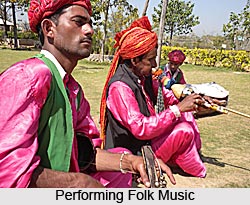
 Sarangi has its origin in the initial folk instruments of Rajasthan or the ones the Sindhis used to play. Traditionally, the name suggests a hundred hues of tonal colours. It is an extremely diversified instrument, closely resembling the human voice. This character makes the instrument a favourite of the now-a-days Sarangi concerts. Instruments resembling the Sarangi can be found among several tribes, local groups and communities in the country. Most scholars` hold that the Sarangi originated from folk fiddles, like the Kamaicha or the Sindhi Sarangi, prevalent in Rajasthan and other parts of North-Western India.
History of Sarangi
Historically, it is not until the 19th century that one gets prominent references to the Sarangi, as it exists in the present form, as the favourite accompanying instrument for Khayal and Thumri concerts. Following the eclipse of dhrupad and the confinement of Khayal in princely courts in the 19th century, Thumri rose in popular esteem. It also came to be associated with the culture of the Kothas and Nautch girls. The decline of the Kothas, from the late 19th century, owing to several social, cultural and historical factors, led to a rapid decline in the popularity of the instrument. However, it is also a fact that reputed Sarangi players taught classical vocal music to courtesans well into the 20th century; for few know the nuances of tuneful music as they do. During the later part of the 19th century, and early parts of the 20th century, several Khayal singers started using the Sarangi as their chief accompaniment. However, with the entry of the harmonium, first in Kolkata and later in other parts of the country, during the very end of the 19th century and the early part of the 20th centuries, the fortunes of the sarangi suffered an irreversible setback. Today, a majority of the established sarangi players hail from parts of Delhi, Rajasthan, Uttar Pradesh and Madhya Pradesh. In the 1970`s- 80`s, some of the gifted players to strike out on their own as soloists and help the instrument win back its lost glory on the national and international stage. In the hands of such players of genius as Ustad Bundu Khan, Pt. Ram Narayan, Ustad Ghulam Sabir Khan, Ustad Sagiruddin Khan and Pt. Gopal Mishra, and brilliant contemporary artists like Ustad Sultan Khan and the late Ustad Abdul Latif Khan of Bhopal, the fortunes of the instrument have revived considerably.
Construction of Sarangi
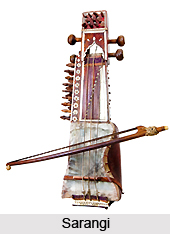
Its design and structure are not as standardized as several other instruments. Variations do exist. Yet structurally, it comprises of the deep-set belly (peth), the narrowed neck (chhathi) and the head (magaj). These parts are all made from one single hollowed piece of wood, usually the tun. The sound box or the body is covered with the skin of a young goat. The main playing strings, which are three in number corresponding to the low, middle and high octaves are made of animal gut; there is also a fourth sympathetic string made of brass. It also has as many as 35 to 40 metallic sympathetic strings running below the main playing strings. These are tuned using elaborate sets of wooden tunets placed on the side of the instrument. They are divided into 4 different "choirs". On the lowest level are a diatonic row of 9 tarabs and a chromatic row of 15 tarabs, each encompassing a full octave plus 1-3 extra notes above or below. Between these lower tarabs and the main playing strings are two more sets of longer tarabs, which pass over a small flat ivory bridge at the top of the instrument.
Playing of Sarangi
Being a fretless instrument, the player uses the base of his nail and finger tip of his left hand to stop the sound while bowing the instrument, using a horsehair bow or Gaz with his right hand. While playing, the player places the belly of the instrument on the floor or between the feet and the upper end rests on his shoulder. The coordination of the right hand bowing technique with the left hand fingering and stopping calls for great skills in synchronization. The best players are those who can harmonise both the bowing and the fingering in graceful and sustained ways.