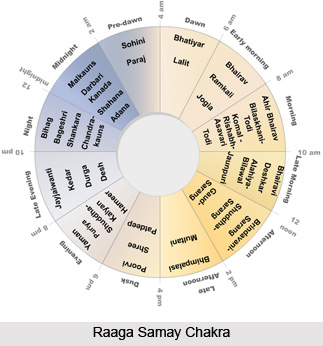
 Concept of time in Raaga is seen as a never ending cycle. It is fully reflected in the conception of matra, tala and tala chakra through which the sound expresses itself and takes a shape. Infinite sound from the inaudible or audible low pitch to the audible or inaudible high pitch is again a cycle or cycles of saptakas. Even within the human use, it is a spiral sound, the explicitness of which is seen in the treatment of the melody line in Indian music and the sama, the beginning matra in the cakra of a tala, and the balancing of the musical space.
The timelessness and never-ending circle psychology rooted in Indian thought has deeply influenced the rendering of a raaga. This is one of the defining features of Indian music, that despite being so sophisticated and complex, it is not a `fixed in time` composition. A raaga is contemplation in sound and contemplation could be as short or precise, as the utterance of aum or a word or a phrase, a mantra or a sthayi or an acara of a raaga, or it could be a contemplation unlimited in time. All Indian performing musicians are very much aware that a raaga could be as precise as a pakad or it could be rendered for any length of time; even the same raaga may be rendered for days and months together and the raaga is never exhausted, the artist may feel exhausted. At least this is the idealized position although practical or other limitations play their part. But the germinal "cosmos"- the raaga- remains stable and maintains its germ character of never-ceasing time.
Time character of rendering of raaga-music (both in Dhrupad and Khayal styles) has not changed music in spite of limitations of the disc, the tape, the measured-time broadcasts. Perhaps, raaga music is an isolated instance where "time" has still not imposed its severities. It is believed that it helps to feel the boundlessness of time and the spiritual experience of non-attachment and other worldliness. The (goals proposed in the Hindu, Buddhist and Jain religions of the world). The urge for spiritual experience has a counterpart in the psycho-aesthetic experience of non-referential pure raaga music. It requires to be added that while time-cycle conception gets mirrored in the medium of music, music imparts its own characteristics to the image of time. The art-music of raaga has a special flavour, an aesthetic-spiritual "delight", the taste (the asvada) for which is acquired through training in sensibilities.