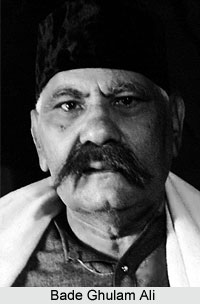
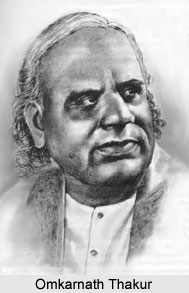
 A competent musician will always endeavor to etch the raagabhaava in the mind of the listener. Yet the plain and simple question one may ask is whether emotions inhere in swaras. Or, does the musician project and transpose his/her own emotions onto the framework of the raaga. The interpretations of Malkauns discussed earlier, illustrate that the framework of notes are fluid as they are malleable. Hence, a lyrical interpretation of the same raaga as in the case of Bade Ghulam Ali, one blazing with devotional fervour as with Omkarnath Thakur, or a contemplative one in the case of Amir Khan. The present writer`s own accounts are themselves open to dispute and dismissal, given that the affective impact of music is subjective. The underlying connections made between raaga and responses emerge wholly from the nexus between one`s cultural conditioning and the aesthetic experience.
It would be interesting, by way of comparison, to note that several 19th century Western composers like Beethoven in his Moonlight Sonata and Pastoral Symphony, Mendelssohn in his Hebrides Overture and Debussy in his Prelude to the April Afternoon of the Faun attempted to co-relate music to natural phenomena or, more precisely, represent the vividly visual and the aural in musical terms. Formal and structural devices were used to evoke mood and colour. In compositions such as these, the composers sought to make music more visual or `impressionistic` by using appropriate musical instruments to stimulate natural phenomena such as a thunderstorm, the roar and rush of swelling waves or a sultry afternoon in a forest. While Indian classical singers do resort to modes of musical impressionism and tonal onomatopoeia from time-to-time to imitate natural phenomena, for the most part raaga-music relies on poetic evocation and suggestion rather than on descriptive and mimetic effects.
 So the question of whether seasonal raagas like Mian Malhar evoke the atmosphere associated with the monsoon, or Basant summons forth images of the spring, cannot stand the test of rational scrutiny. If they do kindle the listener`s visual imagination, the credit goes entirely to the musician. The listener`s cultural conditionings, as well as the musician`s prowess for reinforcing these associations through modes of melodic coordination, create a state of tadatmya or aesthetic integration thorough complete absorption.
Moods and emotions, as mentioned earlier, are the creations of the psyche, which it projects onto the outer world. The well-known story about the legendary Tansen`s rendition of Raaga Deepak on the Emperor`s request, the consequential heat generated in his body, and his being saved by the torrential rains brought about by his daughter`s singing of Mian Malhar, may well belong to the realm of myth. Yet the crux of the story, which is often forgotten, is that both Tansen`s and his daughter`s dumbfounding raaga renditions acted on nature and brought about the desired results. Thus, emotions mould and colour one`s perceptions of nature, as of the raaga, and not the other way round.