
 Kashmiri Muslim Community forms an overwhelming part of the population of the state. It is one of the most important constituent groups of the population of Kashmir. They form a separate group of people with their own beliefs and customs.
Kashmiri Muslim Community
Kashmiri Muslim Community comprises a huge portion of the population of Kashmir. Islam first made its presence felt in Kashmir in the 13th and 14th centuries, and brought about a major change not only in the belief of the people but even in their social set up.
Introduction
Kashmiri Muslim Community forms an overwhelming part of the population of the state. It is one of the most important constituent groups of the population of Kashmir. They form a separate group of people with their own beliefs and customs.History of Kashmiri Muslim Community
Islam penetrated into the Kashmiri society when it was still ruled by Hindu kings. The subjects were adversely suffering at the hands of the then contemporary rulers and the tyranny of the Brahmins. Both religious and social changes had become an absolute necessity.
The name associated with its earliest propagation in Kashmir is that of Bulbul Shah, who is said to have visited the tract first about 1310 AD. He was a widely travelled Syed from Turkistan who had a long stay at Baghdad and was a disciple of Shah Nizamatullah Farsi of the Suhrawardy school of Sufis. He had an enormous influence on the people among whom he worked and lived.
When Sahadeva, the last Hindu king fled the kingdom following the invasion of Gaddi tribesmen from across the Banihal Pass, his army commander, Ramchandra, defeated the marauding tribesmen but was assassinated by Rinchin. The latter was another adventurer from Ladakh who, seizing power, married Ramchandra`s daughter, Kota Rani.
Rinchin was Lamist in religion but wanted to strengthen his position by adopting the religion of his new subjects and requested the religious head of the Shaivas to let him be submitted to the Hindu fold but he was curtly refused as the caste of his birth was not known.
In the early hours of the morning he heard the call of the muezzins and saw the devout Bulbul Shah at prayer. He asked to be admitted to his religion which was readily done and it was in this way that Rinchin became the first Muslim king of Kashmir and Islam became the state religion of Kashmir. But this hardly changed its political and cultural conditions, the administration remaining in the hands of the traditional official class (the Brahmins) and Sanskrit continuing to be the court language for about two centuries after the advent of Muslim rule and the medium of official communication.
Sultan Shahab-ud-din (1345-73) refused to melt the silver and copper idols of a Hindu temple for coinage. He held that as past generations had set up idols to obtain fame and earn merit, to demolish them would be a great crime. But there were religious zealots like Sultan Sikandar, Yaqub Shah Chak and a number of Mughal and Afghan governors, though their persecution of non-Muslims was resented by many local Muslims, who protected their compatriots.
Mughal rule, which brought peace and prosperity to Kashmir, completely crushed the martial qualities of the Kashmiris. The brief Afghan rule from 1753 to 1819 brought suppression and tyranny. The Sikhs, who succeeded were also hard and rough masters so were the Dogras who followed.
The name associated with its earliest propagation in Kashmir is that of Bulbul Shah, who is said to have visited the tract first about 1310 AD. He was a widely travelled Syed from Turkistan who had a long stay at Baghdad and was a disciple of Shah Nizamatullah Farsi of the Suhrawardy school of Sufis. He had an enormous influence on the people among whom he worked and lived.
When Sahadeva, the last Hindu king fled the kingdom following the invasion of Gaddi tribesmen from across the Banihal Pass, his army commander, Ramchandra, defeated the marauding tribesmen but was assassinated by Rinchin. The latter was another adventurer from Ladakh who, seizing power, married Ramchandra`s daughter, Kota Rani.
Rinchin was Lamist in religion but wanted to strengthen his position by adopting the religion of his new subjects and requested the religious head of the Shaivas to let him be submitted to the Hindu fold but he was curtly refused as the caste of his birth was not known.
In the early hours of the morning he heard the call of the muezzins and saw the devout Bulbul Shah at prayer. He asked to be admitted to his religion which was readily done and it was in this way that Rinchin became the first Muslim king of Kashmir and Islam became the state religion of Kashmir. But this hardly changed its political and cultural conditions, the administration remaining in the hands of the traditional official class (the Brahmins) and Sanskrit continuing to be the court language for about two centuries after the advent of Muslim rule and the medium of official communication.
Sultan Shahab-ud-din (1345-73) refused to melt the silver and copper idols of a Hindu temple for coinage. He held that as past generations had set up idols to obtain fame and earn merit, to demolish them would be a great crime. But there were religious zealots like Sultan Sikandar, Yaqub Shah Chak and a number of Mughal and Afghan governors, though their persecution of non-Muslims was resented by many local Muslims, who protected their compatriots.
Mughal rule, which brought peace and prosperity to Kashmir, completely crushed the martial qualities of the Kashmiris. The brief Afghan rule from 1753 to 1819 brought suppression and tyranny. The Sikhs, who succeeded were also hard and rough masters so were the Dogras who followed.
Society of Kashmiri Muslim Community
The advent of Islam changed the social structure of the people but they retained some of their old customs. Many continue to bear their old surnames - Kaul, Bhatta Mantu, Raina and Pandit, are converts from the Brahmin caste, and Dhar, Magrey, Rathor, Lone and Chak from the Kshatriya. The name `Syed` indicates descent from the Prophet Mohammad`s family and `Pirzada` descent from Sufi saints. Every village has a mullah to minister to the religious needs of the people.
Kashmiri Muslims, who are in an overwhelming majority in Kashmir, are physically a fine stock, tall and well built, with complexions varying from olive to very light, almost fair. The women are beautiful lively and intelligent and the people are full of fun and fond of amusement.
Kashmiri Muslims are as noted for their hospitality as for their hard work. Theft in the villages is uncommon and personal crime negligible.
The staple food of the Kashmiri Muslims is rice with which they eat vegetables, the favourite being the spinach hakov karam. Kashmiri dishes are famous for their variety and taste. In spite of living in a cold region, Kashmiri Muslims do not like liquor. They drink large quantities of green tea to which salt is added instead of sugar. The Kashmiri samovar is always steaming with boiling tea.
Many of the ceremonies connected with the birth of a Muslim child are akin to those followed by the Kashmiri Brahmins, such as visiting of shrines, requisitioning the aid of saints and pirs and the keeping of religious fasts by childless parents in order to be blessed with children.
When a child is born, the mullah intones the azan, welcoming the new arrival into the world of faith. Then he whispers into the child`s left ear the takbir (God is Great, God is Great, God is Great) and adds the warning that death is the end of all things. A boy is circumcised at the age of four or five. His feet are dyed with henna and the relatives and friends invited to a feast. For seven days before the ceremony, there is continuous singing and feasting.
Marriage: For a week before a wedding, festivities are held in the homes of the couple. The day before the marriage, a quantity of henna dye is sent to the bride, who paints her hands and feet with it. On the wedding day, the relatives give the bridegroom presents of money. First he and his party visit some neighbouring shrine and say their prayers and then visit the graves of his ancestors. Then they move on a procession to the bride`s house. When they are near the bride`s house, they are welcomed with songs sung by the women of the family. The nikah (wedding ceremony) follows the usual Muslim order. After the nikah, the bride is carried by her brothers or maternal uncles into the palanquin and, followed by a party of singing women, she departs with her husband.
Fairs at Astan Sharifs or the tombs of Sufi saints that are spread all over the State are very popular.
Perhaps the best example of the synthesis of the Sufi and Bhakti cults is provided by the emergence of the Islamic rishis. The founder of the order, Sheikh Nur-ud-din alias Nand Rishi is the patron saint of Kashmir and is venerated by both Hindus and Muslims. His teachings were conveyed through the Kashmiri language and have been collected and preserved in two volumes, the Rishinama and Nurmima.
A large number of Persian and Arabic works were produced by Kashmir Muslims during the medieval period. With the increasing patronage extended to the Persian language and scholarship by the later sultans, Kashmir`s poets and writers produced works of beauty, style and depth of thought. The best known of them were Sarif, Ghani, Faani and Hubbi. Considering the abundance of Persian scholars in this region, it is little wonder that Kashmir was known as Iran-i-Saghir (little Iran).
The earliest of the Persian scholars was Mullah Ahmad Kashmiri, a distinguished poet and historian. He was followed by a long line of eminent historians. Hyder Malik,Chaudura, Mohammad Azam Di-damari, Mohammed Aslam, Maulvi Hasan Shah and Mohammed-ud-din Fauq to name a few.
Two outstanding Kashmiri poets and scholars of the time of Akbar were Sheikh Yaqub Sarfi and Baba Daud Khaki. The former was also the author of several works on Suftsm, Islamic traditions and travel. The greatest name associated with Persian poetry is that of Ghani Kashmiri who won fame in his lifetime within India and Iran.
A notable contribution to the study of comparative religion and philosophy was made by Mullah Muhsin Fanni, the celebrated author of Dabistan-i-Mazahib.
The Kashmiri language is indebted to several Kashmiri Muslim writers and poets. Nand Rishi`s sayings are the jewels of Kashmiri literature. The lyrics of the great poetess, Habba Khatoon, written towards the end of the 16th century, are beautiful and much loved. During the last century, they were the prolific productions of Mahmood Garni, followed by those of Maqbool Shah Kralawari, Rasool Mir, Abdul Wahab Para and others.
The modern period in Kashmiri poetry was ushered in by Ghu-lam Ahmad Mahjur, a votary of Hindu-Muslim accord, and Abdul Ahad Azad who longed for a socialistic pattern of society.
Among the new writers in Kashmiri may be mentioned Mohi-ud-din Akhtar, Ghulam Hassan Beg Arif, Mohammad Amin Kamil, Ghulam Nabi Khayal, Ali Mohammad Lone, Rehman Rahi and Abdul Khaliq Tak.
Kashmiri Muslims excelled in producing book illustrations. Numerous Persian manuscripts are copiously illustrated with miniature paintings of exquisite beauty,
Sufism: Sufism, which predominated during this period, was partial to dance and music, believed to be essential in bringing about a state of spiritual ecstasy. The Kashmiri bafizas (danseuses) belonged to a class, of professional dancers who had to undergo a long and exacting training under competent masters. Their style of dance was popular till the beginning of the present century. The rauf, a folk dance, is performed at marriages and festivals.
A distinctive form of classical music known as Sufiana Kalam developed with its style borrowed from Persian music and its 54 magams (modes) corresponding to the Indian ragas, some of which have Indian names (like Bhairavi, Lalit and Kalyan) and others Persian (like Isfahan, Dugah, Rasti and Farsi). Sufiana Kalam is always sung in chorus.
The santoor is the most distinctive musical instrument in use. It has a hundred strings, stretched over a hollow wooden frame of mulberry wood, which are struck with two delicate little sticks, beautifully carved and slightly curved at the end. Some other instruments are the saz-i-Kashmi sitarand durka.
The Kashmiri craftsmen, among whom are many Muslims are fine artists and have a great sense of the aesthetic, colour and design. Kashmiri weavers produce beautifully embroidered woollen shawls which have been famous in many countries, particularly those of Europe.
Their other cottage industries are carpet weaving, introduced by Sultan Zain-uI-Abidin, the carpets being beautiful and famous; hand embroidery done on silk saris, table ware, bags, etc.; making of leather goods; making of patterned silver ware; of exquisitely carved objects in wood; making of hand painted articles of papier mache; weaving of silk, fine and ordinary woolen fabrics and the cultivation of saffron.
Kashmiri Muslims, who are in an overwhelming majority in Kashmir, are physically a fine stock, tall and well built, with complexions varying from olive to very light, almost fair. The women are beautiful lively and intelligent and the people are full of fun and fond of amusement.
Kashmiri Muslims are as noted for their hospitality as for their hard work. Theft in the villages is uncommon and personal crime negligible.
The staple food of the Kashmiri Muslims is rice with which they eat vegetables, the favourite being the spinach hakov karam. Kashmiri dishes are famous for their variety and taste. In spite of living in a cold region, Kashmiri Muslims do not like liquor. They drink large quantities of green tea to which salt is added instead of sugar. The Kashmiri samovar is always steaming with boiling tea.
Many of the ceremonies connected with the birth of a Muslim child are akin to those followed by the Kashmiri Brahmins, such as visiting of shrines, requisitioning the aid of saints and pirs and the keeping of religious fasts by childless parents in order to be blessed with children.
When a child is born, the mullah intones the azan, welcoming the new arrival into the world of faith. Then he whispers into the child`s left ear the takbir (God is Great, God is Great, God is Great) and adds the warning that death is the end of all things. A boy is circumcised at the age of four or five. His feet are dyed with henna and the relatives and friends invited to a feast. For seven days before the ceremony, there is continuous singing and feasting.
Marriage: For a week before a wedding, festivities are held in the homes of the couple. The day before the marriage, a quantity of henna dye is sent to the bride, who paints her hands and feet with it. On the wedding day, the relatives give the bridegroom presents of money. First he and his party visit some neighbouring shrine and say their prayers and then visit the graves of his ancestors. Then they move on a procession to the bride`s house. When they are near the bride`s house, they are welcomed with songs sung by the women of the family. The nikah (wedding ceremony) follows the usual Muslim order. After the nikah, the bride is carried by her brothers or maternal uncles into the palanquin and, followed by a party of singing women, she departs with her husband.
Fairs at Astan Sharifs or the tombs of Sufi saints that are spread all over the State are very popular.
Perhaps the best example of the synthesis of the Sufi and Bhakti cults is provided by the emergence of the Islamic rishis. The founder of the order, Sheikh Nur-ud-din alias Nand Rishi is the patron saint of Kashmir and is venerated by both Hindus and Muslims. His teachings were conveyed through the Kashmiri language and have been collected and preserved in two volumes, the Rishinama and Nurmima.
A large number of Persian and Arabic works were produced by Kashmir Muslims during the medieval period. With the increasing patronage extended to the Persian language and scholarship by the later sultans, Kashmir`s poets and writers produced works of beauty, style and depth of thought. The best known of them were Sarif, Ghani, Faani and Hubbi. Considering the abundance of Persian scholars in this region, it is little wonder that Kashmir was known as Iran-i-Saghir (little Iran).
The earliest of the Persian scholars was Mullah Ahmad Kashmiri, a distinguished poet and historian. He was followed by a long line of eminent historians. Hyder Malik,Chaudura, Mohammad Azam Di-damari, Mohammed Aslam, Maulvi Hasan Shah and Mohammed-ud-din Fauq to name a few.
Two outstanding Kashmiri poets and scholars of the time of Akbar were Sheikh Yaqub Sarfi and Baba Daud Khaki. The former was also the author of several works on Suftsm, Islamic traditions and travel. The greatest name associated with Persian poetry is that of Ghani Kashmiri who won fame in his lifetime within India and Iran.
A notable contribution to the study of comparative religion and philosophy was made by Mullah Muhsin Fanni, the celebrated author of Dabistan-i-Mazahib.
The Kashmiri language is indebted to several Kashmiri Muslim writers and poets. Nand Rishi`s sayings are the jewels of Kashmiri literature. The lyrics of the great poetess, Habba Khatoon, written towards the end of the 16th century, are beautiful and much loved. During the last century, they were the prolific productions of Mahmood Garni, followed by those of Maqbool Shah Kralawari, Rasool Mir, Abdul Wahab Para and others.
The modern period in Kashmiri poetry was ushered in by Ghu-lam Ahmad Mahjur, a votary of Hindu-Muslim accord, and Abdul Ahad Azad who longed for a socialistic pattern of society.
Among the new writers in Kashmiri may be mentioned Mohi-ud-din Akhtar, Ghulam Hassan Beg Arif, Mohammad Amin Kamil, Ghulam Nabi Khayal, Ali Mohammad Lone, Rehman Rahi and Abdul Khaliq Tak.
Kashmiri Muslims excelled in producing book illustrations. Numerous Persian manuscripts are copiously illustrated with miniature paintings of exquisite beauty,
Sufism: Sufism, which predominated during this period, was partial to dance and music, believed to be essential in bringing about a state of spiritual ecstasy. The Kashmiri bafizas (danseuses) belonged to a class, of professional dancers who had to undergo a long and exacting training under competent masters. Their style of dance was popular till the beginning of the present century. The rauf, a folk dance, is performed at marriages and festivals.
A distinctive form of classical music known as Sufiana Kalam developed with its style borrowed from Persian music and its 54 magams (modes) corresponding to the Indian ragas, some of which have Indian names (like Bhairavi, Lalit and Kalyan) and others Persian (like Isfahan, Dugah, Rasti and Farsi). Sufiana Kalam is always sung in chorus.
The santoor is the most distinctive musical instrument in use. It has a hundred strings, stretched over a hollow wooden frame of mulberry wood, which are struck with two delicate little sticks, beautifully carved and slightly curved at the end. Some other instruments are the saz-i-Kashmi sitarand durka.
The Kashmiri craftsmen, among whom are many Muslims are fine artists and have a great sense of the aesthetic, colour and design. Kashmiri weavers produce beautifully embroidered woollen shawls which have been famous in many countries, particularly those of Europe.
Their other cottage industries are carpet weaving, introduced by Sultan Zain-uI-Abidin, the carpets being beautiful and famous; hand embroidery done on silk saris, table ware, bags, etc.; making of leather goods; making of patterned silver ware; of exquisitely carved objects in wood; making of hand painted articles of papier mache; weaving of silk, fine and ordinary woolen fabrics and the cultivation of saffron.
Krams of Kashmiri Muslim Community
The old krams or nicknames of Pandit, Bhat, Dar, etc. are, however, still retained and new ones also added by reason of the special calling of the head of the family or any of his ancestors or because of such peculiar circumstances which may have occurred to him.
The Sheikhs, Sayyids and Pirzadas are still considered to be krams of respectability among the Muslims. Mullahs or priests, though not numerous, are a class by themselves and every village has got a family or two to minister to the religious needs of the people and to officiate at the birth, marriage or death ceremonies. Recently they have taken to agriculture as well, but otherwise they live by the free gifts of grains bestowed on them by the villagers at harvest time.
The Sheikhs, Sayyids and Pirzadas are still considered to be krams of respectability among the Muslims. Mullahs or priests, though not numerous, are a class by themselves and every village has got a family or two to minister to the religious needs of the people and to officiate at the birth, marriage or death ceremonies. Recently they have taken to agriculture as well, but otherwise they live by the free gifts of grains bestowed on them by the villagers at harvest time.
Sects within Kashmiri Muslim Community
The Muslim population of Kashmir is divided into the Sunni sect and the Shia sect, the former being in an overriding majority. In certain Tehsils and villages there is, however, a concentration of Shias. They have monopolised the papier mache trade and during the hey-day of the shawl industry they were the proprietors of shawl factories. Since there was an unbalanced economy between the shawl weavers who were generally Sunnis and the capitalists, numerous Shia-Sunni riots took place then, the interested parties lending a religious tinge to these.
Rituals of Kashmiri Muslims
 Rituals of Kashmiri Muslims mark all the important events of life, such as birth, marriage and death. They are carried out in accordance with the customs and traditions that have been long established by the Muslims residing in Kashmir. The Muslims of the Valley are very fond of celebrating their holy festivals with great enthusiasm. On the Id days they don their new clothes and attend mass prayers in the Idgahs of the towns and villages. Presents are exchanged between relatives and friends. Feasts are held and sumptuous dishes served.
Some of the most important of these various rituals are discussed below:
Birth Rituals of Kashmiri Muslims
Many of the ceremonies connected with the birth of a Muslim child are similar to those among the Kashmiri Pundits. For instance, visiting shrines, calling the aid of saints and keeping religious fasts by childless parents in order that they might be blessed with children are common customs.
Among the Kashmiri Muslims, 1 or 2 months prior to the time for the confinement, the young wife generally goes to her parent"s house where she gives birth to the child. Immediately after the event, the Mullah comes in and taking the infant by the right ear, whispers the "Azan" welcoming the new arrival to this world of faith, and then he repeats in the left ear the "Takbir" and adds a warning that death is the end of all things. The young mother fasts for one or two days during which she takes only an infusion of certain herbs.
On the 7th day which is known as the "Sunder" day, the mother bathes and the child is given its name. The name is usually given according to the month in which the child is born. On the same day, a barber is called in and he shaves the child"s head. The neighbours and relatives are entertained in the feast. 2 or 3 months later the mother returns to her father-in-law"s house carrying with her presents, among which may be a calf or a pony or a mare.
 At the age of 4 or 5 years, the male child will be circumcised and this is an occasion of great rejoicings and festivities. The child"s feet are dyed with henna on the Manzirat night and the relatives and friends are invited to a good feast. For seven days before the ceremony, there is nothing but singing and feasting, and on the day of the circumcision the child is placed on a basket under which a cock is cooped, for the benefit of the barber who performs the circumcision. All friends and relatives kiss the child`s hand and give him money after which the guests go off to a shrine with the boy and return to the house for a feast.
Marriage Rituals of Kashmiri Muslims
To the extent possible, the Muslims try to marry within their own tribe close to the family circle. The system of "Khana damad", where the bridegroom goes to live with the bride`s family, is quite prevalent. The custom of "Khanada Madi" is prevalent among cultivators and Hanjis. When a suitable match is found, a betrothal ceremony is held. A feast is held to celebrate the betrothal and the contract is sometimes committed in writing by a priest. There is a constant exchange of gifts between the families of the boy and the girl till the day of the final marriage. When the day for the final marriage is fixed, the boy`s father sends cash present as "lagan" to the girl`s father. On the wedding day, following the various customs and rituals, the boy and his party set off for the girl`s house, praying on the way from a neighbouring shrine and the graves of the bridegroom`s father or grandfather. As they approach the bride`s house, they are welcomed by the women of the bride`s party come out, singing the song of welcome and praising the bridegroom`s qualities. When the whole party is assembled, the groom sits on cushions and the feast commences winding up with tea. After the feast, the Qazi proceeds to the marriage of the bride and the groom. The bride then departs for to the groom"s house in a palanquin. The reception of the bride takes place amidst much gift-giving and fanfare.
Death Rituals of Kashmiri Muslims
The ceremonies connected with the death of a Musalman are quite simple. At the time of death, the "Kalma" and some verses from the Holy Quran are pronounced into the ear of the dying man. Those present around call on the name of God. The corpse is then bathed and wrapped in a shroud and carried to the graveyard in a wooden coffin (Tabut). The Tabut is covered with a black cloth from a shrine nearby. The burial is accompanied with recitations of the holy verses from the Quran and other sacred books. The mourners then pray for the peace of the soul of the departed and return to their homes. For some days till the next Friday, the chief mourner daily visits the grave with the Mullah and offers prayers. On the next Friday, all the friends and relatives of the departed gather at the grave and offer "Fatiha" or prayers. They then return to the house of the chief mourner and are served with light refreshments. For a year or two, the Mullah receives alms from the house of the departed on certain Muslim holy days. The graveyard is planted with irises, tulips, narcissi and some spring flowers.
Many rituals and ceremonies connected with birth, marriage and death, have, however, undergone reforms in consequence of modern socio-economic necessities.
Recently updated articles in Religion in India
Kusumayudha
Kusumayudha is a name of Kamadeva, the Hindu God of Love. Depicted with a sugarcane bow and flower-tipped arrows, he represents attraction and longing...
Bhoyar Caste
Bhoyar Caste is largely found in the Central Provinces of the country. Traditional occupation of Bhoyars is agriculture. They are good cultivators and...
Chasa Caste
Chasa caste is a prominent agrarian community native to Odisha. Traditionally associated with cultivation and farming, Chasas have historically played...
Vigneswara, A Form of Lord Ganesha
Lord Vigneswara is another form of Lord Ganesha or Vinayaka, prominently worshipped as the God of intelligence and good luck in the Indian subcontinen...
Maheswara
Maheswara, meaning “the Great Lord,” is a revered name of Lord Shiva in Hindu tradition. It represents Shiva’s supreme authority over creation, preser...
Related articles in Religion in India
Religion in Indus Valley Civilization
Religion in Indus Valley Civilisation included Hinduism, Buddhism and Jainism. Details about the religion in Indus Valley Civilization have been gathe...
Iyer Brahmin
Iyer Brahmins are originally from Tamil Nadu of South India. They are known for their adherence to Advaita philosophy and Smarta traditions. Tradition...
Kumbhakar / Kumhar Caste
Kumbhakar or Kumhar caste is a traditional artisan community in India known for pottery making. Derived from Sanskrit word Kumbhakar, meaning potter,...

Gujjars in Mughal Era
Gujjars in the Mughal era enjoyed great power. Further their power increased with the decline of Aurangzeb, Mughal emperor.
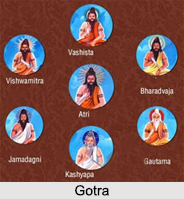
Gotra in Hinduism
In Hinduism, gotra refers to a lineage system tracing descent from ancient sages, primarily through the paternal line. Originating from Vedic traditio...