


 Karma Yoga is the first step in the spiritual discipline (Sadhana) which is to be adopted for Moksha. Karma yoga can serve as an aid to Jnana Yoga which secures the realization of the self. It can also serve as a direct means to self-realization since the practice of Karma Yoga in the prescribed manner includes in it the Jnana Yoga. The two are interrelated. But it is easier to practice karma yoga as it takes less effort and time to realize the goal because of the divine grace showered on the individual in response to the disinterested performance of karma. Karma Yoga is the first step in the spiritual discipline (Sadhana) which is to be adopted for Moksha. Karma yoga can serve as an aid to Jnana Yoga which secures the realization of the self. It can also serve as a direct means to self-realization since the practice of Karma Yoga in the prescribed manner includes in it the Jnana Yoga. The two are interrelated. But it is easier to practice karma yoga as it takes less effort and time to realize the goal because of the divine grace showered on the individual in response to the disinterested performance of karma.
Etymology of Karma Yoga The term karma bears different meanings. In a general sense it means action or any activity. It also refers to the merits and demerits acquired as a result of the performance of good and bad deeds respectively. It is also understood as the observance of the prescribed religious acts and in this sense the term is used in the present context. Yoga means upaya or method to be adopted to achieve a goal. So the compound word karma yoga means a specific religious act adopted as a means or upaya for self-realization. Religious Duties for Performing Karma Yoga There are several religious duties laid down by the sacred texts. The Bhagavad Gita has enumerated the following as illustrative - (1) worship of God (devarchana) (2) performance of the sacrifice (yaga) in the consecrated fire (3) control of the sense organs (indriya-samyama) by arresting their outward movement towards external objects (4) control of the mind (manas-sarityama) (5) giving away the money earned in a righteous way in charity (dana) either for the worship of God or for performance of homa or to deserving persons etc. (6) observance of austerities (tapas) in the form of performance of prescribed rites such as fasting (7) visiting holy religious centres and bathing in sacred waters (punyatirtha-punyasthana-prapti) (8) recitation of the Vedas and study of the teachings of the sacred texts (svadhyaya tadartha jnanabhyasa) and (9) practice of breath control (pranayama). It is not necessary that all of these religious duties have to be observed for the purpose of karma yoga. Any one of them, depending upon the capacity and choice of an individual, adopted as a Sadhana or religious discipline can become karma yoga for self-realization. Each one of these acts is called Yajna in the Gita, thereby implying that it is to be performed with the spirit of a sacrifice (yaga) for the sole purpose of self-realization. 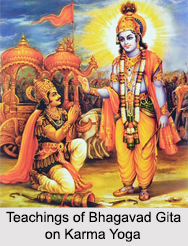
Requirements for Karma Yoga There are several important requirements to be fulfilled for a successful performance of Karma Yoga by an aspirant. In the first instance, he should acquire adequate philosophic knowledge about the true nature of Jivatman and Paramatman through the study of the sacred texts under the guidance of a qualified preceptor (Guru). The need of such knowledge is obvious because without knowing the true nature of the self, one cannot strive for its realization. The second important requirement is that a person performing karma yoga is required to observe without fail all the other religious duties which have been laid down by the sacred texts, in accordance with one's Varna (caste) and Asrama (stages of life). These duties are generally called karmas. These karmas are of three types: a) ‘Nitya’ or those prescribed religious duties which are mandatory and to be performed unconditionally b) ‘Naimittika’ or those prescribed rituals which have to be observed necessarily but only on certain occasions or for certain specific purposes and c) ‘Kamya’ or those which may be performed only when one desires to attain some specific result such as heaven or wealth. The first two are obligatory duties because the non-performance of them will result in sin. The third one is purely optional. These duties vary in accordance with one's caste and the stages of life. The third requirement, which is the most important one, is that the religious act which is adopted as a Sadhana for the purpose of self-realization should be performed without any attachment either to oneself, or to the karma itself or even to the result arising from it. Karma Yoga and the Need for Renunciation There are three factors involved in the performance of karma yoga emphasising a spirit of renunciation. The first one is the renunciation of egoism in the form that ‘I am the doer of the act’ (Kartitva-Tyaga), the second is the renunciation of selfish attachment to the act, viz., that ‘it is my act’ (Mamata-Tyaga), and the third one is the renunciation of the desire in the fruit accruing from the deed, viz., that ‘I am reaping the benefit for my purpose’ (Phala-Tyaga). When an individual seeking Moksha undertakes the performance of the prescribed karma as a Sadhana for liberation from bondage, it is imperative on his part to develop this sense of renunciation. Results of Karma Yoga The practice of karma yoga in everyday life leads the aspirant to a state of steadfastness in self-knowledge. The Gita describes him as a ‘Sthitaprajna’ and extols him as the ideal person. The person has conquered the senses and mind, enjoys a state of mental tranquillity that neither joy nor sorrow affects him. He neither develops hatred towards others nor any attachment to any because he has conquered the two unethical mental qualities of Kama or desire and Krodha or anger. He thus becomes the fittest person for the practice of Jnana Yoga to attain the direct vision of the self or even the practice of Bhakti Yoga to attain God-realization. |
| |||



Karma Yoga - Bhagawat Gita
| Karma Yoga is the path of unselfish action and service. It is based on the teachings of the Bhagavad Gita, a sacred Sanskrit scripture of Hinduism. |
| ||||||||||||||||||||||||||||

