


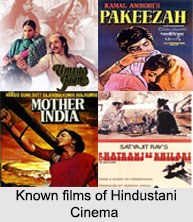
 Cinema of the Golden Era of Indian Cinema, centering mostly in the 1950s, is often referred to as Hindustani Cinema. It was the Hindustani language that set the tone for Hindi cinema from the 1940s to the 1960s. The films were primarily made in Hindi language and in some cases the Urdu language as they were spoken all over the northern and western parts of India. The Hindustani Cinema encompassed all popular genres -family oriented dramas, melodramas, thrillers, action films, historical and costume films, musical comedies, pure comedy and farce. Cinema of the Golden Era of Indian Cinema, centering mostly in the 1950s, is often referred to as Hindustani Cinema. It was the Hindustani language that set the tone for Hindi cinema from the 1940s to the 1960s. The films were primarily made in Hindi language and in some cases the Urdu language as they were spoken all over the northern and western parts of India. The Hindustani Cinema encompassed all popular genres -family oriented dramas, melodramas, thrillers, action films, historical and costume films, musical comedies, pure comedy and farce.
The Hindustani Cinema brought with it a cultural symbiosis, which was to stay in Indian Cinema, especially the Hindi film industry, for a long time. In spite of the turmoil of the Partition of India, both Hindus and Muslims worked harmoniously together in all spheres of cinematic art. Besides the characteristics of Persian civilization that have been passed on to Indian civilization, mainly being music and dance, the Urdu language is one the legacies of Islam in India. Urdu became a literary dialect from the 14th to 15th century onwards. It was largely used along with Persian dialects in royal courts. The splendour of these courts has been evoked with nostalgia in films like ‘Mirza Ghalib’ (1954), ‘Pakeezah’ (1972), ‘Shatranj Ke Khilari’(1977) and ‘Umrao Jaan’ (1981). The era of Hindustani Cinema also witnessed the contribution of great talents who were members of the Muslim community. Amongst the directors were the likes of Mehboob Khan and Kamal Amrohi, while the actors and actresses included legendary names like Dilip Kumar, Meena Kumari, Nargis and Waheeda Rehman. Credible music directors such as Ghulam Haider, Naushad Ali and Ghulam Mohammed are few examples of artistic talents from the community. The Hindustani Cinema also witnessed the rise of eminent neo-realists like Satyajit Ray, Ritwik Ghatak and Guru Dutt who presented realistic films, even to the extent of being autobiographical. The cult films of Guru Dutt have been immortalised in the history of Indian cinema. Another film that is also regarded a cult is ‘Mother India’ (1957) by Mehboob Khan. It is one of the earliest woman centric films with awe-inspiring performances by the entire cast. Hindustani Cinema attained new heights mainly because of four esteemed directors, namely Bimal Roy, Mehboob Khan, Guru Dutt and Raj Kapoor. The last phase of this period is referred to as the Raj Kapoor Era. If not politically, these directors were socially committed and often dealt with serious social problems that were rampant in pre-independent India in their cinematic productions. Some of the films by these directors are hailed as masterpieces in Indian Cinema and the magic of their art still remains unrivalled. |
| |||



Hindustani Cinema
| Hindustani Cinema refers to the films made during the Golden Era of Indian Cinema. |
| ||||||||||||||||||||||||||||

