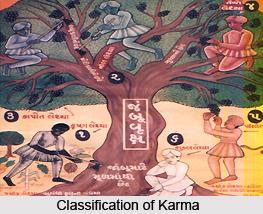
Classification of Karma, Jain Philosophy - Informative & researched article on Classification of Karma, Jain Philosophy
  Indianetzone: Largest Free Encyclopedia of India with thousand of articles Indian Philosophy


in  
Art & Culture | Entertainment | Health | Reference | Sports | Society | Travel
Forum  | Free E-magazine
Indian Philosophy : Indian Philosophy l Schools of Indian Philosophy l Classical Indian Philosophy l Indian Religious Philosophy l Buddhist Philosophy l Upanishads l Indian Philosophers l Atomic Theories l Hindu Philosophy
Home > Reference > Indian Philosophy > Schools of Indian Philosophy > Jain Philosophy > Classification of Karma
Classification of Karma, Jain Philosophy
According to Jaina philosophy, there are eight basic types of karma, which have many sub-types.

Bhagwan Mahavir of the Jaina dharmaAccording to Bhagwan Mahavir of the Jaina dharma, the world is full of misery and sorrows. Therefore, the fundamental object of religion should be to help the worldly souls to cross the river of sorrows and attain liberation from the cycles of births and deaths. The actual reason behind the soul`s worldly career is its own actions, which relate it with different types of external material particles called karma.

There are mainly two classifications of Karma:
  • Destructive and
  • Non-destructive karma


  • Destructive karma is to get bound with the soul and destroy its natural qualities. There are of four types of destructive karma.
  • The perception- obscuring (darshanavarni) karma
  • The knowledge- obscuring (jnanavarni) karma
  • The deluding- (mohaniya) karma
  • The obstructing- (antaraya) karma


  • These destructive karma are again divided into two parts-
  • All-destructive karma: This type of karma destroys the natural qualities of a soul completely. This karma again has 20 sub-types.
  • Partially destructive karma: This karma destroys the natural qualities of soul partially. There are 25 sub-types of this karma.


  • Non-destructive karma does not harm the main qualities of the soul. These are again four types:
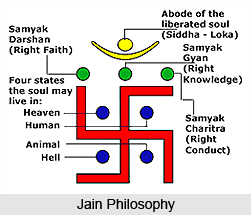
  • The feeling- producing (vedaniya) karma
  • The life-span- determining (aayu) karma
  • The physique-determining (naam) karma
  • The status- determining (gorta) karma and


  • All these again have many sub-types of karma.

    It is believed that all living in this world come under the influence of these eight types of karma. Again, as per another classification, karma is of two kinds:
  • Physical (dravya) karma, which are material particles and
  • Abstract or Psychical (bhava) karma, which is impure mental dispositions.


  • The karmic body is constituted of the physical karmic particles, which is linked with the soul. The gross material body is built through nutrition from the environment. The abstract karma is said to be responsible for attracting material karmic particles to the soul. The physical karma has its influences the psychological disposition. In this way, a psycho-physical cycle is maintained between the physical karma and abstract karma.

    The Physical Karma is the substance of karmic variform that attracted by the activity of mind; speech and body are unified with the soul.

    The Psychical karma is the passions, attachment, jealousy and aversion that are constantly attached to the soul. It can be said a type of mental condition.

    The four non-destructive karmas are again divided into two types:
  • Meritorious karma and
  • Demerit karma


  • The results of which karma yield sensuous, physical and worldly pleasures are known as merits. The demerits karma results or cause physical pains, worldly sorrows and displeasure to senses.

    There are total 158 sub-groups of the basic eight karma available in Jaina philosophy. These are:
  • Knowledge obscuring karma 5 sub groups
  • Intuition obscuring karma 9 sub groups
  • Feeling producing karma 2 sub groups
  • Deluding karma 28 sub groups
  • Life span determining karma 4 sub groups
  • Body making karma 103 sub groups
  • Status determining karma 2 sub groups
  • Energy obstructing karma 5 sub groups
  • 158 sub groups


  • (Last Updated on : 22/04/2011)
      More Articles in Jain Philosophy
     
    Constituents of reality in Jain philosophy Metaphysics in Jain philosophy Milestones towards moksha, Jain philosophy
    Morality and Ethics in Jain philosophy Nature of Divinity and God in Jain philosophy Path to Salvation in Jain Philosophy
    Jain Symbols Social Utility of the Jaina Karmic Theory Classification of Karma
    Karma In Jain Philosophy Dissociation of karma Cause of karmic bondage
    Nirvana Pushpadanta Pushpottara
    Dravyas or Substances in Jain Philosophy Pudgala Basic Truths of Jain Philosophy
    Body Functions Reform Movement of the Jains Action of the soul
    Conduct of Life Types of Soul Conditions of Soul
    Concept of Suffering Fourteen Gunasthanas Jain Cosmology
    Anekanta Vada Syadvada Nayavada
    Nigrantha Movement    
    Recently Updated Articles in Indian Philosophy
  • Suhrawardi Order
    Suhrawardi Order, founded by Shihab-ud-din Suhrawardi, is considered one of the most prominent principles of Sufism.
  •  
  • Naqshbandi Order
    Naqshbandi Order is a notable Sufi order that originated during the reign of Akbar in India.
  •  
     
  • Hakim Sanai
    Hakim Sanai is considered to be the earliest Afghan teacher to use the love-motif in Sufism.
  •  
  • Sufi Philosophy
    Sufism is the philosophy that traces back to the Prophet Mohammad with a copious tradition.
  •  
  • Satya
    Satya means truth and is the quality of goodness, purity, knowledge and quiescence.
  •  
    E-mail this Article | Post a Comment
    RSS Feeds
    Forum
    Forum on Indian Philosophy

    Free E-magazine
    Subscribe to Free
    E-Magazine on Indian Crafts
     
     
    Classification of Karma, Jain Philosophy - Informative & researched article on Classification of Karma, Jain Philosophy
    Sitemap
    Contact Us   |   RSS Feeds
    Copyright © 2008 Jupiter Infomedia Pvt. Ltd. All rights reserved including the right to reproduce the contents in whole or in part in any form or medium without the express written permission of Jupiter Infomedia Pvt. Ltd.
