 Marriage is considered a personal concern and there are no religious directions on whether or not a person should marry or remain unwed. There is also no formal wedding service in Buddhism. This does not, however, mean that Buddhist weddings do not have a rich tradition. Buddhist shows a different concept of wedding. Buddhism does not regard marriage as a religious duty nor as reparation that is ordained in heaven. Buddhist offers many interesting wedding rituals. The Buddhists are strict conventionalist when ceremonies and rituals come. The most pleasurable thing about the Buddhist weddings is that they are based more on faith and less on religion.
The lama recites the prayers and then a concoction called the "Madyan" is served to the guests, this is considered as a religious drink. The astrologer or the monk carries out the rites on the auspicious day for the wedding.
Pre Wedding Rituals of Buddhist
pre wedding rituals are also an important part of wedding. Its also varies with different types of wedding. Khachang is one of the pre wedding rituals performed prior wedding.
Khachang
The foremost and the most important ritual amongst Buddhists is the horoscope matching. It is thought to be quite important and is practiced with dedication. After matching the horoscopes of the probable bride and groom, the boy`s family in discussion with the lama decides an auspicious date for putting the proposal of the wedding. Monks bless the house with holy water and recite verses from the Tipitaka. As the monks complete their blessing, the groom"s family offers them gifts to bring good luck to the marriage. Once it is decided that you want to marry this particular girl, a family friend would usually go to the girl"s house. He would carry a bottle of whisky and a white silk scarf called "Khada" to offer. It is meant to see whether they give a nod to the proposal. This is the ceremony which has the formal engagement taking place.
The next ceremony is the "Chessian Betrothal` ceremony, where the maternal uncle of the bride is seated on a raised platform. The priest recites prayers and gives "Madyan" as a holy drink to everybody. The bed is significant in the Buddhist culture and an older couple may sometimes be called on to prepare the bridal bed and decorate it with lucky talismans such as bags of rice, sesame seeds and coins. These symbolize fertility and happiness.
The Buddhist Wedding
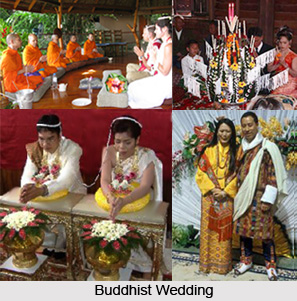
Spiritual Buddhist wedding traditions do not necessarily require the presence of monks or the use of a temple"s shrine room. In the early morning, the bride`s and the groom`s families arrive at the temple. The groom`s family bring many trays containing fruits, wine, traditional cake, tea, meat, and most importantly jewellery that the bride will be getting as dowry. The trays are necessary to be either six or nine in number. Seven or eight are considered unlucky numbers amongst the Buddhists. One of the trays also contains a pair of candles, which are lit either by the bride and the groom or their parents; the tradition varies with places and countries. The lighting up of the two candles symbolizes the unification of the two families. The couple is dressed in traditional outfits. It is here that the couple first sees each other on that day.
The couple and the assembly deliver a procession hymns from "Vandana", "Tisarana" and "Panchasila" before a specially constructed shrine and the image of Lord Buddha. The candles and the incense sticks are lit before the image of Lord Buddha and flowers are offered in abundance. Next, the bride and the groom narrate the traditional undertakings as inscribed in "Sigilovdda Sutta". A red paste is applied on the foreheads of the bride and the groom.
The ritual of red paste is created is similar to what is done at Hindu weddings. The bride`s mark is done with the butt of a candle keeping in with the tradition of not even touching women.
The groom says the following words: "Towards my wife I undertake to love and respect her, be kind and considerate, and be faithful, delegate domestic management, present gifts to please her". The bride in response speaks: "Towards my husband I undertake to perform my household duties efficiently, be hospitable to my in-laws and friends of my husband, be faithful, protect and invest our earnings, discharge my responsibilities lovingly and fastidiously".
Knot-Tying Ceremony
This is a very special and joyous part of your wedding day. Traditionally, led by local village elders and traditional musicians, the groom would make his way towards the house, where the bride waits for him. Once the groom arrives, he must prove his worth to the "gatekeepers" before he is allowed to get married. The bride then has the opportunity to ask the groom to make promises for their life together.
Post Wedding Rituals of Buddhist
Once officially married, the bride goes to the groom"s house where she is welcomed by her mother-in-law and a feast is shared. The wedding ceremony comes to an end with the recital of "Mangal Sutta" and "Jayamangala Gatha" as a blessing for the newlyweds. . And lastly bride and groom decide to live separately or with whole family. Buddhist marriage is very simple and does not include any complex ritual.
A typical wedding is divided into two parts, one is Buddhist component and the other is non-Buddhist component. The Buddhist component includes offering prayers along with gifts to the monks and Buddha image. The non-Buddhist constituent engulfs customary practices followed by the family of the couple. The non-Buddhist component is deep-seated in folk traditions, followed by the couple`s family.
Modern Buddhist Wedding
Buddhist weddings in recent times have cut down on the complicated ceremonies involved. Monks also have a greater role as compared to previous times when they were forbidden.
The twin forces of modernity and scientific knowledge have made their influence on Buddhist weddings as well. Though Buddhist weddings are quite informal but their structure has changed extensively. Initially monks did not attend the weddings, as they had to be present during the funeral rites. Nowadays, the role of the monks in weddings has become quite reflective. Buddhist weddings are customary ceremonies and are an essential part of Buddhist culture.