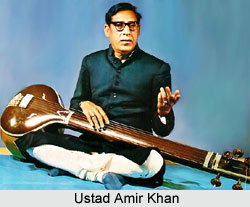
 Though not the most popular or widely-known of gharanas, the Bhendi Bazaar style make a conspicuous impact on North Indian classical music during the first half of the 20th century through the efforts of its most gifted exponent, Ustad Aman Ali Khan. His ancestors, Chhaju and Nazir Khan, originally trained in the Rampur-Sahaswan style, migrated from Uttar Pradesh in the turn of the 19th century and settled down in the Bhendi Bazaar area in Bombay. A modest and reticent man, Aman Ali was not only a fine singer, but also a composer par excellence. One of his best-loved compositions is the swingy bandish Laagi lagan pati sajan sangh (structured along the lines of Dikshitar`s kriti, Vatapi ganapathim bhaje) in Hamsadhvani, later popularised by Ustad Amir Khan. His popularity in Western India was so vast that Lata Mangeshkar had learnt under him for a while. Ustad Amir Khan picked up the subtleties of this gayaki from his father, Shamir Khan, who had learnt under Chhaju Khan and Nazir Khan, and later from Aman Ali himself.
Aman Ali was strongly influenced by certain aspects of Karnatic music, especially the rendering of complex note patterns (swaraprasthas) in aesthetically agreeable ways. He, along with Abdul Karim Khan, was largely responsible for popularising the use of sargams during raaga elaboration. During the time of Partition, he migrated to Pakistan leaving behind a few dedicated disciples like Anjanibai Malpekar, Shivkumar Shukla, Ramesh Nadkarni and T.D. Janorikar to continue his legacy. Suhasini Koratkar is a well-known contemporary exponent of this style.
Some of the identifiable aspects of this gharana are
• Use of merukhand method of singing notes and note combinations. The singers incorporate the complex merukhand permutations into their raaga elaboration.
• Use of aesthetic ornaments imported from the Karnatic system like brukas (short, swift and razor-sharp executions of melodic ideas during raaga elaboration) and sargams with great aesthetic feeling and finesse.
• Particular stress on the proper articulation and enunciation of the words of the bandish. Many of Aman Ali`s compositions possess much literary quality, demanding a great deal of vocal dexterity and sensitivity to bring forth their beauty.
• Preference for singing in the medium tempo.