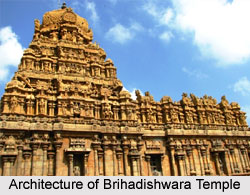
Introduction
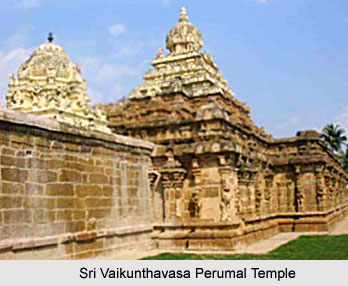 The small village called Nemili is situated off the Chennai-Tirupati highway, is the abode of a small but very beautiful temple for Vaikunthavasa Perumal. The temple is a legendary one and the inscriptions found in this temple show that this village was called Nenmali and that Lord Vaikunthavasa was known by various names in the preceding centuries. The names by which the Lord was called were Tirumetrali-Devar, Tirumetraiip-erumanadigal and Tirumetrali-Perumal. Nenmali alias Chalukulakala-chaturvedimangalam was in ancient times, a village peopled by great scholars proficient in the Vedas and ancient scriptures. It was situated in the ancient territorial area called Ihatur-nadu, a subdivision of Kunravattana-kottam in Jayamkondachola-mandalam.
Legend of Sri Vaikunthavasa Perumal Temple
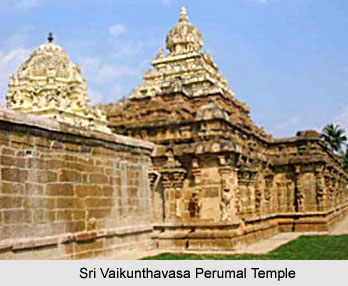 The antique temple of sri Vaikuntha Perumal is associated with celebrated legends, which has endowed it with a majestic grandeur. However the legends are mainly connected with the principal deity of this temple. According to one of these legendary stories, a farmer of the village promised Vaikunthavasa Perumal to give Him a large share of the grain from his land. Eventually he was rewarded with a bountiful yield that year but the farmer decided to take it home instead of giving it to the God. The rice grains which were heaped like a hill suddenly changed to a hill of stone. The repentant farmer came to understand about his mistake and fell at the feet of the God. God accepted his apology and took a single rice grain in His two fingers and gave back the rest to His devotee, the farmer. Following this legendary story, the presiding deity in this temple is still seen holding a rice grain in His left hand. It is believed that Nemili is the corrupted form of the word Nelmalai or hill of grains.
Apart from this, another interesting legend is connected with this temple which is similar to the famous one associated with the Eri Katha Rama temple at Madhuranthakam. The common belief in Nemili runs that during heavy rains, the irrigation tank in the village started to overflow. The villagers, who were scared that the tank might breach and flood their houses and land prayed fervently to the Lord to prevent this calamity. Lord was satisfied with their ardent prayers and in answer to their sincere prayers He prevented the breaching of the tank with His back.
The temple houses Lord Vaikuntha Perumal as the principal deity following the stories of Legends associated with it.
Architecture of Sri Vaikunthavasa Perumal Temple
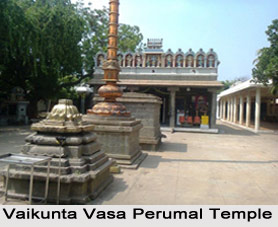
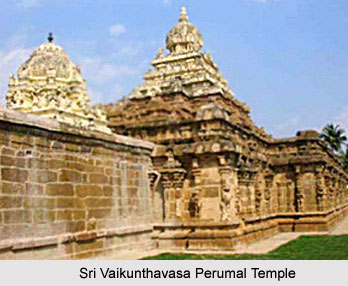 The exquisite architectural design not only points to the excellence of the craftsmanship of the artists but also provided an idea about the architectural trend of the contemporary period. However this temple is of very modest proportions. The vimana rising above the main sanctum-sanctorum is typical of Pallava architecture of the 8th-9th centuries A.D. as is evident from the shrines constructed by the kings of this dynasty at Kanchipuram and other nearby places. This Vimana testifies the exceptional craftsmanship of the then artists. The main sanctum enshrined the large image of Lord Vaikunthavasa in a seated posture
on Adisesha under the Pushpakoti Vimana facing East. The imposing image of the Lord is the best specimen of the contemporary art. Also known as Eetrirunda Perumal, the Lord is seated in the sukhasana posture with four arms. Hence He is also called Chaturbhuja. In His upper hands the lord Vaikunthavasa Perumal, holds the conch (sankha) and discus (chakra) which is in the prayoga mode. This posture points to the idea that the Lord is ready to be hurled at the foes of His devotees. His lower right hand is placed in abhaya pose as if the Lord is granting an everlasting protection to His worshippers, while His left palm holds a grain of rice pertaining to the legendary story. The captivating image of Lord Vaikunthavasa is flanked by the deities Sri Devi and Bhu Devi on the either side.
The utsava-murti or bronze processional image is extremely captivating and here is called Nitya Kalyana Perumal. A rare metal icon of Krishna with four arms, holding the sankha and chakra and playing the flute (venu) is one of the striking features of the temple. An idol of Santhana Gopalan here is placed in a separate sanctum. It is believed that the deity offer blessings on those who worship Him. An extremely beautiful bronze image of Kalinga Narthana Krishna is also seen here, holding the tail of the snake with His left hand also bears out the exceptional architectural supremacy of the artists. It is believed that when the event of paal-abhisekam is performed here, the milk turns blue in color as this is considered as Rahu-Kethu Sthala. A large number of people affected by the ill effects of Rahu, Kethu and Navagraha dosha visit this temple due to the special sanctity of this image. It is believed that the deity enshrined in the temple can remove the ill effects of these "doshas" or vices if He is worshipped properly. The shrine for Garuda decorated with snakes (nagabharana) is erected in front of the main shrine.
By the side of the small pillared mandapa in front of the principal sanctum are erected the stone images of Chakrattazhvar, a unique one of Kalinga Narthana Krishna and Vishvaksena or Senai Mudaliar. Opposite this temple, across the narrow road, there is also erected a tiny shrine dedicated to the man devotee of Lord Rama Hanuman, known here as Bhakta Vinaya Anjaneyar. Although this temple does not have a gopura over the front entrance, yet the remnants of the base of an unfinished gopura can still be seen. These have stone sculptures representing rivers Ganga and Yamuna on either side of the entrance, very characteristic of the Vijayanagara style of sculpture of about the 15th or 16th centuries A.D. Since the present temple is the relic of the original one, here is noticed the original architectural trend of the Vijayanagara times.
Inscriptions of Sri Vaikunthavasa Perumal Temple
 There are a very large number of inscriptions stamped on the on the outer walls of the main sanctum and on the steps leading to it. These inscriptions not only point to the chronological significance of the temple rather provide some important information relevant to Sri Vaikunthavasa Temple. The oldest of these inscriptions belongs to the reign of the last Pallava king Aparajitavarman, as the historians have revealed. The Pallava king Aparajitavarman ruled from his capital-city of Kanchipuram during the 905 A.D as the inscriptions revealed. This inscription also points that this ancient temple was in active worship in the early years of the tenth century A.D. This inscription records the registration of the gift of land to the temple of Tirumetrali-Devar at Nenmali by a person named Sattandai Sutthamallan.
Numerous inscriptions of the Chola age, beginning from the time of Parantaka Chola I of the 10th century A.D., record the numerous gifts and endowments made to this Vishnu temple by people from all strata of society. These epigraphic evidences clearly point out that this shrine must have played an important role in the religious as well as the socio-cultural sphere in ancient times. The part played by the "Ur" and the ` Sabha`, the local administrative organizations of the Pallava and Chola ages in the management of the temple are clearly evident from the facts depicted in these inscriptions. The achievements of the Rashtrakuta kings of the ancient Karnataka area who ruled over this territory for some time are etched on this temple. One of these inscriptions mentions that this shrine was renovated by a chief called Kilakkayittru-Tiruvadi, belonging to the Rashtrakuta dynasty. Many other epigraphs of later times are also engraved on the temple walls, which mostly records donations to this temple.
Thus the inscriptions provide the temple with a dignified magnificence. The inscriptions are also the added grandeur to the antiquity of the temple.
However Sri Vaikunthavasa Perumal temple is also considered immensely sanctified. It is widely believed that those desirous of getting married should worship Lord Vaikunthavasa according to a certain prescribed procedure to fulfill their wishes. The mode of worship followed in this temple is according to the codes of the Pancharatra Agama. The sanctified temple is also considered as an abhimana-Sthala and a prarthana-Sthala. It is so pleasing to see that this carefully maintained temple is more than a thousand years old. Presently this consecrated place is a great centre of religious activity and it still continues to arrange celebrations during the pujas and rituals. During this time a chink of devotees are drawn to the temple precincts not only from Nemili but from afar as well, all through the year.