|
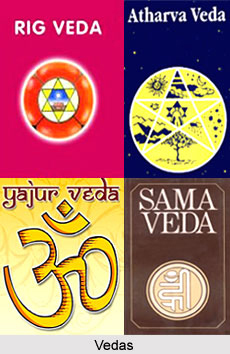 Vedangas, literally meaning limbs of the Vedas, are actually the auxiliary sciences of the Vedas. These Vedangas include, besides the works on ritual, also a number of works on phonetics, grammar, etymology, metrics and astronomy. They are Siksa (phonetics), Vyakaran (grammar), Chandas (meter), Niruktam (etymology), Jyotisham (Astronomy) and Kalpam (Ritual Practices). In one of the Upanishads it is said that there are two kinds of knowledge, a higher and a lower. The higher is that which teaches one the knowledge of the imperishable Brahman, but the lower consists of Rig Veda, Yajur Veda, Sama Veda, Atharva Veda, phonetics, ritual, grammar, etymology, metrics and astronomy. This is the oldest enumeration of the so-called six Vedangas, i.e. the six supplementary sciences of the Veda. Vedangas, literally meaning limbs of the Vedas, are actually the auxiliary sciences of the Vedas. These Vedangas include, besides the works on ritual, also a number of works on phonetics, grammar, etymology, metrics and astronomy. They are Siksa (phonetics), Vyakaran (grammar), Chandas (meter), Niruktam (etymology), Jyotisham (Astronomy) and Kalpam (Ritual Practices). In one of the Upanishads it is said that there are two kinds of knowledge, a higher and a lower. The higher is that which teaches one the knowledge of the imperishable Brahman, but the lower consists of Rig Veda, Yajur Veda, Sama Veda, Atharva Veda, phonetics, ritual, grammar, etymology, metrics and astronomy. This is the oldest enumeration of the so-called six Vedangas, i.e. the six supplementary sciences of the Veda.
Originally Vedangas did not mean special books or special schools but only subjects of instruction, which had to be learned in the Vedic schools themselves, in order to understand the Vedic texts. Thus the beginnings of the Vedangas may be sought in the Brahmanas and Aranyakas. It is here that along with the explanations of the sacrificial ritual that one can also find discussions on matters of phonetics, grammar, etymology, metrics and astronomy. In the course of time, these subjects were treated more and more systematically, and separate special schools, though still within the Vedic schools, arose for each of the six supplementary sciences of the Veda. These then evolved special school texts known as Sutras. These Sutras or manuals were composed in a peculiar prose style intended for memorization.
The term Sutra originally means 'thread', then a short rule'. This means a precept condensed into a few words. As a fabric is made out of several threads (thus the transition of meaning might be explained), so a system of instruction is woven together out of these short precepts. A larger work consisting of a number of such Sutras strung together is also called Sutra. These works serve a purely practical purpose. They are to present some science systematically in concise brevity, so that the pupil can easily commit it to memory. It is the task of the author of such a work to say as much as possible in as few words as possible, even at the expense of clearness and intelligibility.
In later times, the explanations given by the teachers on the Sutras were also written down and these are now present as extensive commentaries on all the Sutra texts. These are of immense importance as without these the Sutra texts would be impossible to understand. Sutra style originated in the prose of the Brahmanas. This prose of the Brahmanas consists almost exclusively of short sentences and indirect speech is almost entirely absent. The sequence of principal sentences is rarely interrupted by a relative or conditional clause, and its monotony is only relieved to some extent by participial constructions. For the purpose of the greater saving of syllables and still shorter summarising only one new element was introduced: the formation of long compound words, which is seen for the first time in the Sutras. This is particularly characteristic of the classical Sanskrit literature and gained even more popularity during later periods. It is thus right to conclude from the many quotations from the Brahmanas in the oldest Sutra texts that the Sutra style was developed from the prose of the Brahmanas.
|





