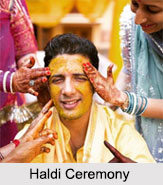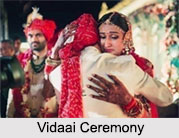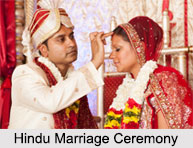
The Hindu marriage ceremony consists of various stages. Starting with the selection of bride and the bridegroom to the after-marriage ceremonies; all make up the auspicious ritual of marriage among Hindus. The rituals start with the selection of bride and the bridegroom, betrothal, then marriage and also the after-marriage ceremonies. The steps of Hindu marriage are explained below:
Selection of the Couple
The parents or the elders generally make the selection of the bride and bridegroom. The elders are experienced men and can better evaluate the virtues of the partners. The boy and the girl are young and immature and can be drawn to more momentary feelings, rather than permanent valuable considerations. Love marriage was not encouraged in the ancient Hindu households.
However, the system of arrange marriage has also faced many criticisms after seeing abundance of instances, where in many cases, parents get their son or daughter married to the girl who is not a suitable match if thinking about the biological or psychological aspects, but whose position and wealth matches to their prestige. It is, therefore, recommended that the boy and the girl should met once before marriage and consult their thoughts, emphasizing on them the reasons for the choice of the parents.

The young boys and girls of the present generation have a terrorizing desire of a perfect marriage and perfect partner, which is not always possible. They feel that their new marriage should not be hampered by old thoughts. The present generation wants their would-be partner to have beautiful facial characteristics, pure love, loyalty and fidelity and also companionship and complete transparency.
They fail to see the authenticity of marriage and after failing, they blame their parents instead of realizing the mistake of expecting excessive and naive demands they make on the marriage. The parents are ethically bound to search compatible mates for their children and the children should accept the parental choice. The marriage among Hindus is considered not only as a union between two young people, but also between two families. However two considerations should always be kept in mind that the mates chosen must be outside the family and within the caste. However, the advent of western culture has overtaken the minds of the youngsters and traditional Hindu customs are often ignored in the contemporary age.
During ancient days, the selection of the couple was based on Shastric views and a sight into the similar texts. The guardians of the girl not only considered the boy`s well-built body, but also his conduct, family virtues, education and reputation. The boy is chosen according to the age of the girl, the boy` age is usually more than the girl, but not much more (as much as treble to her age). The boy should be presentable and sound in body and in mind and his family should be free from genetic diseases. He should not live in a distant land, neither be frequently engaged in war or an ascetic. Other than the above-mentioned eligibilities, the boy should have the following particularized qualifications too:
Broad and deep - Voice, inherent power, chest, his naval, face and forehead.
Short - Throat, male organ, back and legs.
Fine - Hair, nails, the joints of the fingers, flesh and teeth.
Long - The distance between the two eyebrows, his nostrils, his breasts, his arms and his chin.
Red - The soles of his feet, his palate and tongue, the palms of his hands and both corners of each eye.
The girl should be aspinda, which means that she should not be related to the boy according to the following degrees. Her Gotra should be different as the boy. Taking birth in the Mangal Ras or house of mars is considered to be a Mangalik girl; in this case the boy selected should also be a mangalik. The girl should be beautiful, young, virgin and free from disease. She should also have a brother; otherwise her first-born son has to be given to her father, according to the marriage contract. Thus he might become his maternal grandfather`s heir.
Many more qualifications are allotted for the girl; such as good health, good reputation, fine teeth and hair, a swan like step, delicate limbs and red-soled feet without prominent joints. Her fingers and toes should not be adjoined, and the palm of her hand should resemble the shape of a lotus for luck. The shape of her body should be fish-like, and on the soles of her feet should carry the marks of a good and barleycorns.
The knees of the girl should be preferably round and her legs free from hair; her should be forehead broad and prominent, the naval deep, with three wrinkles in the abdomen. The nipples should be round and hard, her throat like a lion, her lips as red and the voice soft like a cuckoo. The nostrils of the girl should be evenly matched, and the eyes should be like lotus.
Lastly, her little toes should not be touching the ground as she walks lest she becomes a widow and the second toe should not reach beyond the big toe, or else her character is not clear, and her legs should not be long and thin, this calls for the omen of widowhood. Hair on the legs predicts misfortune, and a well-seen abdomen predicts sickness and sterility. Her eyes should not be reddish brown or like those of a cat, which means easy virtue. Hair on the nipples shall bring misfortune on her husband. Dry hair and reverted lips presages quarrelsome rage and so on. These qualifications are based on firm Shastric laws and astrological interpretations.
These qualifications in a boy and a girl are, were considered to be of great value, but with the change in the circumstances and the modern thinking of the boys and the girls, these are ignored nowadays.
The Betrothal
The betrothal is decided on after the selection of the boy as the bridegroom and of the girl as the bride. During this stage, an auspicious day is fixed for its festivity, which has some specific times of the year. For example, a marriage should not take place in the month of Posh (December), Kartik (October) or Chetra (March). During these times, Venus and Jupiter are on the decline path. Also during the shhradas, annual or general, interconnected months or when the Venus and the Jupiter are in the same direction of rasa and soon. Sundays, Tuesdays and Saturdays are usually avoided for marriage. The ideal time for betrothal is during the following Nakshatras like Phslgun (January-February), Bhfidrapada (August-September) and June-August.
On the auspicious day that is appointed for the rite, the boy`s family and relatives go to the girl`s house and both parties are seated. In the meanwhile, the Brahmins recite the Manghz Charan or benedictory prayer and Shri Ganesh is worshipped. The deities are kept on a brass dish. Rice is sprinkled on Ganesh and the boy`s family members. Sometimes red colored water is also sprinkled over the group of relatives and family.
The girl`s guardian can be her father, paternal grandfather, brother, one of the same family and lastly her mother. They announce that their girl is dan or gift by word of mouth, and is the soul of the betrothal bond. It is now irreversible, and breaking this bond is almost impossible. Once the promise has passed by the girl`s guardian, it can only be withdrawn for truly serious causes. Then the girl`s guardian gives the boy a janeo or sacred thread, fruits, flowers and some clothes. The girl`s Brahmin applies Tilak to the boy and his relatives. The boy`s parents and other family members give gifts to Brahmins and distribute sweets and money amongst them.
The boy goes to his father`s house and then a morsel of bread, sugar, butter and dal rice khichri is given to him. The female also give Khichri to the brotherhood and again in return receives presents. Till far into the night, the women sing songs. Betrothal thus creates a kind of relationship between two families strongly. Receiving money for a girl is firmly prohibited by the shastras, and one who takes it will surely go to hell.
Among the Hindus betrothal as a rule, this contract is an indispensable one in the preliminary stage of marriage in a girl`s life. If a woman, once married, is remarried on the legal basis of divorce or widowhood. The ceremonies performed in the first betrothal are not performed so dutifully. Betrothal is of three types:
(i)
Dharam or Pun - In this type the girl is given by his parents or guardian, as a quasi-religious donation to her future husband.
(ii)
Waffa Suffa or Exchange - In this type two or more families exchange brides.
(iii) In this last type a bride price is more or less openly paid.
These kinds of marriages exist in modern Hindu system. These days, the essentials of a legal betrothal are the approval of the match, feasting and the exchange of gifts. The religious ceremonies are given secondary importance. The contract of Hindu betrothal is irreversible, generally, except for certain grave reasons, or in cases when it has become impossible to fulfill the commitment. Even when the literal fulfillment is impossible due to the death of the boy, there is a common feeling that an obscure contract exists to marry the girl to any another member of his family. Hindu marriage is more of a relationship between two families, rather than between the boy and the girl alone. The castes and tribes, which allow the remarriage of widows, have a strong feeling that the betrothal effects the boy`s family a claim on the girl`s hand, so that if her original fiancé dies, she may be married to another boy of the family.
The above-mentioned causes, gives a good reason for a refusal to carry out an agreement of betrothal are mainly physical problems that include leprosy, blindness, impotence, or mental disease in either case. Immorality of the girl is also a compelling reason. The reason of immorality is much more fastening on the girl`s relatives than in case of the boy. Betrothal is also said to be revocable on some grounds including that the parties are within the forbidden degrees of relationship or that they belong to diverse tribes.
A promise of marriage cannot be imposed for exact performance, but a refusal to complete a promise of marriage by an actual marriage ceremony. In case of such breach, a father or guardian, would be permitted to recover money properly spent in such marriage. If the girl dies before the marriage, the bridegroom is entitled to take back the presents given by him to her. Among Hindus, as a rule, priority of betrothal gives the girl. A social, though not legal ceremony claims to be married first. In a Hindu household, the first married wife occupies a more or less honored position, unlike in case of the Muslims, where all the four wives are absolutely equal in the eye of the law.
More on Hindu Wedding Rituals
| Pre-wedding Ceremony in Hinduism |
Main Wedding Ceremony in Hinduism |
Post-Wedding Rituals of Hinduism |
More on Indian Religious Weddings
More on Indian Wedding Accessories
More on Types of Marriages
See also