


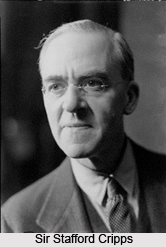
 The Cripps Mission came to India in 1942 headed by Sir Stafford Cripps, a socialist member of the war cabinet, to negotiate with Indian leaders on behalf of the British government. When the entire world was at midst of Second World War, the British government in India declared the participation of India in the war in favour of Allied Powers. This was done without consulting the Indian political leaders or the elected representatives of the parties. This provoked the crowd who reacted to this injustice where it was the Indians who were to lay their lives for a war out of which they themselves would hardly win anything. As a result the mission on its arrival was received with a huge countrywide protest resulting into a complete failure.
Background of Cripps Mission With the success of Germany over Russia and Japan's extension towards India, the British government was forced to find some alternative to win the war. In order to provide men and money, the British Government immediately declared the involvement of India in the war in order to have an easy access to men and money. This aggravated the Indian crowd as well as the leaders who could never understand the meaning of their involvement in the war. On this Churchill sent sir Stafford Cripps to negotiate with Indian leaders on behalf of the government so that India agrees to participate with the British. 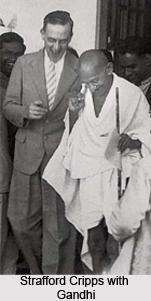 Proposal of Cripps Mission
The Cripps Mission included that the British promised the earliest possible realization of self-government in India. A 'new Indian union' would be created which would be a 'dominion, associated with the united kingdom and the other dominions by a common allegiance to the crown, but equal to them in every respect, in no way subordinate' to them. India would be able to frame its own Constitution after the war. A new central executive council would operate till then. The net result of this was that 'in place of the majority of British members in the existing executive council, there would be an executive council composed of Indians alone.' This would mean that India would enjoy a significant measure of self-government even before the conclusion of the war. In exchange for these concessions, the British asked for India's support in its war effort. Leaders of the principal sections of the Indian people were invited to give their active and constructive help in the discharge of a task. This task was vital and essential for the future freedom of India, namely the defeat of the Axis dictatorships. A few leaders of Indian opinion responded favourably to Cripps's proposals. Manabendra Nath Roy, who was then the head of the Radical Democratic Party, supported them on the grounds that the defeat of the axis was the most important thing at that moment. Reaction to Cripps Mission The Cripps Mission resulted in a mixed reaction among the Indian leaders who were divided into groups which included one group who wanted to launch a revolt against the British Government who was then busy with Second World War. The other group with members like Chakravarti Rajagopalachari wanted to support them in their crucial time with the hope to gain a profit in the terms of Independence. Even Mahatma Gandhi also did not support the proposal as he was morally against the war all together and did not believe that the British Government will give independence to India so easily. In case of Muslim League, Mohammad Ali Jinnah extended full support to British proposal and condemned the Congress move. On his arrival, Cripps faced mixed reaction from the Indian leaders whom he could not convince to agree to the proposal. This forced the Congress leaders to withdraw under the leadership of Gandhi who then proposed to threat the British government with Quit India Movement. Thus Cripps Mission ended up in a complete failure though it remained relevant to the history of India. |
| |||



Home > Reference > History of India > Modern History of India > Indian Freedom Struggle > Quit India Movement > The Cripps Mission
The Cripps Mission
| Cripps Mission was an effort made by the British Government to seek the support of Indian National Congress as well as Muslim League for the role played by the British government in the Second World War. In the name of Sir Stafford Cripps the mission was named as the Cripps Mission which had to face strong protest on Indian Land. |
| ||||||||||||||||||||||||||||

