Though looked at squinty, this unique custom of chewing pan supari or betel leaves with chunam i.e. slaked lime and areca-nut is perhaps the most common and considered to be one of the essentials for health, wealth and prosperity.
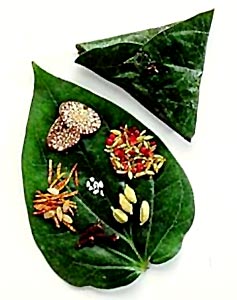 No occasion is considered to be auspicious unless pan supari is freely distributed to the people assembled. If a Hindu pays a visit to his friends or relatives, a plate containing the essential ingredients for betel chewing will be the first thing handed in to him or pushed towards him. Surely one should be inclined to examine and find out the reason or reasons that might have placed this custom on such a popular basis.
The betel and the other ingredients used in chewing have carminative effects. The Indian physicians of bygone ages had discovered this and perhaps prescribed it for the overfed rich. These wealthy people lacks in exercise, required some agreeable stuff to help them in digesting their food. To avoid creating in the minds of these the idea of several doses of medicines, chewing of betels ought to have been introduced perhaps as a luxury. Moreover, it is in human nature to make use of everything found in nature to be useful, and there were these harmless but useful articles handy. So the rich people took to this custom which slowly spread among the masses.
On festive occasions people are wittingly or unwittingly accustomed to overload their stomachs. They therefore require some artificial digestives to be taken in. So these materials were procured to sharpen the appetite first and to aid digestion after partaking of the meal.
Another reason for the origin of this custom may also be given. These materials serve the purpose not only of all-round tonics but they are also germicides on a small scale. The whole alimentary system in animals affords excellent breeding places for microbes and worms commencing from the mouth to the anus. By eating vegetables, etc., of various kinds men may breed germs in the mouth, and large and small worms in the stomach and both the small and large intestines. Repeated betel-chewing destroys these to some extent and also helps to keep the alimentary system clean. By this afford there is no facility for these to grow and flourish. The mouth is one of the outlets for the gases formed in the alimentary system by the decomposing of the undigested food materials taken inside. Often these emit a bad smell. Betel-chewing not only checks the fermentation and the formation of gases, but also helps to conceal, if not to remove completely, the bad smell in the mouth formed of matter sticking to the teeth and the gums.
 There is also a popular belief that Lakshmi, the goddess of wealth, abides in certain materials and betel leaf is one of them. Men and women by chewing these favourite leaves of hers are supposed to please her and receive her blessings.
Avoiding the two extremes, viz., chewing too much betel and not chewing any, it appears that the use of the pan supari early in the morning checks the formation of the phlegm. It also cleans and clears the bowels. The use of it before meal time sharpens the appetite. Its use after meals helps digestion. If people use it with moderate discretion to help them in one or other of the above uses, in that case they may find it conferring health on them which is both wealth and prosperity in one.