About Sri Pandava Doota Perumal Temple
The temple for Pandava Doota Perumal (Sri Krishna) is one of the significant temples of Kanchipuram in South India. It is situated in the core of Kanchipuram (Periya Kanchi) very near the Ekamranatha temple. Sri Pandava Doota Perumal Temple is considered as one of the 108 Divya Desams eulogized by Pey Azhvar, Bhudattazhvar, Tirumazhisai Azhvar and Tirumangai Azhvar. They speak of this sacred place as the holy Paadagam. The inscriptions in this temple also record the name of this place as Tiruppaadagam and refer to the deity here as Tiruppaadagattazhvar. This temple along with other two temples, named Yathoktakari temple at Tiruvehkha and the Ulagalanda Perumal temple, Ooragam forms a trinity, which are considered to be among the most ancient temples in Kanchipuram. The antiquity of this temple is one of the chief cause for which it is venerated as the holy place or Paadagam.
Sri Pandava Doota Perumal Temple is the Vishnu temple of South India. It houses the idol of Lord Krishna and lord Vishnu. The different stately posture of lord Vishnu in this trinity enhances the grandeur of this temple along with its antiquity. The majestic and unusually large images of Vishnu at Paadagam, Ooragam and Tiruvehkha seen in the sitting, standing and reclining postures respectively are of stucco (sudhai) and not of stone. According to scholars, these images were probably set up for worship even in the pre-Pallava times, i.e., in the Sangam age.
The Sri Pandava Doota Perumal Temple is considered as a legendary temple according to the references made in the Sthala Purana. Moreover the legendary story of this temple is associated with an interesting episode found in the Mahabharata. This legendary myth increases the antique grandeur of the temple. According to the story of Mahabharata associated with this temple, when Sri Krishna went as an emissary (Doota) of the Pandavas to the court of the Kauravas at Hastinapura to request Duryodhana to follow the path of peace and to avert war, Duryodhana hatched a plot to capture and imprison Krishna. However, the Lord at that time assumed His Vishwaroopa form and the crowd at Duryodhana`s court began to worship Him. With Krishna`s grace, the blind Dritharashtra, Duryodhana`s father, was able to temporarily get back his eyesight to have a vision of the Lord`s Vishwaroopa. This awe-inspiring, gigantic image of Lord Krishna at Paadagam is believed to be this Vishwaroopa form, which he revealed to Janamejaya by giving his consent to the wish of this king who performed severe penance.
The huge colossal image of Lord Krishna in the Sri Pandava Doota Perumal Temple is utterly overwhelming. No other Vishnu temples have accommodated such a massive idol of Lord Krishna. The idol of Lord Krishna in this temple faces east and is approximately twenty-five feet in height with His crown almost touching the roof of the holy sanctum.
The deity of Lord Krishna, exhibiting a tranquil countenance and beautiful smile, is seen seated in the ardha-padmasana posture with His right leg bent and His left leg placed in front. His right hand shows the protection gesture (abhaya) while His left hand indicates the boon-giving gesture (varada). While Vishnu icons in most temples are shown with four arms (chaturbhuja), the one here at Paadagam is two armed, probably indicative of the human incarnation of Krishna. The processional deity (utsava murti) in this shrine is a four-armed Vishnu surrounded by Sri Devi and Bhu Devi.
In a small compartment in front of the main shrine are installed the images of many Azhvar and Acharyas. Of particular importance is the idol of Arulala Perumal Emberumanar, which is rarely seen in other Vishnu temples thereby enhancing the stately grandeur of the Perumal temple He was believed to be the disciple of Sri Ramanuja, the preeminent Srivaishnava preceptor (Acharya).
The legend of the temple makes the temple famous and the idols constructed according to the legendary stories enhanced the traditional importance of the temple.
Architecture of the Sri Pandava Doota Perumal Temple
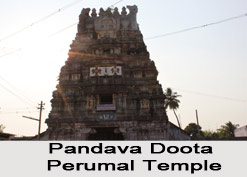
Sri Pandava Doota Perumal Temple is famous for its exquisite architectural designs. The architectural trappings throughout the temple surface enhanced the grandeur of the legendary Vishnu Temple of Kanchipuram. The main sanctum enshrining Pandava Doota Perumal is very large conforming to the huge size of the deity. The entire temple is rectangular in structure with a very high barrel-shaped roof known as Bhadra Vimana. The original shrine was probably built of brick and later remodeled in stone during the Chola period of about the 11th -12th centuries A.D, as the later researches articulate. The maha-mandapa is the principal chamber of the Pandava Doota Perumal Temple. According to the historians, this maha-mandapa in front of the main shrine also belongs to the Chola age as seen from the pattern of the pillars. The architectural trappings of the maha mandapa are one of the chief attractions of the temple. There is a mukha-mandapa in front of the maha-mandapa, which was constructed, in later times, probably in the Vijaynagar age.
Apart from the exceptional architectural carvings the structure and construction of the temple also enhance its majestic grandeur. Sri Pandava Doota Perumal Temple has only one enclosure or prakara. The main shrine is surrounded by very few sub-shrines. The sanctum of Goddess Rukmini, the consort of Lord Krishna situated close to the main shrine on the south side and facing east was also probably built or rebuilt during the Chola days. There is a sanctum, constructed in recent times, enshrining the idol of Sudarsana (Chakrattazhvar) with Lord Narasimha on the reverse side situated on the north side of the prakara. On the northeastern corner of this temple-complex is the sacred tank, which is also, called pushkarini. This pushkarini or the sacred tank is known as Matsya Tirtham. The main entrance to this temple is through the eastern doorway over which is a small four-tiered gopura, constructed during the Vijayanagara times.
The architectural style and structural design of the Sri Pandava Doota Perumal temple lend it not only the majestic grandeur but also makes it exclusive from the contemporary ones.
Inscriptions of the Sri Pandava Doota Perumal Temple
 The inscriptions engraved on the surface of the temple enhance the legendary significance of the Sri Pandava Perumal Temple. A few historic inscriptions are found etched on the walls of this temple, which provide information about the benefactions made to this shrine in the ancient days. The Inscriptions moreover help to determine the chronology of the temple. However as the historians have opined after a thorough research, that the earliest of these epigraphs found on the north wall of this temple is dated 1075 A.D. They have also said following the inscriptions that the temple belongs to the reign of the Chola ruler Kulottunga I (1071-1122 A.D.). The inscription engraved in the north wall depicts a story associated with the Sri Pandava Doota Perumal Temple. This inscription states that a merchant named Arulaladevan living in Kanchipuram provided the temple of Tiruppaadagam with a flower garden and purchased some land from the assembly of the village of Orirukkai (Orikkai near Kanchipuram) to support the gardeners and their families.
Apart from this some other inscriptions are also found. An inscription of the reign of the same ruler dated 1109 A.D. found on the south wall of this temple states the chronicle of an undertaking given by Dudakari Tiruvaranga-mani Bhattan and Ninra Narayana Bhattan. They were performing worship in the temple of Tiruppaadagam to supply daily a certain amount of curd for the offerings to the God in lieu of interest on the gift money received by them. The gift of two kalanju and two manjadi of gold were made by a merchant of Kanchipuram. It is possible that Dutakari, the name of the priest of this temple mentioned in this inscription could be Duta- Hari. The Duta Hari is also considered as Lord Krishna, who was the messenger of the Pandavas.
The third epigraph inscribed on the west wall of the central shrine of this temple is dated 1167 A.D and belongs to the time of Rajadhiraja Chola (1163/66-1179/82 A.D.). This inscription narrates the story of the gift of thirty-two cows for maintaining a perpetual lamp to the God of Tirupadagattazhvar by a person named Nirainindaan.
Interestingly, a Sanskrit epigraph of the Pallava age of the 8lh century A.D. found inscribed on the Sundaravarada Perumal temple at Uttiramerur near Chengalpattu Kanchipuram district. This inscription provides some information about the talented architect named Parameshvara who constructed this outstanding Vishnu temple. He is mentioned as an expert among architects who was acclaimed from Paataka or Paadagam in Kanchipuram. The historians also have pointed to the possibility of the fact that that this architect may have contributed to the Pandava Doota Perumal temple at Paadagam also.
The inscriptions engraved on the surface walls of the Sri Pandava Doota Perumal Temple provide it the magnificence of legendary greatness and also point to the antiquity of the Temple.
Festivals of the Sri Pandava Doota Perumal Temple
The legendary Sri Pandava Doota Perumal Temple is a famous Vishnu Temple of Kanchipuram. A number of festivals are celebrated in the Pandava Doota Perumal temple, which are associated with the veneration of Lord Vishnu. It is the observation of various festivals, which makes the Sri Pandava Doota Perumal temple a famous one in Kanchipuram. The most important festival, which is observed in the temple, is the Brahmotsavam during Krishna Jayanthi.The festival is also called Sri Jayanthi and is occurred in the Tamil month of Avani (August-September). During the month of Karthigai (November-December) in Bharani Nakshatram, a festival called satumurai is conducted in honour of Arulala Perumal Emberumanar. These two are considered famous festivals performed in the Sri Pandava Perumal Temple. During these time a chunk of devotees gather in the temple surroundings.