 The study of remains illustrates that people were divided into four grades, namely- learned persons, warriors, businessmen and working class.
(a) Food-Vegetarian and non-vegetarian items of provisions were eaten by the subjects of Indus Valley Civilization. Significant stuffs of food comprised wheat, barley, rice, milk, fish, beef, mutton etc., in addition to date, which was their preferred fruit.
(b) Dress-Cotton as well as woollen clothes were worn by the people. Weaving was a substantial trade of the inhabitants of Mohenjodaro. However, plain clothes were also used. Men donned a kind of shawl for the upper body and a type of dhoti for the lower portion. Women wore a dissimilar kind of dress which elongated like a fan at the backside of their heads.
(c) Fashion-People of Indus Valley were highly stylish. Some kept beards and moustaches, whereas others were completely clean-shaven. Short as well as long hair was prevalent among the men folk. Objects like ivory combs, bronze, mirror etc. discovered, demonstrate that women too were fond of stylising. They used fan-shaped headgear. From these refinements above mentioned, they appear to have been far more sophisticated in attractiveness and toilet culture.
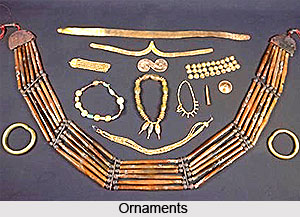
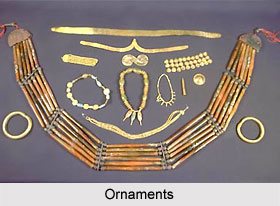
(d) Ornaments-Both men and women of the Indus Valley were partial towards ornaments, which were made of different metals like gold, silver, copper, bronze etc. and also from ivory and shell. Various kinds of ornaments donned by them comprised beads of carnelian, agate, amethyst, turquoise, lapis lazuli, bangles from shells, glazed faience and terracotta, necklaces, armlets, finger rings, earrings, bracelets etc.
(e) Means of amusement-Dicing and some kind of chess were the usual pastimes of the inhabitants. As commented by Sri Padmini Sen Gupta, "Gambling was obviously a favourite amusement and various kind of dice have been found as well as countries somewhat resembling halma pieces or chessmen". Men of Indus Valley loved hunting expeditions. This is adequately exemplified by the figures of men hunting as well as figurines of animals like wild goat, antelope, tigers etc. Children built toys of clay and played with them. People were also fond of keeping birds, possibly to witness their combats.
(f) Condition of Women-Condition of women was pretty good. They were entitled equal honour along with men in the society. The worship of mother goddess demonstrates that they were venerated in the form of mother.
(g) Means of Communication-Bullock cart was the primary resource of communication.
(h) Disposal of the Dead-There were three ways of disposing the dead. Firstly, the dead body was buried. Secondly, after burning the corpse, the dead body was buried underneath the soil. Lastly, the dead bodies were left for wild animals to scavenge on. According to Sir John Marshall, the second method was mostly used.
(i) Medicines-Not much is known however about the medicines used by people of Indus Valley. Nevertheless, Shilajeet, Coral and Leaves of Neem (all these own medicinal qualities) have been identified.