Pratyaksa anumana agamah pramanani, Patanjali Yoga Sutra - Informative & researched article on Pratyaksa anumana agamah pramanani, Patanjali Yoga Sutra
  Indianetzone: Largest Free Encyclopedia of India with thousand of articles Yoga


in  
Art & Culture | Entertainment | Health | Reference | Sports | Society | Travel
Forum  | Free E-magazine
Yoga : Yoga l Types of Yoga l Yoga Asanas l Patanjali Yoga Sutra l History of Yoga l Mudra l Suryayoga l Bhakti Yoga l Kundalini Yoga l Hatha Yoga l Yoga Institutes in India l Indian Yoga Gurus l Tantra Yoga l Sahaja Yoga l Kriya Yoga l Chakras l Karma Yoga l Yoga Ashramas in India l Pranayama l Japa Yoga l Astanga Yoga l Indian Yogic Philosophy l Properties of Yoga l Yoga Diet
Home > Health > Yoga > Patanjali Yoga Sutra > Samadhi Pada > Pratyaksa anumana agamah pramanani
Pratyaksa anumana agamah pramanani, Patanjali Yoga Sutra
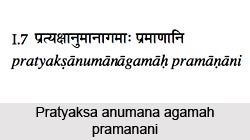
pratyaksa anumana agamah pramanani is the seventh yoga sutra, which is contained in Patanjali Yoga Sutras.

Correct knowledge is direct, inferred or proven as factual - this what has been ideally described in this seventh yoga sutra, pratyaksa anumana agamah pramanani.

pratyaksa direct perception
anumana inference
agamah traditional sacred texts or scriptural references, a person who is a scriptural authority and whose word can be relied on
pramanani kinds of proof

Correct knowledge is direct, inferred or proven as factual.

Correct knowledge is based on three kinds of evidence - direct perception, correct inference or deduction, and testimony from authoritative sacred scriptures or experienced persons.

Initially, individual perception should be ascertained by rational logic, and then checked to correspond to traditional or scriptural wisdom. This process necessitates the enlightened intelligence, or buddhi.

In present intellectual terms, buddhi is regarded as a monolithic entity. This is discouraging when attempting to understand its true role in human life and in everyday yogic practice. It is mandatory to first separate it from mind, where brain, whose function is to receive sensory information, to think and to act, has its source taking expresses itself in the form of electro-magnetic waves.

Intellect is subtler than mind. It is concerned with the knowledge of acts and the analysing ability, and becomes noticeable only through its monolithic quality, intelligence, which is closer to consciousness rather than to the mind or thought process. Intelligence is innate in every aspect of human existence, from the physical to the blissful. It is non-manifest only in the atmanJpurusa, the core of being.

The quality of intelligence is inherent but inactive, so one`s primary step must be to awaken it. The practice of asana brings intelligence to the surface of the cellular body through stretching and to the physiological body by holding the pose. Once aroused, intelligence can unwrap its vibrant aspect, its ability to tell apart. Then one endeavours for equal extensions to achieve a balanced, unwavering posture, measuring the upper arm stretch against lower, right leg against left, inner against outer, etc. This precise, thorough process of measuring and discriminating is the apprenticeship, or culturing of intelligence; it is followed in the internal sheaths by pranayama, pratyahara and the advanced stages of yoga.

It can thus be seen that discrimination is a pressing process, belonging to the world of duality. When what is wrong is discarded, what is left should be correct.

When discrimination has been cultivated and intelligence is full and dazzling, ego and mind retreats, and dtta becomes astute and clear. But spiritual intelligence, which stands for true wisdom, gets through only when discrimination ends. Wisdom does not function in dichotomy. It recognises only oneness. It does not abandon the wrong, it perceives only the right. (Patanjali calls this exalted intelligence, or vivekajajOanam, m.55.) Wisdom is not unified with nature, and is indeed inappropriate for the difficulties of life in a dualistic world. It would be of no use to a politician, for instance, however high his motives, for he must pick and decide in the relative and impermanent world. Spiritual wisdom does not decide, it knows. It is beyond time.

However, the progressive refinement of intelligence is indispensable for the search for freedom. The incisive intellect should be used to `defuse` the negative impact of memory, which links humankind in psychological time to the world of sensory pleasure and pain.

Every matter, from rocks to human cells, contains its own intrinsic intelligence, but only man has the capability to arouse, culture and finally surpass intelligence. Just as the totally pure citta, free from sensory entrapments, gravitates towards the atman, so, once intelligence has accomplished the highest knowledge of nature, it is attracted inwards towards the soul (iv.26). Buddht has the capacity to comprehend itself - its inherent virtue being honesty (1.49).

(Last Updated on : 20/03/2010)
  More Articles in Samadhi Pada
 
Atha Yoganusasanam Yogah cittavrtti nirodhah Visoka va jyotisman
Tada drastuh svarupe avasthanam Vrtti sarupyam itaratra Vrttayah pancatayyah klista aklistah
Pramana viparyaya vikalpa nidra smrtayah Pratyaksa anumana agamah pramanani viparyayah mithyajnanam atadrupa pratistham
sabdajnana anupati vastusunyah vikalpah Abhava pratyaya alambana vrttih nidra Anubhuta visaya asampramosah smrtih
Abhyasa vairagyabhyam tannirodhah Tatra sthitau yatnah abhyasah Sa tu dirghakala nairantarya satkara asevitah drdhabhumih
Drsta anusravika visaya vitrsnasya vasikdrasamjna vairagyam Latparam purusakhydteh gunavaitrmyam Vitarka vicar a ananda asmitarupa anugamat sathprajnatah
Viramapratyaya abhyasapurvah samskarasesah anyah Bhavapratyayah videha prakrtilayanam Sraddha virya smrti samadhiprajna purvakah itaresam
Iivrasamveganam asannah Mrdu madhya adhimatratvat tatah api visesah Isvara pranidhanat va
klesa karma vipaka asayaih aparamrstah purusavisesah Isvarah Tatra niratisayam sarvajnabljam Sa esah piirvesam api guruh kalena anavacchedat
Tasya vacakah pranavah Tajjapah tadarthabhavanam Tatah pratyakcetana adhigamah api antaraya abhavah ca
vyadhi sty ana samsaya pramada alasya avirati bhrantidarsana Duhkha daurmanasya ahgamejayatva svasaprasvasah viksepa sahabhuvah Tatpratisedhanham ekatattva abhyasah
Maitri karuna mudita upeksanam sukha duhkha punya apunya visayanam bhavanatah Visayavatt va pravrttih utpanna manasah sthiti nibandhanl, Patanjali Yoga Sutra Vttaraga visayam va cittatn
vapna nidra jnana alambanam va Yathabhimata dhyanat va paramanu paramamahattvantah asya vasikarah
Kstnavrtteh abhijatasya iva maneh grahitr grahana grahyesu tatstha tadahjanata samapattih Tatra sabda artha jnana vikalpaih sahkirna savitarka samapattih Smrtiparisuddhau svarupasunya iva arthamatranirbhasa nirvitarka
Etayaiva savicara nirvicara ca suksmavisaya vyakhyata Suksmavisayatvath ca alihga paryavasanam Ta eva sabijah samadhih
Nirvicara vaisaradye adhyatmaprasadah Sruta anumana prajnabhyam anyavisaya visesarthatvat Tajjah samskarah anyasamskara pratibandhi
Tasyapi nirodhe sarvanirodhdt nirbijah samadhih Samadhi bhavanarthah klesa tanukaranarthasca  
Recently Updated Articles in Yoga
  • Impact of Yoga on Muscular System
    Impact of Yoga on Muscular System of the human being is instrumental in improving flexibility, steadiness and muscle tone in an individual, through regular practice.
  •  
  • Types of Yoga Mudra
    Types of Yoga Mudra aid an individual to attain overall well being. Yoga Mudra has a remarkable effect on posture and thought process.
  •  
     
  • Types of Mudras
    Types of Mudras are categorised as mudras, eye mudras and others. The different types of mudras support self development. Practice of mudras enables one to balance mind and body.
  •  
  • Exercises for Swadhisthana Chakra
    Exercises for Swadhisthana Chakra involves various asanas like mediation and Goddess Pose. These yoga asanas help in activating the chakras.
  •  
  • Yoga Exercises of Mooladhara Chakras
    Yoga Exercises of Mooladhara Chakras encompasses different types of asanas like Apanasana, Setu Bhandasana, Shalabhasana and Janus Sirsasana.
  •  
    E-mail this Article | Post a Comment
    RSS Feeds
    Forum
    Forum on Yoga

    Free E-magazine
    Subscribe to Free
    E-Magazine on Indian Crafts
     
     
    Pratyaksa anumana agamah pramanani, Patanjali Yoga Sutra - Informative & researched article on Pratyaksa anumana agamah pramanani, Patanjali Yoga Sutra
    Sitemap
    Contact Us   |   RSS Feeds
    Copyright © 2008 Jupiter Infomedia Pvt. Ltd. All rights reserved including the right to reproduce the contents in whole or in part in any form or medium without the express written permission of Jupiter Infomedia Pvt. Ltd.
