
Of the many unique customs prevalent among the Hindus, the wearing of a Pavithram i.e. a kind of ring, made of kusa grass in the ring finger is very important. It has to be worn in the right hand while performing religious rites and ceremonies. This is a noticeable custom. The word Pavithram means purity. Hence this ring substitute of kusa grass bearing that name implies that the man performing the rites and ceremonies becomes purified for the time being by wearing it. In fact physical purity, as well as emotional and mental, are considered highly essential for the success in the performances of such rites and ceremonies. People usually bathe in rivers previous to the commencement of all such religious ceremonies. They can also bathe in tanks or any reservoir of water to obtain physical purity. As an apology for emotional purity they either fast or live on lighter diet at least for a day or a night. If that is not possible, they usually do it prior to the commencement of the ceremony itself. As there is only the mental purity to be attempted. It can be safely presume that this Pavithram is intended for the purpose.
Now it can be tried to understand if there is any explanation for wearing this Pavithram of kusa grass while performing religious rites and ceremonies. In all cases like this, the popular expressions and their meanings as well as the myths that are in reality allegories containing deep and also hidden truths. Where many of them may be pressed into service.
There is a saying Kusagra Buddhi which means keen intelligence. People somehow have connected this grass kusa with mind or intellect. So our statement that Pavithram of kusa grass has a direct application for mental purity stands supported and strengthened. Further, Lord Subrahmanya, the second born of Siva, is represented by a serpent which symbolizes wisdom. Puranas say that he was born in a Saravana or forest of kusa grass. This fact is highly significant and emphasizes that eventually supports this statement.
The Pavithram made for people performing inauspicious rites and ceremonies, as for instance, the funeral rites for the dead, consists of only one blade of the kusa grass. whereas that made for people performing auspicious ceremonies like the marriage ceremonies consists of two blades. The ceremonies neither auspicious nor inauspicious but performed with spiritual significance as for example the Tarpanam i.e. oblations of water and Sesamum offered to the Pitris or manes on new-moon days require the wearing of Pavithram of kusa grass made of three blades. The number of blades has also its significance. One blade signifies the mental force of one, while two blades signify the force of two i.e. the husband and the wife. The three blades were intended to signify the mental force of the preceptor or some one else added to those of the husband and wife.
Pavithram
This custom popularly known as purification is a unique Hindu custom observed by many.
Recently updated articles in Indian Festivals
Festivals of Dadra and Nagar Haveli
Festivals of Dadra and Nagar Haveli reflect the vibrant tribal culture and traditions of the region. Celebrations such as Tarna Festival and Divasol F...

Teething Ceremony in Indian Customs
In India, teething is observed with deep cultural significance, blending health and tradition. Families often use age-old remedies like rubbing honey,...
Lizard Chirping - Indian Belief
In Hinduism, lizard chirping is often regarded as a sign of divine communication and is considered auspicious in many traditions. The sound, such as h...
Festivals of Haryana
The festivals of Haryana reflect the state's rich cultural heritage and religious fervor. Celebrations like Gugga Naumi, Teej and Gangore are marked b...
Hareli Festival
Hareli Festival is a popular festival of Chhattisgarh. It is celebrated in the month of Shravan by the farmers who worship cows and other equipments u...
Related articles in Indian Festivals
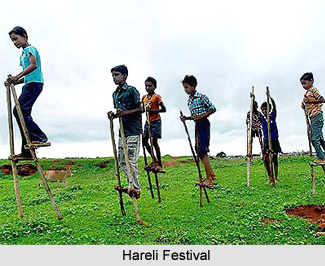
Hareli Festival
Hareli Festival is a popular festival of Chhattisgarh. It is celebrated in the month of Shravan by the farmers who worship cows and other equipments u...
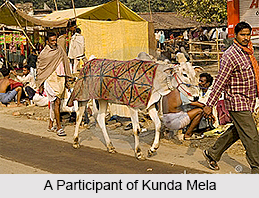
Kunda Mela
Kunda Mela is one of the famous and largest festivals of Jharkhand. The biggest attraction of this fair is the cattle trade.
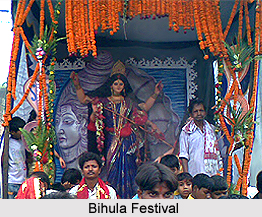
Bihula Festival
Bihula Festival is one of the popular festivals in Bhagalpur, Bihar.
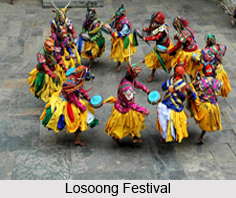
Losoong Festival
Losoong Festival is the Sikkimese New Year, of the Bhutia tribe, celebrated every year in the month of December. This festival is very famous in easte...
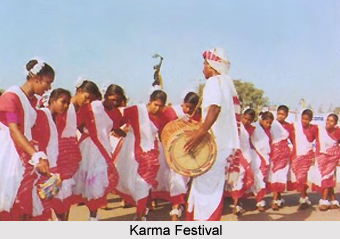
Karma Festival
Karma Festival is a tribal festival celebrated in Madhya Pradesh, Bihar, Jharkhand and Chhattisgarh.