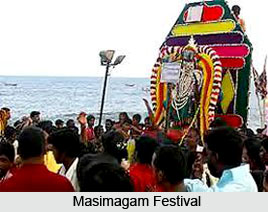
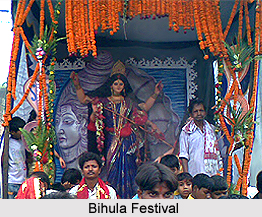
Sometimes it happens that some of the minor deities by some cause or other get displeased with the whole village or particular people in the village. Then they vent their wrath by causing epidemics among the villagers, their cattle or their produce. To avert the evil the villagers carry the Ayyan through the streets in procession at nights with burning torches and the beating of tom-toms and trumpets. The deity stops in front of each of the houses and the inmates offer him incense, fruits, halves of just then broken cocoanuts and burning camphor. The deity is taken back to the temple generally at a very late hour.
This peculiar custom appears to be special for India, since so far as ascertained no other country appears to be following or to have followed this custom.
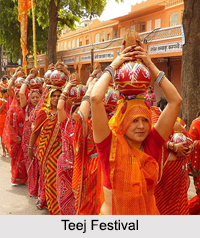
 There is the custom of carrying Karakam or pot containing water and decorated with margosa leaves, flowers, sandal paste, lime fruit, etc. When any epidemic is virulent in any village, one or more Karakams are carried through the streets of the village on the heads of people. These are especially chosen for the purpose, who must bathe and keep clean and pure for the time being. The popular belief is that this carrying of the Karakam or Karakavis in procession checks the virulence of the epidemic, though it may not avert calamity forthwith.
In auspicious religious ceremonies, the Hindus place a pot of water over paddy spread on the ground, swept and washed clean and decorated. A cluster of mango leaves is placed over the pot and on it a cocoanut is placed. After the chant of certain mantras or incantations the water is said to become possessed of special properties, being magnetized perhaps by the above processes. It is then distributed in small quantities to be taken in and it is also sprinkled over the persons or things to purify them.
In auspicious religious ceremonies malevolent and evil spirits would not be invoked by the people. Hence it stands to reason that the pot of water is intended to invoke the presence of benevolent and good spirits only. Hence the Karakam should have hovering over it only good spirits. The presence of the good spirits whose influence radiating from them is perhaps uncongenial to the evil spirits to remain in their positions of vantage any longer. They are scared away even as a bear is scared away by a lighted match. Evening twilight is the time that is most favourable for carrying the Karaka in procession. This is because of the reason that only at that time the spirits are considered to have special power.
When houses are being built, a kind of melon called Sambal Poosunikdi or white pumpkin is kept suspended in front of the house to scare away undesirable spirits who might otherwise enter the premises and cause harm to the owners of the buildings and at times to the builders themselves. It might be asked as to why these evil spirits did not enter there before. The reason perhaps is that they do not like orderly and inhabited places and prefer only ruined or uninhabited places. When a house is being demolished the evil spirits hasten there. But the melon resembling something full of water or juice has the power to frighten them away. Perhaps this vegetable has the same power which the Karakams have. But the main difference is that in the former case evil spirits are prevented from entering the house under construction while in the latter case the streets are rid of their presence.