


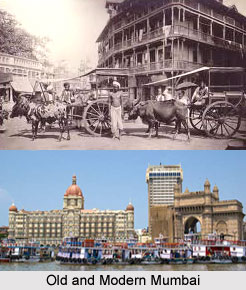
 The history of Mumbai narrates the advent of Europeans, the Parsis, land possession and finally industrial and economic development. The Mumbai of today was originally an archipelago of seven islands. Artefacts unearthed near Kandivali, in northern Mumbai indicate that these islands had been inhabited since the Stone Age. Although heavy human habitation existed throughout the history of Mumbai, the people living during the Stone Age, the Kolis, a fishing community, were the earliest known settlers of the islands. The Kolis used to call the islands "Mumba" after Mumbadevi, the Hindu deity to whom a temple called Mumbadevi templeis dedicated at Babulnath near Chowpatty Beach. The British changed the Portuguese name "Bom Baia" to "Bombay". The remnants of the Koli settlements can still be seen at Backbay reclamation, Mahim, Bandra, Khar, Bassien and Madh Island Beach. The history of Mumbai narrates the advent of Europeans, the Parsis, land possession and finally industrial and economic development. The Mumbai of today was originally an archipelago of seven islands. Artefacts unearthed near Kandivali, in northern Mumbai indicate that these islands had been inhabited since the Stone Age. Although heavy human habitation existed throughout the history of Mumbai, the people living during the Stone Age, the Kolis, a fishing community, were the earliest known settlers of the islands. The Kolis used to call the islands "Mumba" after Mumbadevi, the Hindu deity to whom a temple called Mumbadevi templeis dedicated at Babulnath near Chowpatty Beach. The British changed the Portuguese name "Bom Baia" to "Bombay". The remnants of the Koli settlements can still be seen at Backbay reclamation, Mahim, Bandra, Khar, Bassien and Madh Island Beach.
The history of Mumbai began from the time of Maurya Empire. It gained control of the islands during the third century BC. Later the Mauryas changed it into a centre for Hindu and Buddhist culture and religion. Later, between the 2nd century BC and 9th century, the islands experienced the control of Satavahanas, Abhiras, Vakatakas, Kalachuris, Chalukyas and Rashtrakutas, before being ruled by the Silhara dynasty from 810 to 1260. The Hindu rulers of the Silhara Dynasty later administered the islands till 1343, when the kingdom of Gujarat annexed them. Some of the most ancient edifices of the archipelago are the Elephanta Caves and the Walkeshwar temple. The Portuguese came to India in 1498. The Portuguese had seized the islands from Bahadur Shah of Gujarat in 1534. They were reassigned to Charles II of England in 1661, as part of dowry for Catherine de Braganza. The Mughal Emperor invaded the islands during the end of the 17th century. During the mid-18th century, the city emerged as an important trading town, with maritime trade contacts with Mecca and Basra. Economic and educational development characterised the city during the 19th century with the first Indian railway line between Bombay and neighbouring Thane in 1853 was developed by the British East India Company. The later half of the 19th century, the history of Mumbai saw feverish construction of buildings in the city, many of which such as, the Victoria Terminus, the General Post Office, Municipal Corporation, the Prince of Wales Museum, Rajabai Tower and the University of Mumbai. The Elphinstone College and the Cawasji Jehangir Hall, the Crawford Market, the Old Secretariat (Old Customs House) and the Public Works Department (PWD) Building still stand today as major landmarks in Mumbai. The Gateway of India was built to commemorate the visit of King George V and Queen Mary for the Darbar at Delhi in 1911. The city became a strong base for the Indian independence movement during the early 20th century and was the main centre of the Rowlatt Satyagraha of 1919 and Royal Indian Navy Mutiny of 1946. The momentous session of the All India Congress Committee began on the 7th of August 1942. Its venue was the Gowalia Tank Maidan, where the Indian National Congress was born in 1885. In the session of 1942, the "Quit India Movement" call was given by Mahatma Gandhi and other Indian National Congress leaders. The city was renamed Mumbai in 1996 after Indian independence. The city's secular structure was destroyed in the communal riots of 1992-93, while the bombings of 1993 caused extensive loss of life and property. The city has suffered several terrorist attacks during the 21st century. However, the interesting history of Mumbai is the strong evidence behind the growth of one of the most pulsating metropolis of India. |
| |||



History of Mumbai
| History of Mumbai reveals that the centre of Buddhist religion converted into the commercial hub of India. |
| ||||||||||||||||||||||||||||

