


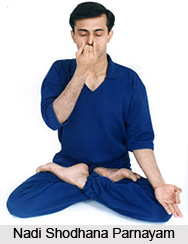
 The fiftieth yogic sutra expresses about the conditions of pranayama, in the form of inhalation, exhalation, and retention of breath. One can regulate the inhalation and exhalation process according to the capability of the sadhaka. Retension however is of two types in pranayama - interruption of breath and in- breath and out- breath. This must be performed according to the capacity of the lungs of the sadhaka. Concentration is however very much necessary in these sadhanas. The fiftieth yogic sutra expresses about the conditions of pranayama, in the form of inhalation, exhalation, and retention of breath. One can regulate the inhalation and exhalation process according to the capability of the sadhaka. Retension however is of two types in pranayama - interruption of breath and in- breath and out- breath. This must be performed according to the capacity of the lungs of the sadhaka. Concentration is however very much necessary in these sadhanas.
Bahya external Abhyantara internal Stambha restraint, suspension, a pause Vrttih movement Deia place Kala time, duration Samkhyabkih number, precision, minuteness, reflection, deliberation Paridrsfah regulated, measured Dirgha long in place and time, expansion, high Suksmah subtle, soft, minute, fine, exquisite Pranayama has through movements prolonged and fine inhalation, exhalation and retention; all regulated with precision according to duration and place. The first three components of pranayama are regulated inhalation, exhalation and retention; all must be performed, prolonged and refined according to the capacity of the aspirant. The components are to be observed with regard to place (deia), here meaning the torso, kala indicating length of breath and samkhya, denoting precision. There are two types of retention in pranayama. They comprise the interruption of the breath flow following either the in- or outbreath. The movements of the breath and the pauses between them are modulated and prolonged according to the capacity of the lungs (deia), the duration and measured regulation of the breath (kala) and the degree of refinement and subtlety (samkya) of the sadhaka. Mastery is attained by practising in synchronisation, with rhythmic regulation (paridrsfa). Concentration on the regulation of breath (prana vrtti), exhalation (bahya vrtti), inhalation (antara vrtti) and retention (stambha vrtti) is called sabtja (seed) pranayama, because attention is on the breath itself. Inhalation moves from the core of being - the seer - towards the consciousness. As mahat or cosmic intelligence is the first principle for nature's activity, its individual counterpart - citta, acts to excite the soul to activity. The inbreath is made to touch the five sheaths of the body - anandamaya, vijnanamaya, manomaya, pranamaya and annamaya, or the elements - akasa, vayu, tej, ap and prthvi; while the out breath touches in the reverse order. Bracing of the inbreath is the evolution of the soul or the ascending order of the purusa. When the self comes in contact with the physical body, inhalation is complete. Here, the purusa encompasses prakrti. The outbreath moves from the external body towards the seer, layer after layer. It is involution, or the descending order of prakrti to meet its Lord, purusa. If the inbreath is the divine union of purusa with prakrti, the out breath is the union of prakrti with purusa. Retention of the former is antara kumbhaka, retention of the latter is bahya kumbhaka. If antara kumbhaka establishes dedication of the seer (svarupa pratistha), bahya kumbhaka releases one from the four aims of life (purusartha sitnya). |
| |||



Home > Health > Yoga > Patanjali Yoga Sutras > Sadhana Pada > Sutra Fiftieth of Chapter Two - Patanjali Yoga Sutra
Sutra Fiftieth of Chapter Two - Patanjali Yoga Sutra
| This is the fiftieth yogic sutra that is incorporated within the second phase of Patanjali Yoga Sutras. |
| ||||||||||||||||||||||||||||

