





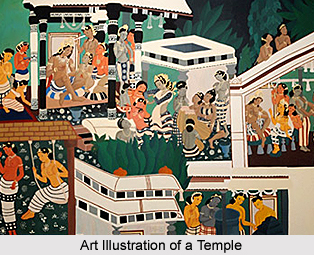
Arts and crafts of Hindu temples lays bare religious fervour mixed with artistic explorations. The Hindu temples in India were mainly constructed and developed by various kings and rulers. Most of these kings were well known for their encouragement to arts, crafts and artisans. Necessity thrives to be the watch word when one considers some basic aspects of the Hindu worldview. The notions are not only overarching and camouflaged under girding worldview concepts, to see how they form the background of specific sacred buildings in India. Those who are unfamiliar with Hinduism may hardly expect a simultaneous complex of ideas expressed in a massive structure. One might expect a single motif in a sacred structure a temple in the shape of a chariot, or a church shaped like a ship with an up-pointed prow and such one-theme structures do exist. But there are also Gothic cathedrals with designs that include a forest of spires, a floor plan which is cross-shaped, a rose window above the main altar and many other forms statues and symbolic art works displaying a combination of themes. The Hindu temple typically involves a multiple set of ideas. Perhaps Hindu traditional architecture has more symbolic meanings than other cultures. It certainly is highly articulated. The temple is oriented to face east, the auspicious direction where the sun rises to dispel darkness. The temple design includes the archetypal image of a Cosmic Person spread out yogi-like; symmetrically filling the girded space of the floor plan, his navel in the centre, and it includes the archetype of the cosmic mountain, between earth and heaven, of fertility, planets, city of the gods, deities, etc.). One encounters these simultaneous archetypal themes and meanings conveyed (and hidden) in the semi-abstract forms in many Hindu temples. The temples were considered as the houses of the King of kings' i.e., of gods and goddesses. Hence, the kings could not keep the temples devoid of any art and crafts. The Hindu temples used to be very big in size and also acted as the biggest employers of the artists and the craftsmen. The Hindu temples provided the greatest security and encouragement to the artisans and artists. There are a number of symbolisms combined in the Hindu temple. In fact the Hindu temple is a fusion of archetypes consciously combined and skilfully crafted into structures of abstract geometry and specific numbers. It is a grand synthesis which solves architectural problems using concepts from the characteristically Hindu religious vision of cosmic order. The temple is a visible sign of that mystery, an access point designed to solve life's problems. These artists and craftsmen made various art works and crafts within these temples and kept there for exhibition. Besides these, the other arts and crafts associated with the temples were music, dance, preparation of musical instruments, embroidery work on cloth, tailoring, preparation of perfumes and scents, making of flower-garlands, cooking of special dishes, astrology, building the ratha, etching or embossing on metal plates used in various ways, making of lamp-posts and stands, as also puja vessels in brass, bronze and copper, painting, gold and silver smithy, ivory craft and so on. These art works flourished in these temples and later became a good trade due to these temples. The traces of those beautiful artworks and crafts can be seen till today in several Hindu temples. "As from a blazing fire thousands of sparks fly forth, each one looking self-similar to its source, so from the Eternal comes a great variety of things, and they all return to the Eternal finally." Mundaka Upanishad. Indian Temples echo the similar attitude. |
| ||||||||||||||||||||||||||||

