About Sri Pataladri Narasimhasvami Temple
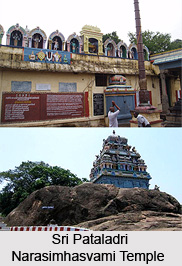
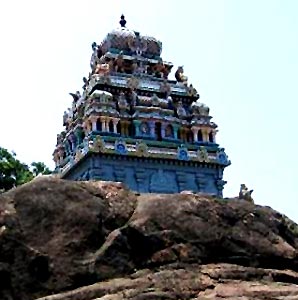 Sri Pataladri Narasimhasvami temple is one of the significant temples in the small village of Singaperumal Kovil. Situated approximately forty-five kilometers from Chennai on National Highway 45 leading to Tiruchirapalli, is located the ancient and celebrated village now known as Singaperumal Kovil. The small village is so named as there is a temple for Lord Narasimha (Singa Perumal), which is situated in the heart of this place. This temple houses the imposing image of Pataladri Narasimhasvami, who is venerated as the presiding deity of the temple. The shrine is actually a rock-cut shrine belonging to the era of the Pallava monarchs who ruled from their capital-city Kanchi (Kanchipuram) over large parts of northern Tamil Nadu. As the historical researches reflect it was from the time of Mahendravarman I Pallava (600-630 A.D.), that the tradition of creating cave-temples for various deities came into vogue in the ancient Tamil country. Mahendravarman`s successors continued with this tradition and the rock-cut Narasimha cave-temple, like many others in the northern parts of Tamil Nadu, thus came into existence during the Pallava era. These rock cut shrine was the specimen of the superb architecture, which was in vogue in the Pallava era.
Singaperumal Kovil is a legendary place and is known by the name of the deity. The name of the deity is derived from the Sanskrit name Pataladri as this hillock (adri) into which the cave-temple has been carved is reddish (patala) in appearance. Although the principal deity here is now known as Pataladri Narasimhasvami and this place is called Singaperumal Kovil, the ancient inscriptions found in this shrine reveal that this deity was known by various other names in the distant past. The names with which the deity was known in the ancient times are Azhvar Narasinga Vinnagar Deva and Narasinga Vinnagar Azhvar. This sacred place where the temple is erected was originally known as Chengunram (red hillock) and was part of the territorial sub-division called Chengunra Nadu situated in the region of Kalattur-kottam. Pataladri is thus the Sanskrit variant of Chengunram, the ancient Tamil name for this sanctified spot.
However a legendary story associated with this temple has pointed to a significant fact about the temple. The ancient Sanskrit text, Brahmanda Purana, mentions that this temple and its surrounding area were once surrounded by dense forest where Jabali Maharishi, a consecrated sage performed strong penance to have a vision of Lord Perumal. The Lord, pleased with his arduous penance, appeared before this sage in the disguise of Ugra Narasimha. Immediately after this incident He had destroyed the demon (asura) Hiranyakashipu. The temple of Sri Pataladri Narasimhasvami Temple at Singaperumal Kovil is a legendary temple and the specimen of the Pallava art and architecture.
Architecture of Sri Pataladri Narasimhasvami Temple, Singaperumal Kovil: - the architectural trappings of the temple reveal the essence of the Pallava era as its essential feature. The beautiful images with their charming architectural carvings reveal the excellence of the contemporary era. The structure of the temple is no less fascinating, which bears the evidence of the contemporary style of art and architecture.
Inscriptions of Sri Pataladri Narasimhasvami Temple, Singaperumal Kovil: - the inscriptions enhanced the legendary greatness of the temple. The inscriptions provide information about the chronology of the temple. Most of the inscriptions belong to the Chola age, which depicts the achievements of the great kings and their benevolent contribution.
Architecture of Sri Pataladri Narasimhasvami Temple
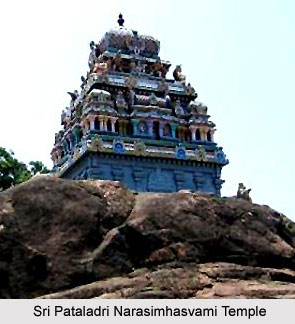 The legendary greatness of Sri Pataladri Narasimha temple is enhanced by the exceptional architectural trappings of the contemporary Pallava era. A stately magnificence is attached with the antiquity of the temple by the unusual architectural craftsmanship of the contemporary artists. The main sanctum of Lord Pataladri Navasimhasvami bears the clear evidence of the contemporary art. The entrance to the main sanctum is flanked by door-keepers (dvarapalakas) is a rock-cut shrine and has the flavor of the architecture, which was in vogue in the 7th century A.D. Immediately in front of this sanctum, which faces east, is erected a mandapa supported by many pillars of the Chola age as is evident from the architectural features as well as the presence of many important Chola inscriptions datable to the 10th century A.D.
The images of the temple are no less fascinating. The images housed in the temple are also the best specimen of the brilliant architecture of the contemporary era. Enshrined in this cave is the awe-inspiring and magnificent image of Lord Ugra Narasimha with the third eye (trinetra) in the centre of His forehead. Pataladri Narasimhasvami, the presiding deity is seen wearing the Salagrama and Sahasranama garlands along with the Lakshmi hara. The deity is seated is a captivating posture with His right leg folded on a pedestal and left leg placed on the ground. This deity is four-armed and carries in His upper right and left hands the discus named Sudarsana chakra and the conch named Panchajanya respectively. His lower right hand is made in the posture of abhaya hasta, thereby representing an offering of ever-lasting protection to His devotees and His left hand is in the attitude known as uru hasta, resting on His lap. The processional deity (utsava-image) here of four-armed (Chaturbhuja) Vishnu surrounded by the deities like Sri Devi and Bhu Devi (Ubhaya Nachiyar) is affectionately called Prahlada Varadar. The vimana above this main sanctum, studded with beautiful stucco images is called Pranavakoti vimana. The Pranavakoti Vimana is a significant architectural specimen and reveals that architecture with stucco was highly in vogue during the Pallava era.
To the right of the rock-cut shrine of Lord Narasimha, is erected the consecrated sanctum dedicated to Goddess Lakshmi. Goddess Lakshmi here is known as Ahobilavalli Thayar just as in Ahobilam. This sannidhi, as well as the one for Andal which is to the left of the main sanctum, are not cave-shrines, but constructed at a later date as the historical researches reflect. These two shrines, both facing east, have guarded with a circumambulatory (pradakshina) passages around them, whereas, the main sanctum for Lord Pataladri Narasimhasvami. The sanctum for the presiding deity, Lord Pataladri Narasimhasvami is carved out of the granite hillock. The entire complex of the sanctum dedicated to the presiding deity is circumambulated by going around the entire cave-temple on the outside by ascending and descending a number of steps. This circumambulatory path is thus called by devotees as "giri-pradakshinam` (giri-valam), which means the circumambulation of the entire hillock. However this process of circumambulation has a special significance, because it is believed that if the entire sanctum is encircled then the god will be delighted and fulfilled the wish of the devotee.
Facing south, near the main sanctum-sanctorum, is stationed a small shrine where Lord Lakshmi Narasimha, along with an image of Vishvaksena, is enshrined. This image of Lord Lakshmi Narayana is exceptionally charming. The striking feature of this temple is that it houses the attractive images of the Azhvars, the pre-eminent Srivaishnava preceptor. Ramanujacharya and Manavala Mamuni are worshipped in the larger pillared mandapa at the entrance. Here, there is erected a small shrine dedicated for the worship of Garuda or Periya Tiruvadi which is directly facing towards Lord Narasimha. At the end of the road, perpendicular to the main entrance to this temple is a small shrine for Anjaneya or Siriya Tiruvadi. These sub shrines are the clear evidence of the exceptional architecture of the contemporary era.
The tenets of the Vaikhanasa Agama are followed with regard to pujas and rituals in this temple. The sacred-tank, situated a short distance from the temple is called Shuddha Pushkarini and the sacred tree (sthala-vriksha) here is popularly known as Parijatha tree which, with its beautiful and sweet-smelling flowers, can be seen by devotees as they ascend the steps to perform the giri-valam.
Inscriptions of Sri Pataladri Narasimhasvami Temple
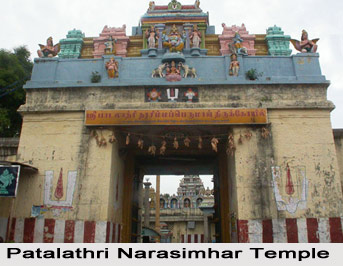 The inscription provides an added grandeur to the legendary greatness of Sri Pataladri Narasimhasvami Temple. There are a number of ancient, historical inscriptions written in Tamil, found etched in various parts of this temple. These inscriptions clearly points to the chronology and thereby points to the magnificence of the temple. The earliest of these, according to the historical researches dated 990 A.D. It has been discovered on the right pillar of the central facade of this rock-cut shrine, which belongs to the reign of Rajaraja I (985-1014 A.D.), the illustrious Chola emperor who ruled from his capital-city of Tanjavur over a large part of South India. This inscription moreover records the donation of twenty-six sheep for the maintenance of Azhvar Narasinga Vinnagar Devar by a person named Senda-Kutti.
Another inscription dated 993 A.D., also of the reign of the same Chola monarch is considered important by the historical research. It records the registration of gift of land to this temple by a person named Ayyaran Nakkan for maintaining two lamps and for food offerings to Narasinga Vinnagar Azhvar. These two lamps were considered as the emblem of the contemporary ruler as the inscriptions depict. Another inscription belonging to the same year (993 A.D.) is found on the rock behind the Andal shrine is unfortunately damaged and incomplete, but appears very significant on close reading. It refers to some gift made by an individual to God Narasinga Vinnagar Azhvar of Chengunram.
The last of the epigraphs in this temple is found on the lower portion of the right pillar of the central-facade of the main shrine. It belongs to the 11th century A.D., but since it is much damaged, the details cannot be made out clearly. It is likely that this one too, like the previous inscriptions, records a donation made to this consecrated temple by the contemporary kings and kings` men.
Festivals of Sri Pataladri Narasimhasvami Temple
 There are a number of festivals celebrated almost every month at the Pataladri Narasimhasvami temple of Singaperumalkoil. Singaperumalkoil is a census town located in Chennai metropolitan city in the Tamil Nadu state of India. It is acknowledged by the name of Pataladri Temple, because here Lord Narasimha is in his Ugra Roopa. Narasimha is one of the incarnations of Lord Vishnu, who is half-man and half-lion. As per the mythological story, it is believed that at the request of Sage Jabali, Narasimha, Singaperumal or the Lion God, manifested himself immediately after he packed off Hiranyakashyapu to the nether world. The festivals of Pataladri Narasimhasvami temple reveal its cultural significance. The festivals are organized with immense pomp and grandeur during which a number of devotees gather in the temple complex to offer their worship to the lord.
The most famous one is the festival of Brahmotsavam in the month of Vaikasi (May-June) which is attended by a very large number of devotees. Some of the other important festivals are Varushapirappu (Tamil new year), Bhashyakarar Utsavam and Nrisimha Jayanthi in the month of Chittirai (April-May); Periyazhvar Utsavam in the month of Ani (June-July); Gajendra moksham, Jyeshtabhisekam and Tiru Adi Puram in Adi (July-August); Pavitrotsavam celebrated for a long period of five days and Sri Jayanthi in Avani (August-September); Navaratri in Purattasi (September-October); Deepavali and Manavala Mamuni Satumurai in Aippasi (October-November); Tiru Kartigai Utsavam in Kartigai (November-December); Dhanurmasa Puja and Adhyayana Utsavam including Vaikuntha Ekadasi in Margazhi (December-January); Sankranti Utsavam and Thai Pusain in Thai (January-February); Ratha Saptami (during which the deity is taken out on seven different vahanas on the same day) and Theppa Utsavam in Masi (February-March); Yugadi Utsavam and Panguni Uttiram in the month of Panguni (March-April). The stanzas from the Periya Tirumozhi of Tirumangai Azhvar, in praise of Lord Narasimha at Ahobilam are recited in this temple. Hence, the temple is considered as a sacrosanct.
The festivals organized in the temple reveal the enduring religious tradition of India. The religious tradition of the temple is continuing its worship for approximately a thousand and four-hundred years, and continues to draw multitudes of devotees even in the present day.