


 The Vedic religion is largely based on the Vedas; hence the prominence of the Vedas in this ancient religion cannot be withheld. The Rig Veda, which is the oldest religious document, contains 1028 hymns that speak much of the religious ideas and deities of the Vedic religion. Natural phenomena were personified and divinity was imposed on them. Vedic hymns refer to deities, consisting of 8 Vasus, 11 Rudras, 12 Adityas and the late Rigvedic Prajapati. These deities belong to the three dimensions of the universe/ heavens, the earth and the intermediate space. The Vedic religion is largely based on the Vedas; hence the prominence of the Vedas in this ancient religion cannot be withheld. The Rig Veda, which is the oldest religious document, contains 1028 hymns that speak much of the religious ideas and deities of the Vedic religion. Natural phenomena were personified and divinity was imposed on them. Vedic hymns refer to deities, consisting of 8 Vasus, 11 Rudras, 12 Adityas and the late Rigvedic Prajapati. These deities belong to the three dimensions of the universe/ heavens, the earth and the intermediate space.
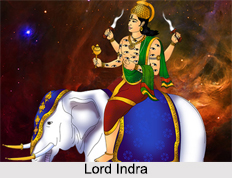
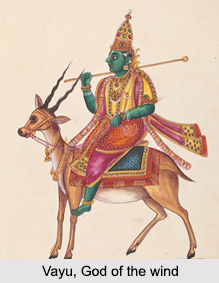
Deities of Vedic Mythology Vedic deities can be classified as terrestrial Gods like Prithvi, Soma and Agni; atmospheric Gods like Indra, Vayu, Maruts, Parjanya etc; heavenly Gods like Varuna, Dyans, Asvins, Surya, Savitri, Mitra, Pushan and Vishnu. The last five forms are associated with the different phases of the sun's glory. Among these Varuna occupied a place of honor. Indra was the God of thunderstorm and caused rainfall to relieve the dry earth. Then comes Agni, the God of fire. There were also some abstract deities like Sraddha(faith), Manyu (anger), and Goddess Usha (goddess of dawn). With the passage of time, the Rig Vedic Gods went through a phase of transformation and change in the Atharva Veda. The Rig Vedic era considered Indra to be the almighty, powerful god, which actually got changed to the Prajapati who was then believed to be the creator and the preserver of the universe. The Gods of the Rig Veda were essentially natural phenomenon, but the Aryans tried to personify them and thus the anthropomorphism began. There are actually two major families of Gods, the Devas and the Asuras. Rivers also play an important part in the Vedic pantheon. They are deified Goddesses, the most important among them being the Sapta Sindhu and the Saraswati river. Yama, the God of the underworld and death, is also worshipped as deity. Origin of Vedic deities The concept of deities finds a remarkable dimension in the Vedic religion. It is said that the Vedic gods who in due course became established in India were the result of the fusion of ideas brought by the invading Aryans and those of indigenous people such as the Dravidians. The Aryans of Vedic era were actually herdsmen but they emphasised less on the propitiation of rural deities. They stressed more on the adoration of more fundamental and abstract conceptions, and natural phenomena such as the sun (Surya), and fire (Agni). The reference of these deities was found in the Vedas along with thorough descriptions of the ceremonies that intended to bring material benefit in this world for the worshipper.
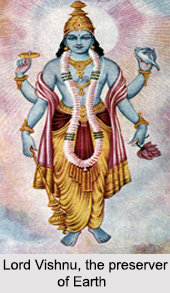 Image and Idol worship in Vedas Image and Idol worship in Vedas
Most of the Vedic deities were to a large extent visualized as having human or animal forms although the degree to which this happened was not the same in all cases. It is not clear that whether these deities were worshipped in the form of images. This uncertainty is perhaps the strongest evidence against image worship in the Vedic period. It is possible that some people of the lower strata of the population, who worshipped images in human or animal form, developed the image worship later. This practice was gradually spread upwards to other sections of society. The Vedic deities were retrospectively given human form and reproduced as images at a much later period. The bronze figure of Surya is an example of this process. When the Aryans penetrated more into India and came in contact with the local inhabitants, the old Vedic religion underwent several changes. These chiefly concerned the deities that were worshipped and the forms of ritual. Some Vedic deities changed their function, gained or lost prestige, while the powers of intervention between deity and layman became monopolized by the priests (Brahmans) who alone could perform the necessary sacrifices. Some deities such as Vayu, the Vedic wind-god, and Indra (king of the Gods and God of the thunderstorm) got more prominence then. The involvement of the layman increased the awesomeness of the Vedic Gods like Varuna, guardian of the cosmic order. Every religion in the world has originated with the idea of the "Supreme Being". Worship is the only way a human being can stay connected to the Supreme Being. In whatever the Rishis of Vedas felt the presence of Supreme Being they started worshipping, for example, sun, wind etc. Even Lord Indra was worshipped because he could control the strength of light, water and rain. Humans worshipped Lord Indra as the strength until the completion of the first three ages. Till the completion of the third age (Dwapar yug), the idea of Supreme Being had been established in peoples’ minds. Lord Krishna had stopped the trend of Indra worship in his childhood and humans started a trend of worshipping Krishna in the name of Gowardhana. Vedas boasted of changing of forms of Supreme Being. Several old deities were assigned to minor positions and others were promoted, and some new deities were introduced. Thus, the need arose for a more satisfying relationship between the devotee and the God. This need for devotion (bhakti) towards a personal God or Goddess inspired the desire for images which would make the deity more easily accessible. The introduction of the images of the deities in the Vedic era was certainly a slow and uneven process. The images were at first only made of minor deities in the pantheon form. The earliest images of the deities were those of Yakshas (tree spirits) and Nagas (snake gods).
 Classification of the Vedic deities Classification of the Vedic deities
The Rigvedic deities may be placed under four categories. The first one can be mentioned as those representing the principal phenomenon of nature, the second one is domestic deities, the third one is abstract deities and the fourth one is minor deities. Vedic Deities that represent phenomena of Nature can be mentioned as follows: Among the Domestic Vedic Deities, the following are important: Among the Abstract Vedic Deities, the following are important: The Minor Vedic Deities can be named as follows: |
| |||



Home > Reference > History of India > Ancient History of India > Vedic Civilisation in India > Vedic Religion > Vedic Deities of India
Vedic Deities of India
| The concept of Vedic deities finds a remarkable dimension in the Vedic religion. Indra, the slayer of Vritra and destroyer of Vala, liberator of the rivers and the cows; Agni the sacrificial fire; and Soma, the ritual drink dedicated to Lord Indra, are the most prominent deities. |
| ||||||||||||||||||||||||||||

