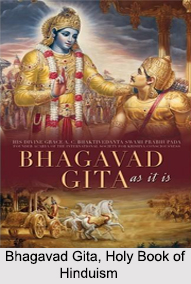
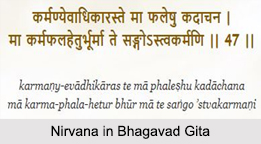
 The Bhagavad Gita has given various paths of `Nirvana` or `moksha`. Some of these paths are discussed here:
Karma Yoga:
According to the Bhagavata Gita, the discipline of action or the `karma yoga` is one of the doctrines of the Gita, through which the Nirvana can be attained. This path of `moksa` supports the performance of actions with balance-mind. It is considered to be the `golden-mean` amid attitudes of `pravritti` and `nivritti` (action and withdrawal). This path can be followed by only those people who are beyond `faint- heartedness` (hridaya-daurbalyam).
The Karma yoga supports attaining `Nirvana` (dharmas) through duties of caste and state. Lord Krishna in Bhagvad Gita asked Arjuna to release himself from all the social obligations. He also advised him that one should never follow others duty. Lord Krishna also maintains the theory that actions should be performed without desire for results (niskama-karma-yoga).
Jnana Yoga:
Jnana yoga is another path for `Nirvana` given by the Bhagavad Gita. It is the discipline of knowledge, which believes in the knowledge of the self (soul) and purity. According to this path, one needs to have self-control and should perform the actions with knowledge to attain `nirvana`. The Gita says that one can get rid of the arrogance, pride and vanity through Jnana yoga and can achieve the excellence of forgiveness.
According to the Bhagavat Gita, a jnani (wise) person is one who identifies the self in all and all in the self. He does not quit normal activities of life, but acts for the welfare of the world (loka-samgraha). This path of Gita asserts that every person can achieve supreme peace by the highest knowledge `karma creates bondage, jnana liberates from samsara`.
Bhakti Yoga:
The Bhagavat Gita informs about another path of Nirvana known as the `Bhakti yoga`. This is the path of devotion. Bhakti means `belief in God` or taking refuge in God. The path of devotion is discussed in the twelfth chapter of the Gita. Here, a devotee is said to be a satisfied soul, who is dearer to God. Those who performs `Bhakti yoga` is said to have persistent wisdom, controlled mind and the person remains beyond praise and suffering. This devotee is devoid of any desire and hate. The individual trying to reach `Nirvana` through `Bhakti yoga` becomes fearless and does not possess egoism. The person is self-restrained, pure, adept, silent and very kindhearted to others.
The follower of Bhakti yoga possesses firm conviction, hopes for nothing and is content with whatever comes to him. He neither disturbs the world nor is disturbed by it. According to the Gita devotion to God is essential and as a result liberation comes. Likewise, the Gita says, `Abandon all duties, and take shelter in God`.
Yoga:
There are different ways of Yoga available in Gita. It is the process of attaining `Nirvana` through meditation. Fundamentally discipline in action is yoga, `karmasu kausalyam yoga`. The path of Yoga insists on self-control and tranquility. This process proposes to the control of body, mind and breath. The process of doing yoga is also discussed here:
i) one needs to sit in a calm and quite place on the
grass/deer-skin,
ii) look at the tip of nose and
iii) Keep the mind on one point that aimed.
It is believed that yoga gives pleasure more than that derived from senses. The perfect peace can be attained through yoga and it leads to nirvana in God.