Madhuca, also known as `butter tree`, is an enormous deciduous tree, 20 metres in height, with an overspreading top. It has stocky leathery leaves and tiny, fleshy, pale or dull white musk-perfumed flowers in bunch near the branch end. Its fruits are plump, greenish, with brown and gleaming seeds.
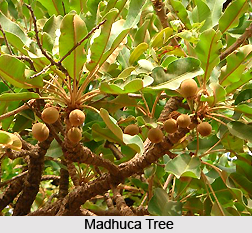 The bark, leaves, flowers and seeds of the tree make up the drug. The trade name, madhuca, is based on the Sanskrit name of the plant.
The tree is indigenous to Central India. It is common in sub-mountainous regions of the Himalayas, and is in certain places a chief component of forest vegetation.
The leaves of the tree hold the alkaloid glucosidic saponin. The seeds contain a fatty oil. In recent times a new sapogenin and basic acid have also been sequestered from the seeds.
Methods of usage
Madhuca has immense usefulness, ranging from common, everyday illnesses, to chronic ones like bronchitis, rheumatism, diabetes, piles, eczema or bleeding gums.
Healing Power and Medicinal Properties of Madhuca
Madhuca is useful in checking secretion or haemorrhage, due to its tannin content. The bark of the tree is an astringent and revitaliser. The flowers boost the deletion of catarrhal matter and phlegm from the bronchial tubes. They also exercise a solacing effect on the skin and mucous membranes. A spirit developed from the flowers is reckoned a nutritive and a revitaliser.
Bronchitis cured by Madhuca
The flowers of the tree are efficacious in bronchitis and coughing. They should be administered in dosages of 30 grams, with 250 ml of milk.
Rheumatism cured by Madhuca
A decoction of the bark can be administered internally in rheumatic illnesses. The oil distilled from the seeds can also be massaged locally on the affected portion.
Diabetes cured by Madhuca
A decoction of the bark can also be consumed in diabetes mellitus with positive consequences.
Piles healed by Madhuca
Madhuca oil distilled from the seeds possesses purgative attributes. It helps cure piles by assuaging acute constipation.
Orchids
Vaporisations of boiling madhuca leaves are helpful in alleviating the pain of orchids or the redness of testicles.
Problem of Breast Milk Secretion healed by Madhuca
Flowers of the tree are efficient in augmenting the flow of milk in lactating mothers. The seeds also bear a parallel dimension.
Bleeding Gums cured by Madhuca
An ointment prepared by blending 4 ml of the liquid extract of the bark of the madhuca tree with 300 ml of water is a superb gargle for bleeding and squashy gums.
Tonsillitis cured by Madhuca
The above-mentioned lotion can also be used as a gargle in the treatment of acute and chronic tonsillitis and pharyngitis.
Eczema healed by Madhuca
The leaves of madhuca are efficacious in treating eczema. The leaves, smudged with sesame oil, warmed over fire and bandaged on the affected parts, provide respite. They should be changed after every 3 to 4 hours.
Skin Disorders healed by Madhuca
The ash of the leaves, merged with ghee, is often used as a dressing for burns and scalds in the aboriginal system of medicine. For the cure of itchiness, a paste of the bark is massaged locally. The oil distilled from the seeds can also be applied locally in skin disorders.
Other Uses of Madhuca
The Madhuca tree is a significant source of food for the Gonds and other tribes in Central and Western India. The flowers are eaten unprocessed or cooked. They are also used for preparing alcohol, vinegar, syrups and jams. Madhuca oil is mostly used in the manufacturing soaps, in addition to cooking.