Literature and art During the Satavahanas
|
Literature and art flourished like any thing during the reign of the Satavahanas.
|
|
|
 From literary point of view this was the period of the rise of the Prakrit language. All the inscriptions of the Satavahana king are in Prakrit language. Halla was the greatest poet of this period. He composed 'Saptshati' in Prakrit language. 'Brihatkatha' of Gunagya was also the composition of this period. According to Allen a scholar named Sarvavarman wrote 'Katantra'. This was a book on grammar during this period. From literary point of view this was the period of the rise of the Prakrit language. All the inscriptions of the Satavahana king are in Prakrit language. Halla was the greatest poet of this period. He composed 'Saptshati' in Prakrit language. 'Brihatkatha' of Gunagya was also the composition of this period. According to Allen a scholar named Sarvavarman wrote 'Katantra'. This was a book on grammar during this period.
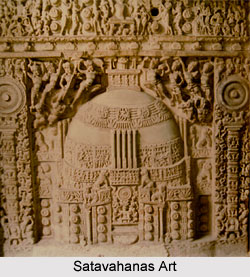
The contribution of the Satavahana period in the field of art is also great and mentionable. The remains of the stupas and sculptures of this period have been found in sites in Andhra at Goli, Jaggayapata, Bhattiprabe, Ghantasala, Amaravati and Nagarjuna Konda. The stupas of Amaravati are the largest and finest in quality. In the opinion of sir John Marshall "There is greater originality, freedom of treatment, spontaneous exuberance in the art of amaravati. The relief of Amaravati indeed appear to be as truly Indian in style as those of Bharhut and Ellora. They followed as a natural sequence on the Mauryan art, when that art was finding expression in more conventionalized forms. They have inherited certain motive and types which filtered from the north-west but these elements have been completely absorbed and assimilated without materially influencing the indigenous character of the sculptures."
In the field of paintings also much progress had been achieved. The architecture was also highly developed. Many Chaitya and Guhagriha i.e. cave-houses built by the Buddhists during this period. These are the fine examples of the art as well.
|
|
|
|





