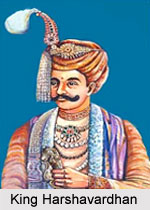
 Besides being a great conqueror and a religious minded and generous king, Harshavardhan was also a great lover of education and learning. He is supposed to be the author of `Ratnavali`, `Priyadarshika` and `Nagananda`. Historians say "Harsha was not a mere detached patron of letters he himself appears to have wielded the pen with no less dexterity and effect than the sword. There are three plays, viz., the `Ratnavali`, `Priyadarsika` and the `Nagananda`, which are said to have been composed by a king named Harsadeva. This royal author has been identified with Harsha of Kannauj, since it is contended that no other sovereign of this name can meet the requirements of the case."
In his book `Gita govind`, Jaidev has compared Harsha with Kalidasa. Itsing, the Chinese traveller has written that the drama `Naganand` was staged before him. According to Itsing, "Harsha himself verified the story of the bodhisattva Jimutavahana. We are also told that Harsha had his own drama Nagananda played before him. He is also credited with the authorship of the two dramas, Ratnawali, and the Priyadarsika, together with a grammatical work. Harsha`s literary reputation was known even in the time of Jayadeva who in his Gitagovindam ranks him as a poet along with Bana and Kalidasa."
Damodar Gupta of ninth century has referred `Ratnavali` as the composition of a king. Madhusudan of 10th century told Harsha as the author of `Nagananda`. Later on, some expressed the view that these books were not written by Harsha and he got them written by giving sufficient wealth to some scholar. The second view in this regard is that these works were the creations of Bana. But considering the style and other related facts and circumstances, these views do not seem to be correct in the absence of any reliable evidence. On the contrary it is perfectly all right to regard Harsha as the author of these literary works.
Harshavardhan was a patron of scholars. By his tolerant support of learning Harsha attracted to his court some of the best men of those days. The chief of them was `Bana` himself.
Bana is ranked among the greatest Sanskrit authors. His two great works are `Harshacharit` and `Kadambari`. `Harsha-charit` is important from historical point of view. Besides this, some scholars are of the view that `Parvati-pranaya` was also written by Bana. But this view is not correct and many scholars reject this view. Jayasena was another great scholar in the court of Harshavardhan.
Jayasena, was another author who also received royal patronage in abundant measure. Recognized for his encyclopedic learning in subjects like Hetuvidya, Sabdavidya and Yogasastra Jayasena was a great scholar. It is said by the historians "the emperor offered to assign to him in recognition of his learning the revenue of as many as eighty villages in the province of Orissa. But Jayasena, true to his own spiritual outlook, declined the royal offer on the ground that it would lead to worldliness." This proves Harshavardhan royal patronage towards education.
Yet another scholar, Mayura was also in the court of Harsha. He was the author of `Suryashatak`. The famous scholar Diwakar also adorned the court of Harsha. Some scholars hold the view that Bharavi, the author of `Kirtarjuniyan`, Subandhu, the author of `Vasavadatta` and Kumardas, the author of `Janaki haran` were also the contemporaries of Harsha. For some time, the famous scholar Dandi was also the contemporary of Harsha but he wrote his literary work `Dashkumar charit` and `Kavyadarsha` after the death of Harsha. To conclude, a quote of Dr. R. C. Majumdar can be added as, "A great general and a just administrator, Harsha was even greater as patron of religion and learning. He gathered round himself the finest intellects and holiest sages. Man like Bana, Mayura, Divakara and Hiuen Tsang thronged round his throne. In this respect he is more fortunate than Samudra Gupta for we still possess some gems of literature that proceeded, according to tradition, from his pen."