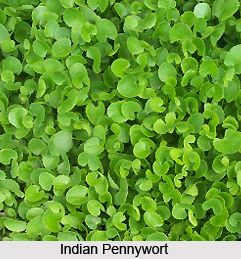
 Indian pennywort is native to India. It was known to Sanskrit writers from prehistoric times. This plant is found all around India both in the plains and hilly tracts upto 2000 metres. It grows extravagantly in damp areas and riverbanks, prospering in shades.
Methods of usage
Indian pennywort heals intelligently, like boosting memory power, curing dysentery, nervous breakdowns, skin eruptions and chronic infectious sickness.
Healing Power and Medicinal Properties of Indian pennywort
The herb corrects the tangled processes of nutrition, by which organism ingests, digests, absorbs, utilises and excretes food substances - and rejuvenates the standard function of the system. It counterbalances swelling and is a mild laxative. It also increases the secretion and flow of urine.
All the parts of the creeper are used both for remedial and culinary purposes.
Improving Memory through Indian pennywort
Leaves of Indian pennywort are considered favourable in boosting retentiveness. The pulverisation of the leaves consumed with milk in small doses for this purpose helps in correcting the disorders.
Dysentery in Children cured by Indian pennywort
The leaves of the plant are a vital remedy in the early stages of dysentery in children. Three or four leaves can be had with cumin and sugar in addition to applying a paste of the leaves on the navel.
Bowel Complaints healed by Indian pennywort
In case of bowel complaints among children, half a cup of an extract of its leaves with fenugreek (methi) can be taken in a single dosage.
Nervous Disorders cured by Indian pennywort
The herb is efficient in nervous disorders, including nervous exhaustion. A grind of the leaves dried in shade and taken in dosages of 3 to 6 decigrams, thrice daily for adults, is effectual. One however needs to reduce the dosage to 0.75 to 2.5 decigrams for children.
Female Sterility healed by Indian pennywort
Indian pennywort is useful in female sterility when combined with another herb called chotakulpha, (trichodesma Indicum). The two herbs should be rooted out when matured and dried in the shade for usage. An equal quantity of both herbs should be taken, fine-grained with sugar candy in the ratio 2:1. Three grams of this powder should be cosnumed both in the morning and evening with cow`s milk for 3 successive days after menstruation. However, the lady using this recipe should be free from menstrual pain, leucorrhoea, obesity or any such disease. If she has any, these should be cured before going in for the said remedy.
Elephantiasis healed by Indian pennywort
The drug is useful in handling elephantiasis of the scrotum and legs, which is distinguished by foul swelling. The juice distilled from a portion of the fresh plant or the dried stem and leaves of the plant mashed with water should be administered locally to the affected portions. A poultice of the fresh leaves or a balm made of four grams of the leaf extract with 30 grams of lanoline is equally effective.
Skin Disorders cured by Indian pennywort
Indian pennywort is a common home remedy for skin diseases like acute and continual eczema, chronic ulcers and syphilitic sores. A fine pulverisation of the dried leaves can be used as a dust in exanthems and syphilic ulcers. To arrest fever associated with these diseases, juice of the leaves should be taken thrice everyday in dosages of 1 to 5 drops.
Dosage - The drug is normally administered as a decoction in dosages of 30 to 60 ml or as pulverisation in dosages of 2 to 6 decigrams thrice daily. The leaves of the plant can be consumed in dosages of 30 to 60 grams. The juice of the leaves can be had in dosages of 60 to 100 ml and the decoction of the leaves from 120 to 150 ml.
Precautions - It is better to take the raw juice of the leaf in small, because the juice is very effective and a surplus intake leads to coma.
Other Uses of Indian pennywort
The leaves of Indian pennywort have gastronomic uses too and can be used for cooking soup, raw chutney, tea, raw juice and chapatis (mixed with wheat flour).
Composition
Indian pennywort is a perpetual wild vine growing parallely and is small and polished to look at. It has lean branches and tiny internodes. A number of leaves sprout out at each node on the upper side and several roots grow into the soil at each node. The vine thus has profuse leaf growth and new plants sprout out from several nodes.
The leaves of the plant are plain or have one blade, thickish, nearly round or kidney-shaped and yellowish green in colour. The fruits are undersized, flat, round and hard. The fresh leaves emit a fragrance due to the presence of an oily matter called vellarine. The fragrance is however lost on drying.
Several other substances have been sequestered from the herb. These include a volatile oil, fatty oil, sitosterol, tannin and a resinous substance. The dry plant produces an alkaloid, hydrocotylin. The leaves and roots contain a sour principle, vellarine, pectic acid and resin. The leaves of the plant have are miscellaneous in taste-sweet, sour, astringent and bitter. The cellulose content is extremely low.