 Males and females are the mandatory and equivalent partners for the prolongation of their respective species. Human population is by no means an exemption to this law of nature. On March 1, 1991, the total population of India was 846.3 million. From these, 439.2 million were males and 407.1 million were females, which illustrates that males had outnumbered females by as much as 32.1 million. It is twice over the sum total of Australian population. One can just envisage the magnitude of this disproportion between the numbers of the two.
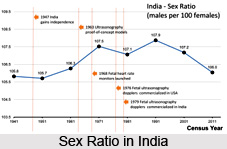
This detail becomes more evident with the help of a ratio between males and females. In India this ratio is conveyed in terms of number of females per every 1000 males. In 1901 there were 972 females per 1000 males. The sex-ratio in India has been gradually reducing over decades. In 1991, it was as low as 927 females per 1000 males. This unrelenting critical trend is adverse for the Indian females. In fact, as a rule, the developed countries of the world demonstrate that females enjoy greater longevity compared to their male equivalents. For example, in Japan sex ratio is 1038 per 1000 males. The Japanese female has an average longevity of 84 years, as compared to merely 77 for males. Even in Kerala, known for the superior status of women, the sex ratio is almost similar to Japan.
In India, the undesirable or critical sex ratio is a perfect suggestion and an outcome of very low social, economic and political position of women. The miserable literacy figure for females is yet one more confirmation, as well as a conducive cause of their overall low standing. It is only in recent times that female life expectancy has improved by borderline, compared to that of males. If this tendency prolongs and gets emphasised, the sex ratio may start to pick up, though very slowly.
Sex ratio in rural areas is fairly higher compared to the urban areas. This is due to the recent inclination of relocation of labour from rural to urban areas. It is a male who generally migrates to another place in search of a job, leaving behind the family, while he earns his livelihood in the town or city. He sends portions of his earnings to his family living in villages.
Women in India also call for an equivalent status along with males in the family and society. Just as educated women start to involve themselves in organised labour force- outside the home and farm, they would be liberated and better propelled to have a small family, so that every child in the family is looked after with appropriate love, fondness and possibilities to mature to their utmost, guaranteeing an all-sided intensification of their personality.