


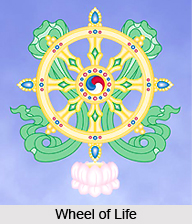
 Monasteries and many buildings in Sikkim are richly decorated with symbols and icons. These symbols are painted or embossed on the walls or on Thankas. These paintings may depict the life of Buddha or some Tibetan saint. The Wheel of Life or a deity surrounded by lesser deities. Monasteries and many buildings in Sikkim are richly decorated with symbols and icons. These symbols are painted or embossed on the walls or on Thankas. These paintings may depict the life of Buddha or some Tibetan saint. The Wheel of Life or a deity surrounded by lesser deities.
Wheel of Life The wheel of life is one of the purest Buddhist emblems. This emblem can be seen in the entrance of almost all monasteries. This emblem is also widely depicted on Thankas or religious scrolls. Eight Lucky signs and their significance The eight signs are called as Tashi Tagyein Tibetan. These auspicious signs are intimate with life and teachings of Buddha. These eight lucky signs manifest themselves in paintings and in the form of carvings on furniture. These can also be seen on the walls of buildings. The eight lucky signs can be explained briefly as. 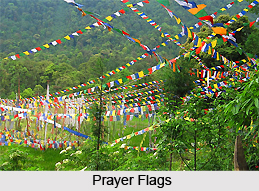
Mandates A mandala is a mystic pictorial representation of the universe. In the centre of the mandala there is a divinity with whom the meditating practitioner aims to merge. Many tupes of mandalas are painted on thankas. The Prayer Flag The Prayer Flags can be seen almost anywhere in Sikkim. It can be seen on hill-tops or on building-tops. 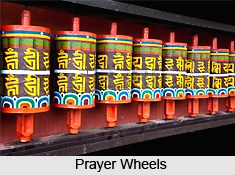 This is an integral part of the landscape of Sikkim. These flags have prayers inscribed on them. There are four types of Prayer flags. Lungta or wind Horse are strips of clothes attached with bamboo poles. These flags have the figure of a horse with the mystical jewel on its back. Chopen or luck flag are long, narrow and oblong in shape. These types of flags are tied on twigs of trees, bridges and top of hills. Gyalsten or Victorious Banner has a large amount of holy text on them including the eight lucky signs. Glan-po stob ryyas or Vast lucky flag include symbols such as crossed dorjee in the centre with a peacock. This is an integral part of the landscape of Sikkim. These flags have prayers inscribed on them. There are four types of Prayer flags. Lungta or wind Horse are strips of clothes attached with bamboo poles. These flags have the figure of a horse with the mystical jewel on its back. Chopen or luck flag are long, narrow and oblong in shape. These types of flags are tied on twigs of trees, bridges and top of hills. Gyalsten or Victorious Banner has a large amount of holy text on them including the eight lucky signs. Glan-po stob ryyas or Vast lucky flag include symbols such as crossed dorjee in the centre with a peacock.
Chortens Chortens or stupas dot every nook and corner of Sikkim. Chortens are normally found concentrated around monasteries. In old times, the chortens were built as relic holders but now they are erected in memory of Lord Buddha or some Buddhist saints. Though chortens vary in size with some as high as a four storied building, their shapes are more or less the same. The shape of the chorten symbolizes the five elements of nature namely earth, water, fire, air and ether to which a body is transformed after death. The rectangular base represents the earth whereas the globe atop this depicts water. Resting on the globe is a triangular structure which signifies fire. On the tip of the triangular is a crescent that represents air. Nested in the crescent is a small oval structure which symbolizes ether. Bell & Thunderbolt The Bell and the Thunderbolt signify the two truths. The Bell or Thrilbu symbolizes that everything in the end is void and the Thunderbolt or Dorjee signifies the immortality of Truth. The Bell is held in the right hand and the Thunderbolt in the left during rituals. Prayer wheel & Rosary The Prayer Wheel is a religious implement on which some holy mantra is inscribed and which is held in the hand and rotated with the motion of the wrist. There are also the bigger type of Prayer Wheels which surround monasteries or chortens. For instance, Phurba-Chorten near Tibetology in Gangtok is surrounded by 113 prayer wheels which are rotated by devotees when they go around the chorten. One can also see Prayer wheels in streams of flowing water where these rotate. The Rosary consists of 108 beads made of small pellets of wood, ivory or precious stones. While telling the beads, holy mantras are chanted to invoke the blessings of the gods. 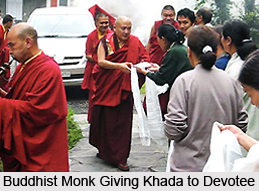 Khada or Scarf
Khadas are long length of silk cloth in the form of a scarf that besides being used as an offering to the gods are also presented at social occasions be it a marriage, birthday or funeral. The method of presenting khadas varies according to the status of the person it is being offered to. To one who is superior, one should raise it in both hands to the height of the forehead. Wheras to the one who is of equal status, one have to raise it in both hands at a level with the shoulders and present it in his hands. To one who is below in status or age one should put the scarf around his neck with the free ends kept hanging in front. To the bereaved, the khada is folded and offered as well. |
| |||



Buddhist Images And Symbols In Sikkim
| Monasteries and many buildings in Sikkim are richly decorated with symbols and icons. |
| ||||||||||||||||||||||||||||

